SunTech Medical 247
 SunTech Medical · Model 247
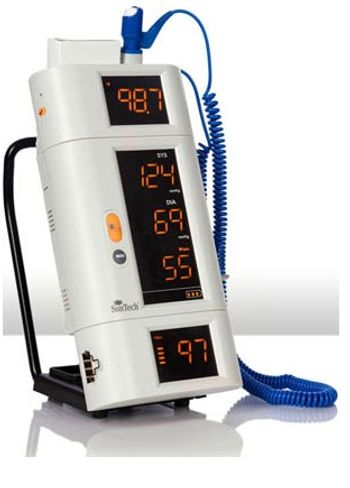
SunTech Medical 247 As automated BP devices have become routine for blood pressure measurement, it’s important to remember that not all are created equal. The 247™ BP + Vitals device offers SunTech’s clinical-grade blood pressure technology in a package designed to fit easily into clinical workflows for measuring and collecting patient vital sign information. With the modular design, start with blood pressure and add other parameters such as temperature and SpO2 when needed. Additionally, the SunTech 247 comes in a variety of mounting options so you can use it wherever, whenever and however you like.
Key tips
- ·A no-signal/flatline alarm gets checked on the patient first, not the monitor - rule out a real clinical event before troubleshooting.
- ·Recalibrate NIBP against a reference manometer, not just a self-test pass.
- ·Reused patient cables (SpO2, ECG leads) are a common source of intermittent-fault complaints - swap the cable before the module.
Typical Failure Modes
Compiled for this model from its own documentation and established engineering knowledge for this equipment class - not from a verified service record. Confirm against the manufacturer's service manual.
NIBP will not measure or is inaccurate
HighSymptoms: Times out, cuff will not inflate or hold pressure, readings implausible or fail against a reference.
Root cause: Internal pump or valve, a cuff / hose leak, or pressure-transducer / calibration drift.
Cuff / hose fault
MediumSymptoms: Slow inflation, air leak, will not hold, artefact-heavy readings.
Root cause: Split cuff bladder, a cracked hose, or a loose connector.
Motion / artefact rejection poor
MediumSymptoms: Frequent retries or error on moving patients (common on ABPM).
Root cause: Algorithm limits plus a marginal cuff fit or transducer noise.
Battery / power fault
MediumSymptoms: Short run time, will not power on or hold a 24 h ABPM study.
Root cause: Aged battery.
Data download / clock fault (ABPM)
LowSymptoms: Study will not download, timestamps wrong.
Root cause: Download cable / dock or the internal clock battery.
Serviceable Parts & Consumables
Serviceable items for this model, compiled from its documentation and engineering knowledge for this equipment class. Service class and relative cost are estimates, not manufacturer figures; no part numbers are given. Confirm intervals and pricing against the manufacturer.
Cuff and hose set
Class Frequent wear itemRel. cost $R&R Easy
Internal NIBP pump
Class Major service partRel. cost $$R&R Moderate
NIBP valve block
Class Major service partRel. cost $$R&R Moderate
Battery
Class Frequent wear itemRel. cost $R&R Easy
Pressure transducer / main board
Class Major service partRel. cost $$$R&R Difficult
| Part | Service class | Relative cost | R&R difficulty |
|---|---|---|---|
| Cuff and hose set | Frequent wear item | $ | Easy |
| Internal NIBP pump | Major service part | $$ | Moderate |
| NIBP valve block | Major service part | $$ | Moderate |
| Battery | Frequent wear item | $ | Easy |
| Pressure transducer / main board | Major service part | $$$ | Difficult |
Relative cost: $ lowest · $$$$ highest service-part cost for this equipment class. Not a price.
PM Checklist
Preventive-maintenance tasks typical of this equipment class. Perform to the manufacturer's procedure and your facility's policy - this is general reference, not a schedule for this specific unit.
- ·Routine cable and lead-wire inspection for fraying/wear
- ·Battery conditioning cycle
- ·NIBP calibration check against a reference manometer
- ·ECG / SpO2 accuracy verification against a patient simulator
- ·Annual electrical safety test
Troubleshooting Approach
A starting sequence for this model, compiled from its documentation and engineering knowledge for this equipment class. Follow the manufacturer's service documentation for the actual procedure.
Symptom: NIBP will not measure or is inaccurate
- Leak-test the cuff and hose (occlude and watch for pressure decay).
- Run the device's pressure-calibration verification against a calibrated manometer.
- Confirm correct cuff size and placement and check for a kinked hose.
- Verify against a NIBP simulator at several pressures.
- Refer the internal pump / valve / transducer for service if it persists.
Symptom: Slow inflation / air leak / will not hold pressure
- Inspect the cuff bladder and hose for splits and the connector for a poor seal.
- Replace the cuff and hose set.
- Check the internal pump and valve block.
- Re-verify against a simulator.
- Replace the valve block if it leaks internally.
Symptom: Frequent retries / error on moving patients (ABPM)
- Confirm cuff fit and placement.
- Fit fresh batteries and confirm capacity for a 24 h study.
- Check the cuff and hose for leaks.
- Confirm the programmed schedule and that the study downloads.
- Verify against a simulator before re-issuing.
Symptom: Study will not download / timestamps wrong (ABPM)
- Try the correct dock / cable and another USB port.
- Check the internal clock / coin cell.
- Confirm the software reads other units.
- Replace the clock cell.
- Re-verify a full study cycle.
Typical Location
Where this class of equipment is typically deployed - general reference, not this unit's own placement record.
- ICU / CCU
- Emergency Department
- OR / PACU
- General med-surg floors
- Step-down units
- Telemetry units
Documents & Manuals
Related calculators
From BioLab, for work done with this kind of equipment.
Troubleshoot this device with Bio
Describe a symptom or error code. Bio answers from this device's own documented error codes, failure modes, parts, and guides.
Ask Bio