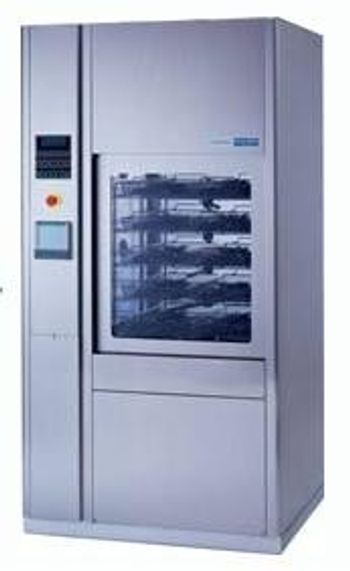
STERIS Reliance Synergy
STERIS · Model Reliance Synergy
Vertical sliding doors are constructed of tinted, tempered glass with stainless-steel trim to allow the operator to view the chamber with the doors closed. While the cycle is in progress, glass doors remain cool to the touch. Doors are pneumatically activated with a built-in safety system. Sliding doors create an airtight seal and are configured for power door operation. Power doors are opened and closed automatically using touch pads located on the control panel. If a power failure occurs, doors can be opened manually. A door interlock feature is provided to prevent cross-contamination. Stainless-steel pump is powered by a dual-speed motor. High pump speed provides the equivalent capacity of a 7.5 hp (5.6 kW) motor, 240 U.S. gal./min at 70 ft (910 L/min at 21.3 m) head pressure. Low pump speed provides the equivalent capacity of a 2.0 HP (1.5 kW) motor, 90 U.S. gal/min at 25 ft (341 L/min at 7.6 m) head pressure. Pump impeller is mounted directly on the motor shaft and does not require additional bearings. Pump motor is equipped with a drip-proof frame, magnetic starter, overload protection and sealed bearings (not requiring periodic lubrication). Pump, spray system and all recirculating piping are of stainless- steel construction. Single removable stainless-steel filter in the chamber sump prevents debris from entering the pump. Heating coil (steam or electric) at the bottom of the wash chamber (sump) raises and maintains water temperature up to 180°F (82°C) during the Wash phase and up to 203°F (95°C) during the Thermal Rinse phase. Rotary spray assemblies are positioned (one at top and one at bottom of chamber, each measuring 24-3/8" [620 mm] long) to reach all surfaces of the load. Every manifold used with the Reliance Synergy Washer/Disinfector has bi-directional rotary arms positioned on the top and bottom of each load shelf. Depending on the type of rack accessory in the chamber, the manifold connector automatically connects to the accessory at the start of each cycle. 16-W fluorescent lamp, mounted within an explosion/vaporproof enclosure, illuminates the chamber interior. Wash chamber is constructed of 16-gauge, #304 L stainless steel (No. 4 finish), argon-welded; wash chamber is of sanitarytype design for complete drainability. All horizontal fixed surfaces are sloped, overlapping metal sheets are minimized to reduce hard-to-clean locations, and there are no dead legs of more than six times the pipe diameter. A complete drain water sensor detects the presence of water in the piping. Double-walled, insulated construction of chamber exterior reduces heat loss and noise level to the work area. Chemical injection pumps. The system comes with one enzyme and one detergent injection pump which automatically add a selected quantity of chemical from 1/8 to 2.0 oz/gal (1.0 to 16 mL/L). Up to two additional chemical pumps give flexibility to wash with a neutral process, dual alkaline/neutralizer process, or to vary the chemical used, depending upon the load. One injection pump is also provided to automatically add a selected quantity of lubricant (from 0 to 2 oz/gal [0 to 16 mL/ L]) during the Thermal Rinse phase. If desired, up to two additional chemical injection pumps can be installed on the washer/disinfector. Optional injection pump(s) can be ordered alone and/or with the Fast Cycles for Instruments and Utensils option. A low-level sensor is included to indicate when the detergent level in the container is low, or when insufficient chemical is available for the next cycle.
Key tips
- ·A failed biological indicator means the entire load is not sterile - no exceptions, regardless of how the cycle printout looks.
- ·Door gasket wear is the most common real cause of a failed vacuum/pressure test - check it before deeper diagnostics.
- ·Water quality directly affects steam-cycle validity - don't ignore scale or mineral buildup.
Typical Failure Modes
Compiled for this model from its own documentation and established engineering knowledge for this equipment class - not from a verified service record. Confirm against the manufacturer's service manual.
Cycle fault / abort
HighSymptoms: Cycle stops with a fault code, load not processed, door locked.
Root cause: Water fill / drain fault, temperature not reached, a dosing-pump fault, or a spray-arm blockage.
Poor cleaning / spray-arm blockage
MediumSymptoms: Instruments come out soiled, spray arms not rotating.
Root cause: Clogged spray-arm nozzles, a blocked filter / strainer, or low water pressure.
Chemistry dosing fault
MediumSymptoms: Detergent / neutraliser / lubricant not dosed, dosing-pump alarm.
Root cause: Empty chemistry container, an air-locked or worn dosing pump, or a level sensor.
Thermal-disinfection temperature not reached
HighSymptoms: A0 / disinfection temperature not achieved.
Root cause: Heater element, temperature sensor, or steam supply.
Door / seal fault
MediumSymptoms: Leaks during the cycle, door will not lock / unlock.
Root cause: Worn door gasket or a door-lock solenoid.
Serviceable Parts & Consumables
Serviceable items for this model, compiled from its documentation and engineering knowledge for this equipment class. Service class and relative cost are estimates, not manufacturer figures; no part numbers are given. Confirm intervals and pricing against the manufacturer.
Spray-arm nozzles / bearings
Class Periodic replacementRel. cost $$R&R Fairly easy
Chamber filter / strainer
Class Frequent wear itemRel. cost $R&R Easy
Peristaltic dosing pump / tubing
Class Periodic replacementRel. cost $$R&R Moderate
Heater element / temperature sensor
Class Major service partRel. cost $$R&R Moderate
Door gasket
Class Periodic replacementRel. cost $$R&R Fairly easy
Fill / drain solenoid valve
Class Periodic replacementRel. cost $$R&R Moderate
| Part | Service class | Relative cost | R&R difficulty |
|---|---|---|---|
| Spray-arm nozzles / bearings | Periodic replacement | $$ | Fairly easy |
| Chamber filter / strainer | Frequent wear item | $ | Easy |
| Peristaltic dosing pump / tubing | Periodic replacement | $$ | Moderate |
| Heater element / temperature sensor | Major service part | $$ | Moderate |
| Door gasket | Periodic replacement | $$ | Fairly easy |
| Fill / drain solenoid valve | Periodic replacement | $$ | Moderate |
Relative cost: $ lowest · $$$$ highest service-part cost for this equipment class. Not a price.
PM Checklist
Preventive-maintenance tasks typical of this equipment class. Perform to the manufacturer's procedure and your facility's policy - this is general reference, not a schedule for this specific unit.
- ·Daily biological and chemical indicator test loads
- ·Door gasket / seal inspection
- ·Steam trap and drain strainer cleaning
- ·Annual full PM and pressure-vessel certification
Troubleshooting Approach
A starting sequence for this model, compiled from its documentation and engineering knowledge for this equipment class. Follow the manufacturer's service documentation for the actual procedure.
Symptom: Cycle fault / abort
- Note the fault code and the phase it aborted in.
- Check the water fill and drain, and the chamber filter / strainer.
- Confirm the spray arms rotate freely and the nozzles are clear.
- Verify the heater reaches temperature and the sensor agrees with a reference.
- Follow the service manual for the specific code.
Symptom: Instruments still soiled
- Clear the spray-arm nozzles and check the arms spin.
- Clean the chamber filter / strainer.
- Confirm detergent is dosing.
- Check the water pressure and temperature.
- Run a soil / protein test on the next cycle.
Typical Location
Where this class of equipment is typically deployed - general reference, not this unit's own placement record.
- Central Sterile Supply Department (CSSD)
- OR sterile core
- Satellite reprocessing areas
Documents & Manuals
No documents available for this device yet.
Troubleshoot this device with Bio
Describe a symptom or error code. Bio answers from this device's own documented error codes, failure modes, parts, and guides.
Ask Bio