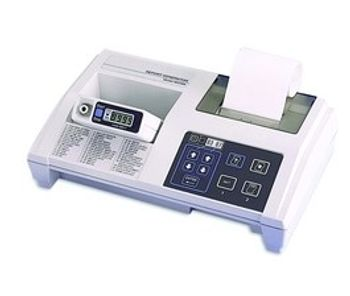
Spacelabs 90239
 Spacelabs · Model 90239
Programs the monitor, analyses the raw data and assembles data into a report. Reports include 24-hour day / night summaries of systolic, diastolic, mean arterial pressure and heart rate. Works with both 90207 and 90217 Ambulatory blood pressure monitors.
Key tips
- ·A no-signal/flatline alarm gets checked on the patient first, not the monitor - rule out a real clinical event before troubleshooting.
- ·Recalibrate NIBP against a reference manometer, not just a self-test pass.
- ·Reused patient cables (SpO2, ECG leads) are a common source of intermittent-fault complaints - swap the cable before the module.
Typical Failure Modes
Compiled for this model from its own documentation and established engineering knowledge for this equipment class - not from a verified service record. Confirm against the manufacturer's service manual.
NIBP will not measure or is inaccurate
HighSymptoms: Times out, cuff will not inflate or hold pressure, readings implausible or fail against a reference.
Root cause: Internal pump or valve, a cuff / hose leak, or pressure-transducer / calibration drift.
Cuff / hose fault
MediumSymptoms: Slow inflation, air leak, will not hold, artefact-heavy readings.
Root cause: Split cuff bladder, a cracked hose, or a loose connector.
Motion / artefact rejection poor
MediumSymptoms: Frequent retries or error on moving patients (common on ABPM).
Root cause: Algorithm limits plus a marginal cuff fit or transducer noise.
Battery / power fault
MediumSymptoms: Short run time, will not power on or hold a 24 h ABPM study.
Root cause: Aged battery.
Data download / clock fault (ABPM)
LowSymptoms: Study will not download, timestamps wrong.
Root cause: Download cable / dock or the internal clock battery.
Serviceable Parts & Consumables
Serviceable items for this model, compiled from its documentation and engineering knowledge for this equipment class. Service class and relative cost are estimates, not manufacturer figures; no part numbers are given. Confirm intervals and pricing against the manufacturer.
Cuff and hose set
Class Frequent wear itemRel. cost $R&R Easy
Internal NIBP pump
Class Major service partRel. cost $$R&R Moderate
NIBP valve block
Class Major service partRel. cost $$R&R Moderate
Battery
Class Frequent wear itemRel. cost $R&R Easy
Pressure transducer / main board
Class Major service partRel. cost $$$R&R Difficult
| Part | Service class | Relative cost | R&R difficulty |
|---|---|---|---|
| Cuff and hose set | Frequent wear item | $ | Easy |
| Internal NIBP pump | Major service part | $$ | Moderate |
| NIBP valve block | Major service part | $$ | Moderate |
| Battery | Frequent wear item | $ | Easy |
| Pressure transducer / main board | Major service part | $$$ | Difficult |
Relative cost: $ lowest · $$$$ highest service-part cost for this equipment class. Not a price.
PM Checklist
Preventive-maintenance tasks typical of this equipment class. Perform to the manufacturer's procedure and your facility's policy - this is general reference, not a schedule for this specific unit.
- ·Routine cable and lead-wire inspection for fraying/wear
- ·Battery conditioning cycle
- ·NIBP calibration check against a reference manometer
- ·ECG / SpO2 accuracy verification against a patient simulator
- ·Annual electrical safety test
Error Codes
Extracted directly from this unit's own service manual.
2Serial time-out (the 90207 ABP Monitor and the Report Generator failed to interface). Low batteries in 90207 ABP Monitor. 90207 monitor removed before data was fully read out.
None
3The 90207 ABP Monitor failed to understand instructions from the Report Generator. Low batteries in 90207 ABP Monitor or bad LEDs in Report Generator. 90207 ABP Monitor misaligned in chute.
None
4The 90207 ABP Monitor failed to give any response. Low batteries or bad LEDs in Report Generator. 90207 ABP Monitor misaligned in chute.
None
5Maximum retries exceeded. Defective 90207 ABP Monitor. Defective infrared LEDs in Report Generator.
None
6Bad 90207 ABP Monitor RAM. Refer to the 90207/90217 Ambulatory Blood Pressure Monitors Operations Manual (P/N 070-0137-xx) for instructions. Low batteries. Monitor RAM fault.
Refer to the 90207/90217 Ambulatory Blood Pressure Monitors Operations Manual (P/N 070-0137-xx) for instructions.
7The Report Generator does not detect the 90207 ABP Monitor in the chute. Try reinserting the monitor into the chute. Bad lithium battery in 90207 ABP Monitor. Infrared LEDs on main board may be misaligned. Missing magnet on main board. Bad main board.
Try reinserting the monitor into the chute.
8Low battery or bad clock chip on main board. Try resetting the clock. Bad lithium battery on the main board. Bad main board. 90239A Hardware Fault 8.
Try resetting the clock.
9Aborted printing the report. Bad control panel. Bad main board. Print report aborted.
None
10Aborted printing the Help menu. Bad control panel. Bad main board. Print help aborted.
None
11Aborted printing the data card summary. Bad control panel. Bad main board. Print card summary aborted.
None
12Power was removed while updating the Report Generator software or the update card was pulled out prematurely. Bad main board.
None
13The 90207 ABP Monitor contains no data. Bad 90207 ABP Monitor. Monitor contains no data.
None
14Setup data checksum error. Bad control panel. Bad main board. Setup data checksum error. Resetting all menu item values to factory defaults. Following is the current date and time. Verify and correct if necessary.
Setup data checksum error. Resetting all menu item values to factory defaults. Following is the current date and time. Verify and correct if necessary.
15Invalid time received from clock. Bad control panel. Bad main board. Invalid 90239A time or date detected. Please reset time and date.
Invalid 90239A time or date detected. Please reset time and date.
16Switch on data card set to write-protect. Bad data card. Bad main board. None
None
17The data card is full. Bad data card. Bad main board. None
None
18The data card is not formatted. Refer to the 90239A Ambulatory Blood Pressure Report Generator Operations Manual (P/N 070-0399-xx) for formatting instructions. Bad data card. Bad main board. None
Refer to the 90239A Ambulatory Blood Pressure Report Generator Operations Manual (P/N 070-0399-xx) for formatting instructions.
19The data card has suffered a failure while printing data. Bad scan report on data card. Reformat the card. Bad main board. None
Reformat the card.
20Unknown or write-protected card. Turn write protection OFF. Bad data card. Bad main board. Card is unrecognized or write protected.
Turn write protection OFF.
21Bad password. Try removing batteries from the 90207 ABP Monitor, then replacing them. Then re initialize the Monitor if using the 90219 ABP PC Direct/Base Station. This erases any data currently stored in the 90207 ABP Monitor. Monitor has a different password. Cannot unlock monitor.
Try removing batteries from the 90207 ABP Monitor, then replacing them. Then re initialize the Monitor if using the 90219 ABP PC Direct/Base Station. This erases any data currently stored in the 90207 ABP Monitor.
22No lithium battery. Bad lithium battery in 90207 ABP Monitor. Missing lithium battery.
None
23Lithium battery low. Bad lithium battery in 90207 ABP Monitor. Lithium battery measures low. Replace lithium battery.
Replace lithium battery.
25The data card is not present in the card slot. Bad data card. Bad main board. No data card present.
None
26Low data card battery. Improperly installed data card battery, or bad battery. Defective data card. Bad main board. The data card battery is low.
The data card battery is low.
Troubleshooting Approach
A starting sequence for this model, compiled from its documentation and engineering knowledge for this equipment class. Follow the manufacturer's service documentation for the actual procedure.
Symptom: NIBP will not measure or is inaccurate
- Leak-test the cuff and hose (occlude and watch for pressure decay).
- Run the device's pressure-calibration verification against a calibrated manometer.
- Confirm correct cuff size and placement and check for a kinked hose.
- Verify against a NIBP simulator at several pressures.
- Refer the internal pump / valve / transducer for service if it persists.
Symptom: Slow inflation / air leak / will not hold pressure
- Inspect the cuff bladder and hose for splits and the connector for a poor seal.
- Replace the cuff and hose set.
- Check the internal pump and valve block.
- Re-verify against a simulator.
- Replace the valve block if it leaks internally.
Symptom: Frequent retries / error on moving patients (ABPM)
- Confirm cuff fit and placement.
- Fit fresh batteries and confirm capacity for a 24 h study.
- Check the cuff and hose for leaks.
- Confirm the programmed schedule and that the study downloads.
- Verify against a simulator before re-issuing.
Symptom: Study will not download / timestamps wrong (ABPM)
- Try the correct dock / cable and another USB port.
- Check the internal clock / coin cell.
- Confirm the software reads other units.
- Replace the clock cell.
- Re-verify a full study cycle.
Typical Location
Where this class of equipment is typically deployed - general reference, not this unit's own placement record.
- ICU / CCU
- Emergency Department
- OR / PACU
- General med-surg floors
- Step-down units
- Telemetry units
Documents & Manuals
Related calculators
From BioLab, for work done with this kind of equipment.
Troubleshoot this device with Bio
Describe a symptom or error code. Bio answers from this device's own documented error codes, failure modes, parts, and guides.
Ask Bio