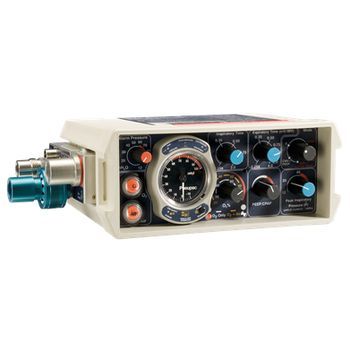
Smiths Medical PneuPac babyPAC 100
 Smiths Medical · Model PneuPac babyPAC 100
Unique variable oxygen concentration gas mixing system Inspiratory pressure control Separate controls for inspiratory and expiratory time Four operating modes PEEP/CPAP control Adjustable pneumatic pressure relief with audible alarm Integrated pressure monitoring/alarm system Low gas supply indicators for 02 and air Complete pneumatic operation Lightweight and durable MR Conditional: 3 Tesla actively shielded magnet max gradient of 430 G/cm, 0.82 W/kg at 125.5 Mhz.
Key tips
- ·Never disable a low-pressure/circuit-disconnect alarm while troubleshooting - silence it, don't disable it.
- ·Verify the O2 supply source and pressure before assuming an internal fault.
- ·Circuit type must match the patient population (adult/pediatric/neonatal) - a mismatched circuit invalidates delivered volumes.
Typical Failure Modes
Compiled for this model from its own documentation and established engineering knowledge for this equipment class - not from a verified service record. Confirm against the manufacturer's service manual.
Fails the pre-use self-test / circuit check
HighSymptoms: Self-test fault, circuit-leak or compliance-check failure, will not be released for use.
Root cause: Patient-circuit / expiratory-valve leak, a flow-sensor fault, an O2-cell fault, or an internal pneumatic fault.
Flow / volume delivery inaccurate
HighSymptoms: Delivered tidal volume or flow does not match the setting, or fails the annual verification.
Root cause: Flow-sensor drift / contamination, an inspiratory / expiratory valve fault, or a blender / proportioning-valve fault.
O2 / air supply or blender fault
MediumSymptoms: Low-supply alarm, FiO2 not matching the setting, O2-cell reads wrong.
Root cause: Wall / cylinder supply issue, an inlet filter / regulator fault, the blender, or an aged O2 cell.
PEEP not held / high circuit pressure
MediumSymptoms: PEEP drifts, auto-PEEP, high-pressure alarms, poor exhalation.
Root cause: Worn or wet expiratory valve / diaphragm, or a blocked exhalation path.
Battery / power fault
MediumSymptoms: Short internal-battery run time, will not charge, transfers to battery unexpectedly.
Root cause: Aged internal battery or a power-supply fault.
Turbine / compressor fault (turbine units)
MediumSymptoms: Noisy operation, cannot meet flow demand, turbine / compressor alarm.
Root cause: Worn turbine / compressor.
Serviceable Parts & Consumables
Serviceable items for this model, compiled from its documentation and engineering knowledge for this equipment class. Service class and relative cost are estimates, not manufacturer figures; no part numbers are given. Confirm intervals and pricing against the manufacturer.
Flow sensor(s)
Class Frequent wear itemRel. cost $$R&R Fairly easy
Expiratory valve / diaphragm
Class Frequent wear itemRel. cost $$R&R Fairly easy
O2 cell / sensor
Class Frequent wear itemRel. cost $$R&R Easy
Internal battery
Class Periodic replacementRel. cost $$R&R Fairly easy
Inlet filters / water traps
Class Frequent wear itemRel. cost $R&R Easy
Turbine / compressor (turbine units)
Class Major service partRel. cost $$$$R&R Difficult
| Part | Service class | Relative cost | R&R difficulty |
|---|---|---|---|
| Flow sensor(s) | Frequent wear item | $$ | Fairly easy |
| Expiratory valve / diaphragm | Frequent wear item | $$ | Fairly easy |
| O2 cell / sensor | Frequent wear item | $$ | Easy |
| Internal battery | Periodic replacement | $$ | Fairly easy |
| Inlet filters / water traps | Frequent wear item | $ | Easy |
| Turbine / compressor (turbine units) | Major service part | $$$$ | Difficult |
Relative cost: $ lowest · $$$$ highest service-part cost for this equipment class. Not a price.
PM Checklist
Preventive-maintenance tasks typical of this equipment class. Perform to the manufacturer's procedure and your facility's policy - this is general reference, not a schedule for this specific unit.
- ·Daily pre-use check: self-test, circuit integrity, alarm function
- ·Scheduled circuit and inspiratory filter replacement per manufacturer interval
- ·Flow and pressure sensor calibration verification
- ·Battery load test and runtime check
- ·Annual full PM and electrical safety test
Troubleshooting Approach
A starting sequence for this model, compiled from its documentation and engineering knowledge for this equipment class. Follow the manufacturer's service documentation for the actual procedure.
Symptom: Fails the pre-use self-test
- Run the self-test with the exact circuit and humidifier that will be used.
- Leak-test the circuit and the expiratory valve; fit fresh flow sensors and an O2 cell if due.
- Repeat the self-test.
- Calibrate the O2 cell and flow sensors per the manual.
- Remove from service and refer an internal pneumatic fault to the OEM / biomed.
Symptom: Delivered volume or FiO2 wrong
- Verify tidal volume / flow with a calibrated gas-flow analyser and FiO2 with an analyser at the wye.
- Calibrate the flow sensors and O2 cell.
- Inspect the inspiratory / expiratory valves.
- Check the air / O2 supply pressures and inlet filters.
- Refer the blender / proportioning valve for service if the mix is still wrong.
Typical Location
Where this class of equipment is typically deployed - general reference, not this unit's own placement record.
- ICU / CCU
- Emergency Department
- Operating Room (anesthesia-adjacent)
- NICU
- Respiratory Therapy department
- Patient transport
Documents & Manuals
Safety & Recalls
Synced live from the FDA openFDA API.
- RECALL
Affected devices have a smaller diameter than expected and may potentially result in inadequate ventilation to the patient. Patient may experience hypoxia, underdose, or cardiopulmonary collapse.
- RECALL
Uncertainty in the seal integrity of the sterile packaging.
- RECALL
The incorrect device is contained in the package.
- RECALL
One lot number of a specific model of ULTRAperc Percutaneous Dilation Tracheostomy Kit, 9.0mm may have been incorrectly labeled as a 7.0mm ID kit.
- RECALL
The labeling was missing information on sterilization and prohibition of reuse.
- RECALL
Smiths Medical became aware that one lot of the 8.0mm UniPerc(R) Adjustable Flange Tracheostomy Tube kit, product reorder number 100/897/080 CZ, lot number 3308971, contains an incorrect 9.0mm sized obturator instead of the correct 8.0mm sized obturator.
- RECALL
Visible orange/ brown particulate on the needles of the 29g Hypodermic Needle-Pro Fixed Needle Insulin Syringes
- RECALL
Pediatric Trachel Tube manufactured with internal diameter smaller than indicated in the label may result in inability to remove secretions and cause partial or complete obstruction of the airway
- RECALL
Smiths Medical noticed an increased trend in leakage associated with 100 ml CADD Medication Cassette Reservoirs Reorder Number 21-7002-24 Lot Numbers 213X18 and 214X18. If a leak occurs in a CADD medication Cassette Reservoir, it may allow spillage of medication, contamination of the fluid path, and/or air to enter the Reservoir. Smiths Medical has not received any report of patient injuries due
- RECALL
Smith Medical has become aware that an increase in pH may occur with some medications when instilled in the Affected Cassettes. Also, a small number of catheter occlusions have been reported from one customer when these Affected Cassettes have been used for delivering Flolan.
- RECALL
Smiths Medical is conducting a recall of 93 Pneupac VR1 Emergency & Transport Ventilators following the identification of a problem which may exist with the demand valve that could cause the ventilator to stop cycling & to deliver continuous flow output to the patient.
- RECALL
Mislabeled Product labeled as 8.0mm inner cannula, may contain a 9.0mm
- RECALL
A potential safety related problem associated with the Pnuepac babyPac Ventilator model 100 has been discovered in that the interface between the air input hose and the air input fitting may leak, and if tightened too much, the air input fitting may loosen when trying to remove the air hose.
Related calculators
From BioLab, for work done with this kind of equipment.
Troubleshoot this device with Bio
Describe a symptom or error code. Bio answers from this device's own documented error codes, failure modes, parts, and guides.
Ask Bio