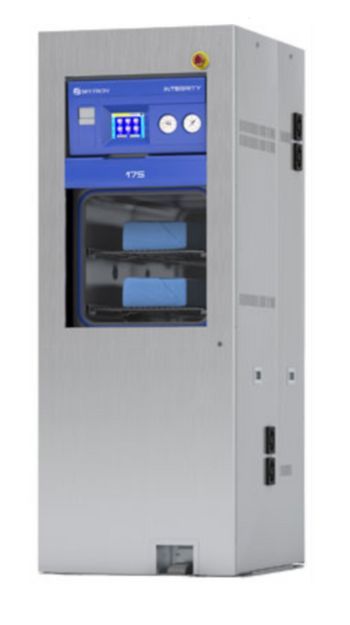
Skytron Integrity 175/175SG
 Skytron · Model Integrity 175/175SG
Increase throughput | Process up to two 25 lb. trays in one cycle – all while requiring minimal floor space Green technology | Reduce water usage up to 67% with integrated water recirculation system Easy to use | Simple touchscreen control, combined with a large countdown timer and progress bar, make operating the Integrity 175 easy Consistent results | Internal water reservoir means that cycles won’t be affected by changes in your facility’s water pressure. And the full steam jacket assures precise temperature every time Get data faster | Record, store and chart all cycle data electronically and print cycle receipts via integrated ink printer - all with simple touchscreen control.
Key tips
- ·A failed biological indicator means the entire load is not sterile - no exceptions, regardless of how the cycle printout looks.
- ·Door gasket wear is the most common real cause of a failed vacuum/pressure test - check it before deeper diagnostics.
- ·Water quality directly affects steam-cycle validity - don't ignore scale or mineral buildup.
Typical Failure Modes
Compiled for this model from its own documentation and established engineering knowledge for this equipment class - not from a verified service record. Confirm against the manufacturer's service manual.
Cycle fault / will not reach sterilization parameters
HighSymptoms: Cycle aborts, temperature or pressure not reached / held, failed BI or chemical indicator.
Root cause: Heater / element fault, a door-gasket leak, a steam-generation or water-fill fault, a blocked chamber drain / strainer, or a temperature / pressure-sensor fault.
Door / gasket seal fault
MediumSymptoms: Steam leak at the door, door will not seal, lock or unlock, pressure will not build.
Root cause: Worn door gasket or a door-lock / interlock fault.
Poor drying / wet packs
MediumSymptoms: Instruments / packs come out wet.
Root cause: Drying-phase vacuum / heater fault, an overloaded chamber, or a clogged drain.
Water / reservoir / feedwater fault
MediumSymptoms: Low-water alarm, mineral scale, cloudy chamber, poor steam quality.
Root cause: Empty or scaled reservoir, a fill-valve / pump fault, or use of non-distilled water.
Steam-trap / air-removal / vacuum fault
MediumSymptoms: Failed Bowie-Dick / air-removal test, slow come-up, air pockets.
Root cause: Blocked steam trap, a vacuum-pump / ejector fault, or a check-valve fault.
Printer / recorder fault
LowSymptoms: No or faint cycle printout.
Root cause: Thermal print head or paper.
Serviceable Parts & Consumables
Serviceable items for this model, compiled from its documentation and engineering knowledge for this equipment class. Service class and relative cost are estimates, not manufacturer figures; no part numbers are given. Confirm intervals and pricing against the manufacturer.
Door gasket
Class Periodic replacementRel. cost $$R&R Fairly easy
Heating element / steam-generator element
Class Major service partRel. cost $$$R&R Difficult
Chamber / feedwater strainer & fill valve
Class Periodic replacementRel. cost $$R&R Moderate
Temperature / pressure sensor
Class Major service partRel. cost $$R&R Moderate
Steam trap / solenoid & check valves
Class Periodic replacementRel. cost $$R&R Moderate
Thermal print head / paper
Class Periodic replacementRel. cost $R&R Fairly easy
| Part | Service class | Relative cost | R&R difficulty |
|---|---|---|---|
| Door gasket | Periodic replacement | $$ | Fairly easy |
| Heating element / steam-generator element | Major service part | $$$ | Difficult |
| Chamber / feedwater strainer & fill valve | Periodic replacement | $$ | Moderate |
| Temperature / pressure sensor | Major service part | $$ | Moderate |
| Steam trap / solenoid & check valves | Periodic replacement | $$ | Moderate |
| Thermal print head / paper | Periodic replacement | $ | Fairly easy |
Relative cost: $ lowest · $$$$ highest service-part cost for this equipment class. Not a price.
PM Checklist
Preventive-maintenance tasks typical of this equipment class. Perform to the manufacturer's procedure and your facility's policy - this is general reference, not a schedule for this specific unit.
- ·Daily biological and chemical indicator test loads
- ·Door gasket / seal inspection
- ·Steam trap and drain strainer cleaning
- ·Annual full PM and pressure-vessel certification
Troubleshooting Approach
A starting sequence for this model, compiled from its documentation and engineering knowledge for this equipment class. Follow the manufacturer's service documentation for the actual procedure.
Symptom: Cycle aborts / fails / will not reach sterilization parameters
- Note the exact fault code / message and the phase it aborted in (heat-up, sterilise, exhaust, dry).
- Confirm the reservoir has distilled / deionised water and the feedwater path, fill valve and chamber strainer are clear.
- Inspect the door gasket for a steam leak and confirm the door lock / interlock; replace a worn gasket.
- Compare the displayed temperature and pressure to independent calibrated references; check the sensor and its calibration.
- Replace the failed element / valve / sensor as isolated, then run a biological indicator and a leak / Bowie-Dick test before returning to use.
Symptom: Wet packs / poor drying
- Reduce the load and re-space it so steam and air can move around every pack.
- Check the drying-phase vacuum and the door-open / drying setting.
- Clean the chamber drain and strainer.
- Confirm the steam trap and check valves are not blocked.
- Confirm packaging is drying-compatible and re-run, inspecting for dryness.
Symptom: Failed Bowie-Dick / air-removal or leak-rate test
- Run the automated leak-rate (vacuum-decay) test.
- Inspect and replace the door gasket; check all chamber fittings and the door-seal channel.
- Check the vacuum pump / ejector and the air / water separator.
- Clear a blocked steam trap or check valve.
- Re-run the Bowie-Dick test after the repair.
Technical Specs
- Chamber Width
- 17.5 in
- Chamber Height
- 17.5 in
- Orientation
- Floor Standing
- Chamber Depth
- 26.5 in
Typical Location
Where this class of equipment is typically deployed - general reference, not this unit's own placement record.
- Central Sterile Supply Department (CSSD)
- OR sterile core
- Satellite reprocessing areas
Documents & Manuals
Troubleshoot this device with Bio
Describe a symptom or error code. Bio answers from this device's own documented error codes, failure modes, parts, and guides.
Ask Bio