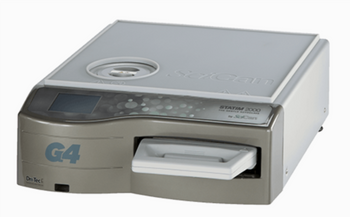
SciCan Statim G4
 SciCan · Model Statim G4
Fast Using only a small amount of water for each cycle, the STATIM heats and converts to steam in mere seconds. The innovative design of STATIM’s fully removable chamber allows for quick heating and cooling. A complete solution: rapid sterilization with rapid drying via the STATIM Dri-Tec drying technology. Smart WiFi enabled G4 technology can connect and send cycle data to your smart devices or computer, allowing staff to focus on the most important thing in a dental practice, the patients G4 technology connects your STATIM to specialized technicians, which allows for remote support and minimizes unnecessary downtime.
Key tips
- ·A failed biological indicator means the entire load is not sterile - no exceptions, regardless of how the cycle printout looks.
- ·Door gasket wear is the most common real cause of a failed vacuum/pressure test - check it before deeper diagnostics.
- ·Water quality directly affects steam-cycle validity - don't ignore scale or mineral buildup.
Typical Failure Modes
Compiled for this model from its own documentation and established engineering knowledge for this equipment class - not from a verified service record. Confirm against the manufacturer's service manual.
Cycle interrupted / aborted / CYCLE FAULT - NOT STERILE
HighSymptoms: "Cycle interrupted", "Cycle aborted" or "CYCLE FAULT" message; load not sterile.
Root cause: Cassette seal mis-aligned or the flexible lip caught, a kinked / obstructed exhaust tube, low or poor-quality water, a steam-generator or valve fault, or a temperature / pressure-sensor fault.
Cassette seal / cassette fault
MediumSymptoms: Steam leak at the cassette, seal will not seat, repeated cycle faults.
Root cause: Worn cassette seal (the holes in the back must align and the flexible lip must be free).
Water-quality / reservoir fault
MediumSymptoms: Low-water alarm, scale, cloudy chamber, poor steam.
Root cause: Empty reservoir, a fill-pump fault, or use of non-distilled / non-deionised water.
Steam-generator / heater fault
MediumSymptoms: Slow to pressure, temperature not held, generator fault code.
Root cause: Steam-generator element or its control.
Exhaust / condenser / drain fault
MediumSymptoms: Poor drying, water on the bench, exhaust alarm.
Root cause: Kinked or scaled exhaust tube, or a blocked condenser / drain.
Serviceable Parts & Consumables
Serviceable items for this model, compiled from its documentation and engineering knowledge for this equipment class. Service class and relative cost are estimates, not manufacturer figures; no part numbers are given. Confirm intervals and pricing against the manufacturer.
Cassette seal
Class Frequent wear itemRel. cost $$R&R Easy
Exhaust tube / condenser
Class Periodic replacementRel. cost $R&R Fairly easy
Steam-generator element
Class Periodic replacementRel. cost $$$R&R Difficult
Fill / water pump
Class Periodic replacementRel. cost $$R&R Moderate
Temperature / pressure sensor
Class Major service partRel. cost $$R&R Moderate
| Part | Service class | Relative cost | R&R difficulty |
|---|---|---|---|
| Cassette seal | Frequent wear item | $$ | Easy |
| Exhaust tube / condenser | Periodic replacement | $ | Fairly easy |
| Steam-generator element | Periodic replacement | $$$ | Difficult |
| Fill / water pump | Periodic replacement | $$ | Moderate |
| Temperature / pressure sensor | Major service part | $$ | Moderate |
Relative cost: $ lowest · $$$$ highest service-part cost for this equipment class. Not a price.
PM Checklist
Preventive-maintenance tasks typical of this equipment class. Perform to the manufacturer's procedure and your facility's policy - this is general reference, not a schedule for this specific unit.
- ·Daily biological and chemical indicator test loads
- ·Door gasket / seal inspection
- ·Steam trap and drain strainer cleaning
- ·Annual full PM and pressure-vessel certification
Troubleshooting Approach
A starting sequence for this model, compiled from its documentation and engineering knowledge for this equipment class. Follow the manufacturer's service documentation for the actual procedure.
Symptom: Cycle interrupted / CYCLE FAULT - NOT STERILE
- Wait a few minutes and attempt another cycle before proceeding.
- Remove the cassette (caution - hot metal and steam) and inspect the seal: the holes in the back must be perfectly aligned and the flexible lip completely free.
- Check the exhaust tube for kinks or obstructions and straighten / clear it.
- Confirm the reservoir has distilled / deionised water and refill.
- Follow the Statim Operator's Manual problem table; refer for steam-generator / sensor service if it persists.
Symptom: Cassette leak / seal fault
- Inspect and replace the cassette seal.
- Confirm the seal seats with the lip free and the back holes aligned.
- Clean the cassette and chamber sealing faces.
- Run a cycle and check for leaks.
- Run a BI to confirm sterilisation.
Typical Location
Where this class of equipment is typically deployed - general reference, not this unit's own placement record.
- Central Sterile Supply Department (CSSD)
- OR sterile core
- Satellite reprocessing areas
Documents & Manuals
Troubleshoot this device with Bio
Describe a symptom or error code. Bio answers from this device's own documented error codes, failure modes, parts, and guides.
Ask Bio