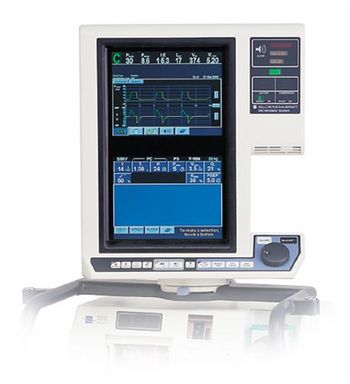
Puritan Bennett 840
 Puritan Bennett · Model 840
Technological Sophistication With its high-performance pneumatics, dual-microprocessor electronics and DualView™ touchscreens. Upgradeable The 840 Ventilator can be upgraded and customized with various software options to meet your clinical needs, today and in the future. Enhanced noninvasive ventilation (NIV) that improves comfort for patients and performance for clinicians. Designed for use on patients with a stable respiratory drive. Seamless Communications The 840 Ventilator supports communication with all major patient monitoring and hospital information systems. It provides seamless electronic data transfer into a patient's medical record. When used with Clinivision® Mobile Patient Charting software, the package provides clinicians the opportunity to practice evidence-based medicine. Low Cost of Ownership The 840 Ventilator is designed with rugged and reliable components. Its modular design provides easy serviceability. Best-in-class Service Puritan Bennett offers one of the most comprehensive field service programs in the ventilator industry. Our Customer Service Engineers are dedicated to providing the highest quality of service to our ventilator customers.
Key tips
- ·Never disable a low-pressure/circuit-disconnect alarm while troubleshooting - silence it, don't disable it.
- ·Verify the O2 supply source and pressure before assuming an internal fault.
- ·Circuit type must match the patient population (adult/pediatric/neonatal) - a mismatched circuit invalidates delivered volumes.
Typical Failure Modes
Compiled for this model from its own documentation and established engineering knowledge for this equipment class - not from a verified service record. Confirm against the manufacturer's service manual.
Fails the pre-use / extended self-test
HighSymptoms: Self-test aborts with a diagnostic code, circuit-leak or compliance test fails, ventilator not released for use.
Root cause: Patient-circuit leak, an exhalation-valve / flow-sensor fault, or an internal pneumatic / electronic fault (see the diagnostic-code table).
Oxygen / air delivery or blender fault
HighSymptoms: FiO2 not matching the setting, low or high supply-pressure alarm, gas-mix alarm.
Root cause: Blender fault, a wall-supply / hose issue, or a failing internal compressor / turbine.
Flow / pressure sensor drift
MediumSymptoms: Monitored tidal volume, pressure or flow implausible, frequent nuisance alarms.
Root cause: Flow sensor(s) or the internal pressure transducers aging or contaminated.
Exhalation-valve fault
MediumSymptoms: PEEP not held, auto-PEEP, high circuit pressure, exhalation-valve alarm.
Root cause: Worn or wet exhalation-valve diaphragm / assembly.
Battery / power fault
MediumSymptoms: Short battery run time, will not ride through a power interruption, will not charge.
Root cause: Aged internal / external battery.
Serviceable Parts & Consumables
Serviceable items for this model, compiled from its documentation and engineering knowledge for this equipment class. Service class and relative cost are estimates, not manufacturer figures; no part numbers are given. Confirm intervals and pricing against the manufacturer.
Flow sensor(s)
Class Frequent wear itemRel. cost $$R&R Fairly easy
Exhalation valve assembly
Class Frequent wear itemRel. cost $$R&R Fairly easy
O2 sensor (galvanic cell)
Class Frequent wear itemRel. cost $$R&R Fairly easy
Internal compressor / turbine
Class Major service partRel. cost $$$$R&R Expert-level
Battery pack
Class Periodic replacementRel. cost $$R&R Fairly easy
| Part | Service class | Relative cost | R&R difficulty |
|---|---|---|---|
| Flow sensor(s) | Frequent wear item | $$ | Fairly easy |
| Exhalation valve assembly | Frequent wear item | $$ | Fairly easy |
| O2 sensor (galvanic cell) | Frequent wear item | $$ | Fairly easy |
| Internal compressor / turbine | Major service part | $$$$ | Expert-level |
| Battery pack | Periodic replacement | $$ | Fairly easy |
Relative cost: $ lowest · $$$$ highest service-part cost for this equipment class. Not a price.
PM Checklist
Preventive-maintenance tasks typical of this equipment class. Perform to the manufacturer's procedure and your facility's policy - this is general reference, not a schedule for this specific unit.
- ·Daily pre-use check: self-test, circuit integrity, alarm function
- ·Scheduled circuit and inspiratory filter replacement per manufacturer interval
- ·Flow and pressure sensor calibration verification
- ·Battery load test and runtime check
- ·Annual full PM and electrical safety test
Troubleshooting Approach
A starting sequence for this model, compiled from its documentation and engineering knowledge for this equipment class. Follow the manufacturer's service documentation for the actual procedure.
Symptom: Self-test / circuit test fails
- Run the extended self-test (EST) with the exact circuit that will be used, and note the diagnostic code.
- Look the code up in the service manual's diagnostic-code table and follow the sequenced repair actions.
- Leak-test the patient circuit, humidifier and water traps.
- Fit a fresh flow sensor and exhalation valve and repeat.
- Verify secure connections of all cables and modules; replace CPU / main boards only after all other remedies.
Symptom: FiO2 or supply-pressure fault
- Confirm the O2 (and air) supply pressures and hoses.
- Verify FiO2 with a calibrated analyser at the wye.
- Calibrate the O2 sensor / blender per the service manual.
- Listen for the internal compressor / turbine cycling correctly on air-supply loss.
- Refer the blender / compressor for service if the mix is still wrong.
Typical Location
Where this class of equipment is typically deployed - general reference, not this unit's own placement record.
- ICU / CCU
- Emergency Department
- Operating Room (anesthesia-adjacent)
- NICU
- Respiratory Therapy department
- Patient transport
Documents & Manuals
- Puritan Bennett 840 Operations ManualUser Manual · External
- Puritan Bennett 840 Ventilator System Service Manual, Schematics Assembly DrawingsSchematic · External
- Puritan Bennett 840 BrochureBrochure · External
- Puritan Bennett 840 End of Life LetterDocument · External
- Puritan Bennett 840 Part List NewDocument · External
Safety & Recalls
Synced live from the FDA openFDA API.
- RECALL
Manufacturing defect at contract manufacturer, employee error, poor training, improper inspection.
Related calculators
From BioLab, for work done with this kind of equipment.
Troubleshoot this device with Bio
Describe a symptom or error code. Bio answers from this device's own documented error codes, failure modes, parts, and guides.
Ask Bio