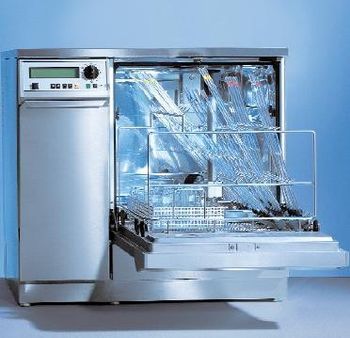
Miele G7835
 Miele · Model G7835
Fully programmable Profitronic Control System featuring 11 standard programs and storage for up to 45 custom wash protocols. An RS-232 port is provided for connection to a printer for monitoring / validating wash steps. Main wash and DI rinse temperatures are fully adjustable from ambient to 95ºC. Temperature is monitored by dual sensors for superior accuracy. The HEPA-filtered forced air drying system with adjustable time and temperature settings helps ensure completely dry glassware, inside and out. Both coarse and HEPA filters are included. The built-in water softener provides optimal detergent performance regardless of incoming water hardness. A 304- and 316-grade stainless steel wash chamber provides superior corrosion resistance and helps extend overall machine life. The G 7835 also includes a validation test port for monitoring of chamber conditions. Flow meters on incoming water lines allow precise water fills, helping to increase overall water savings. A standard steam condenser eliminates the need for an external vent, preventing potentially harmful vapours from entering the laboratory. Each machine includes 6,000 watts of heating power for efficient heating of wash and rinse water. High power elements guarantee proper temperatures are achieved quickly regardless of incoming water temperature. The heavy duty circulation pump is rated at 400 litres per minute for fast, thorough cleaning. Separate drain and circulation pumps are standard to prevent cross contamination between drain and intake steps. The circulation pump includes a speed sensor which monitors pump speed and shuts it down in the event of an obstruction, preventing overheating and pump failure. Miele’s Water-Proof System is designed to protect the laboratory from potential flooding. Double-wall intake hoses divert any leaks to the drip tray, where a float sensor shuts off water lines and activates the drain pump. An audio-visual alarm system alerts operator to machine status and error conditions. In a crowded laboratory environment, the alarm can help save time by alerting the user immediately upon change in machine condition. Built-in top and bottom spray arms, plus a middle spray arm on the standard baskets, provide thorough spray coverage throughout the chamber, regardless of the number of pieces being cleaned or the number of basket levels being used. Miele’s four-stage filter system keeps debris from reaching the pumps, helping to prevent both redeposit of contaminant on glassware and pump damage due to debris in the sump area. Automatic liquid detergent dispensing is standard. Detergent is dispensed directly from a 5L jug, stored in a convenient pull-out drawer, eliminating the need for frequent refilling. The G 7835 automatically dispenses liquid acid neutralizer to remove any final detergent residues. Neutralizer is dispensed directly from a 5L jug, stored in a convenient pull-out drawer, eliminating the need for frequent refilling.
Key tips
- ·A failed biological indicator means the entire load is not sterile - no exceptions, regardless of how the cycle printout looks.
- ·Door gasket wear is the most common real cause of a failed vacuum/pressure test - check it before deeper diagnostics.
- ·Water quality directly affects steam-cycle validity - don't ignore scale or mineral buildup.
Typical Failure Modes
Compiled for this model from its own documentation and established engineering knowledge for this equipment class - not from a verified service record. Confirm against the manufacturer's service manual.
Cycle fault / abort
HighSymptoms: Cycle stops with a fault code, load not processed, door locked.
Root cause: Water fill / drain fault, temperature not reached, a dosing-pump fault, or a spray-arm blockage.
Poor cleaning / spray-arm blockage
MediumSymptoms: Instruments come out soiled, spray arms not rotating.
Root cause: Clogged spray-arm nozzles, a blocked filter / strainer, or low water pressure.
Chemistry dosing fault
MediumSymptoms: Detergent / neutraliser / lubricant not dosed, dosing-pump alarm.
Root cause: Empty chemistry container, an air-locked or worn dosing pump, or a level sensor.
Thermal-disinfection temperature not reached
HighSymptoms: A0 / disinfection temperature not achieved.
Root cause: Heater element, temperature sensor, or steam supply.
Door / seal fault
MediumSymptoms: Leaks during the cycle, door will not lock / unlock.
Root cause: Worn door gasket or a door-lock solenoid.
Serviceable Parts & Consumables
Serviceable items for this model, compiled from its documentation and engineering knowledge for this equipment class. Service class and relative cost are estimates, not manufacturer figures; no part numbers are given. Confirm intervals and pricing against the manufacturer.
Spray-arm nozzles / bearings
Class Periodic replacementRel. cost $$R&R Fairly easy
Chamber filter / strainer
Class Frequent wear itemRel. cost $R&R Easy
Peristaltic dosing pump / tubing
Class Periodic replacementRel. cost $$R&R Moderate
Heater element / temperature sensor
Class Major service partRel. cost $$R&R Moderate
Door gasket
Class Periodic replacementRel. cost $$R&R Fairly easy
Fill / drain solenoid valve
Class Periodic replacementRel. cost $$R&R Moderate
| Part | Service class | Relative cost | R&R difficulty |
|---|---|---|---|
| Spray-arm nozzles / bearings | Periodic replacement | $$ | Fairly easy |
| Chamber filter / strainer | Frequent wear item | $ | Easy |
| Peristaltic dosing pump / tubing | Periodic replacement | $$ | Moderate |
| Heater element / temperature sensor | Major service part | $$ | Moderate |
| Door gasket | Periodic replacement | $$ | Fairly easy |
| Fill / drain solenoid valve | Periodic replacement | $$ | Moderate |
Relative cost: $ lowest · $$$$ highest service-part cost for this equipment class. Not a price.
PM Checklist
Preventive-maintenance tasks typical of this equipment class. Perform to the manufacturer's procedure and your facility's policy - this is general reference, not a schedule for this specific unit.
- ·Daily biological and chemical indicator test loads
- ·Door gasket / seal inspection
- ·Steam trap and drain strainer cleaning
- ·Annual full PM and pressure-vessel certification
Troubleshooting Approach
A starting sequence for this model, compiled from its documentation and engineering knowledge for this equipment class. Follow the manufacturer's service documentation for the actual procedure.
Symptom: Cycle fault / abort
- Note the fault code and the phase it aborted in.
- Check the water fill and drain, and the chamber filter / strainer.
- Confirm the spray arms rotate freely and the nozzles are clear.
- Verify the heater reaches temperature and the sensor agrees with a reference.
- Follow the service manual for the specific code.
Symptom: Instruments still soiled
- Clear the spray-arm nozzles and check the arms spin.
- Clean the chamber filter / strainer.
- Confirm detergent is dosing.
- Check the water pressure and temperature.
- Run a soil / protein test on the next cycle.
Typical Location
Where this class of equipment is typically deployed - general reference, not this unit's own placement record.
- Central Sterile Supply Department (CSSD)
- OR sterile core
- Satellite reprocessing areas
Documents & Manuals
Troubleshoot this device with Bio
Describe a symptom or error code. Bio answers from this device's own documented error codes, failure modes, parts, and guides.
Ask Bio