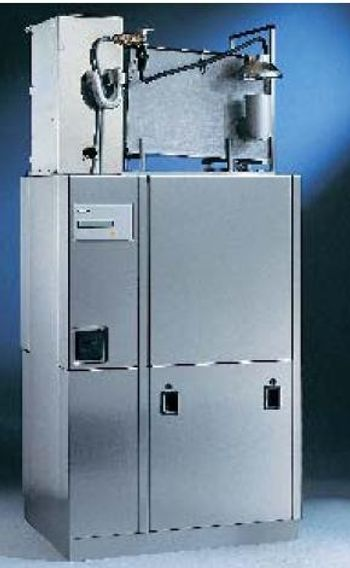
Miele G 7828
 Miele · Model G 7828
Dispensing Systems Four liquid dispensing systems are included for automatic dosing of detergent, acid neutralizing agent, rinse aid, or other additives. For most glassware washing applications Miele recommends the use of a neodisher® brand detergent and a mild acid neutralizing agent to restore the proper pH balance to your glassware. Four 10 liter detergent/ additive containers are located in the base of the washer for convenient storage, and are connected to independent bellows-type pumps for precise dosing. Each siphon tube is colorcoded for operator convenience and safety. By having four dispensing systems available, several detergents can be ready-to-use for multiple cleaning requirements. Powerful Circulation Pumps As always, Miele has designed these washers with pumps that provide a high circulation rate, combined with gentle spray pressure. This ensures that glassware will be throughly cleaned, but not damaged. Water is delivered to the chamber through the upper and lower spray arms (400 liters per minute), and through direct injection units (600 liters per minute). A total of 1000 liters of water per minute is recirculated for extremely effective mechanical cleaning action. This is accomplished while using a mere 35 liters (9 gal.) of water per fill. Fresh Water and Boiler System The system includes water inlet valves for hot tap water, cold tap water and DI water. Between each cleaning stage (pre-wash, wash, rinse or final rinse) water is drained and fresh water is introduced for the next stage. Each fill is typically 35 liters (fills are adjustable from 25 to 55 liters) for economical water consumption. In addition, the Miele system includes a 30 liter boiler for pre-heating of DI water prior to the final rinse. These features help to ensure analytical cleaning results every time. Hot Wash and Rinse Water It is well known that hotter water generally provides for better washing and rinsing results. For this reason water temperatures are adjustable up to 95°C. Independent control of wash and rinse water temperature provides for maximum flexibility in wash program design to meet special cleaning requirements. Triple Filter System A triple filter system ensures that only clean water is introduced into the wash chamber. This system includes: ? Filters on all water inlet hoses to retain even the smallest particles before they enter the washer? Filters in the base of wash chamber to capture residue so that it is not recircultated? Filters upstream of circulation pumps to extend pump life Environmentally Friendly All Miele products are designed with the environment in mind. Water consumption – typically 9 gallons per fill, this washer utilizes less water than many other brands in its capacity range. This means you will spend less on purified water while conserving one of the earth’s vital resources. Detergent consumption – Low water consumption and high circulation rate enable these models to consume minimal detergent amounts. The detergent volume used varies depending upon the wash program, but typically ranges from 50 to 200 ml (2–8 fl. ounces) per cycle. Electrical Efficiency Low water consumption means that less energy is required to heat the water up to washing temperature. Double wall construction and thorough insulation also minimizes heat loss, conserving electricity. Basket Recognition System Many laboratories today are concerned with standard operating procedures or validation of processes. For this reason, equipment must be designed with features that minimize potential operator error. The Miele Basket Recognition System is a unique feature that allows only one predetermined wash routine to be run with a given mobile unit insert. This enables you to be absolutely confident that only the proper wash routine is being utilized. In order for the Basket Recognition System to be used, the user access switch is set to “C”, and the magnetic coding strip is set to match the corresponding predetermined wash program (a description of this simple process is outlined in the operation manual). When the mobile insert is rolled into the wash chamber, the washer automatically reads the magnetic coding strip and indicates that the wash program is ready to start. The user must simply press the door close button and the start button. If one laboratory within the facility requires a different washing protocol than another, a mobile unit could be designated specifically for that lab and set to run only the wash program needed for that ap.
Key tips
- ·A failed biological indicator means the entire load is not sterile - no exceptions, regardless of how the cycle printout looks.
- ·Door gasket wear is the most common real cause of a failed vacuum/pressure test - check it before deeper diagnostics.
- ·Water quality directly affects steam-cycle validity - don't ignore scale or mineral buildup.
Typical Failure Modes
Compiled for this model from its own documentation and established engineering knowledge for this equipment class - not from a verified service record. Confirm against the manufacturer's service manual.
Cycle fault / abort
HighSymptoms: Cycle stops with a fault code, load not processed, door locked.
Root cause: Water fill / drain fault, temperature not reached, a dosing-pump fault, or a spray-arm blockage.
Poor cleaning / spray-arm blockage
MediumSymptoms: Instruments come out soiled, spray arms not rotating.
Root cause: Clogged spray-arm nozzles, a blocked filter / strainer, or low water pressure.
Chemistry dosing fault
MediumSymptoms: Detergent / neutraliser / lubricant not dosed, dosing-pump alarm.
Root cause: Empty chemistry container, an air-locked or worn dosing pump, or a level sensor.
Thermal-disinfection temperature not reached
HighSymptoms: A0 / disinfection temperature not achieved.
Root cause: Heater element, temperature sensor, or steam supply.
Door / seal fault
MediumSymptoms: Leaks during the cycle, door will not lock / unlock.
Root cause: Worn door gasket or a door-lock solenoid.
Serviceable Parts & Consumables
Serviceable items for this model, compiled from its documentation and engineering knowledge for this equipment class. Service class and relative cost are estimates, not manufacturer figures; no part numbers are given. Confirm intervals and pricing against the manufacturer.
Spray-arm nozzles / bearings
Class Periodic replacementRel. cost $$R&R Fairly easy
Chamber filter / strainer
Class Frequent wear itemRel. cost $R&R Easy
Peristaltic dosing pump / tubing
Class Periodic replacementRel. cost $$R&R Moderate
Heater element / temperature sensor
Class Major service partRel. cost $$R&R Moderate
Door gasket
Class Periodic replacementRel. cost $$R&R Fairly easy
Fill / drain solenoid valve
Class Periodic replacementRel. cost $$R&R Moderate
| Part | Service class | Relative cost | R&R difficulty |
|---|---|---|---|
| Spray-arm nozzles / bearings | Periodic replacement | $$ | Fairly easy |
| Chamber filter / strainer | Frequent wear item | $ | Easy |
| Peristaltic dosing pump / tubing | Periodic replacement | $$ | Moderate |
| Heater element / temperature sensor | Major service part | $$ | Moderate |
| Door gasket | Periodic replacement | $$ | Fairly easy |
| Fill / drain solenoid valve | Periodic replacement | $$ | Moderate |
Relative cost: $ lowest · $$$$ highest service-part cost for this equipment class. Not a price.
PM Checklist
Preventive-maintenance tasks typical of this equipment class. Perform to the manufacturer's procedure and your facility's policy - this is general reference, not a schedule for this specific unit.
- ·Daily biological and chemical indicator test loads
- ·Door gasket / seal inspection
- ·Steam trap and drain strainer cleaning
- ·Annual full PM and pressure-vessel certification
Troubleshooting Approach
A starting sequence for this model, compiled from its documentation and engineering knowledge for this equipment class. Follow the manufacturer's service documentation for the actual procedure.
Symptom: Cycle fault / abort
- Note the fault code and the phase it aborted in.
- Check the water fill and drain, and the chamber filter / strainer.
- Confirm the spray arms rotate freely and the nozzles are clear.
- Verify the heater reaches temperature and the sensor agrees with a reference.
- Follow the service manual for the specific code.
Symptom: Instruments still soiled
- Clear the spray-arm nozzles and check the arms spin.
- Clean the chamber filter / strainer.
- Confirm detergent is dosing.
- Check the water pressure and temperature.
- Run a soil / protein test on the next cycle.
Typical Location
Where this class of equipment is typically deployed - general reference, not this unit's own placement record.
- Central Sterile Supply Department (CSSD)
- OR sterile core
- Satellite reprocessing areas
Documents & Manuals
Troubleshoot this device with Bio
Describe a symptom or error code. Bio answers from this device's own documented error codes, failure modes, parts, and guides.
Ask Bio