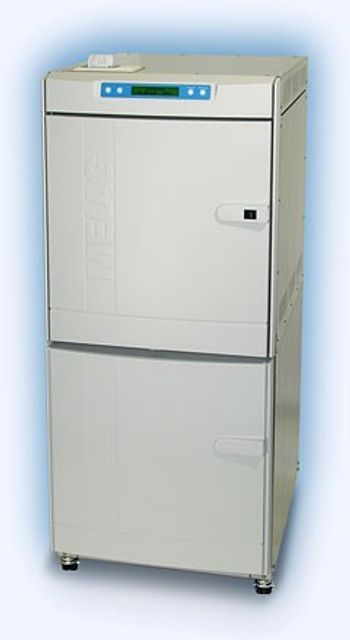
MELAG Cliniklav 25
 MELAG · Model Cliniklav 25
Reliable It becomes really clear in a surgery how important a high-quality autoclave is when you don’t have one: i.e., when you have to postpone an operation because sterile instruments, towels, aprons, etc., are just not ready. Several thousand hours of endurance tests in labs and in numerous surgeries and clinics offer you the guarantee of maximum quality and functional reliability. Close collaboration over many years with internationally acknowledged subcontractors, leading in their specialized fields, is an essential part of our successful corporate philosophy. Quick From the very beginning of development of the Cliniklav 25, Melag has placed great emphasis not only on economy of power and water consumption, but also on short program run times. In addition to reduction of costs per sterilization cycle, these savings also mean that you need fewer instruments in your surgery or clinic. In other words, instruments and textiles are available again very quickly: in the Universal Program up to 15 kg of instruments are ready for use again after no more than 56 minutes (including effective vacuum drying). With the Quick Program, after only 14 min. User friendliness Program diversity must never become an end in itself. A great number of control elements with confusing menu selections may be optically impressive: but they can prove very expensive when they lead to the wrong program selection, aborted programs, and restarts. This all costs time and money. This is why we have limited the control elements of the Cliniklav 25 to only a few buttons that allow very user-friendly selection of the most important functions. The button “Programm” selects the four sterilization programs, the Bowie & Dick test, and the vacuum test. The button “Start/Stop” starts these functions. MELAG can add individual programs to the Cliniklav 25, according to the user’s needs. Compact All components and aggregates are integrated in the Cliniklav 25 table top model. The sub-cabinet is only needed for the installation of the water-treatment-system MELAdem 55. For an easy moving of the Cliniklav 25 for the installation or for the case of maintenance the sub-cabinet is fitted with wheels. The sub-cabinet is delivered with two shelves for storing sterilization containers or other accessories. The required documentation of the sterilization cycles is implemented over the on-board serial port to the connection of the protocol printer MELAprint 42 or to the practice PC. The documentation software MELAwin developed by MELAG is required for this. Additionally the Cliniklav 25 is capable of storing its sterilization records on the MELAflash CF Card Printer on the MELAflash CF Card. The sterilization records can be read out on every PC with the MELAflash CF-Card Reader. Incorporation in the practice network is effected by connecting the MELAnet Box to the serial interface of the autoclave. Thus, the sterilization protocols are imported to the user P.C. The MELAnet Box is fitted with independent software which places websites in the user network so that you can view protocols from any computer. Two helix reference block systems, the MELAcontrol and MELAcontrol PRO are available for the verification of successful sterilization in a class B autoclave. The documentation of the release is carried out with the MELAdoc system, consisting of the documentation pages and the MELAdoc label printer for sterilization packagings. MELAG offers a loading rack for up to 4 trays or 2 baskets for the optimal employment of the chamber. Likewise different sterilization containers are available. In addition, the usual system containers (1 Sterilization unit = 30 x 30 x 60 cm) naturally fit into the chamber.
Key tips
- ·A failed biological indicator means the entire load is not sterile - no exceptions, regardless of how the cycle printout looks.
- ·Door gasket wear is the most common real cause of a failed vacuum/pressure test - check it before deeper diagnostics.
- ·Water quality directly affects steam-cycle validity - don't ignore scale or mineral buildup.
Typical Failure Modes
Compiled for this model from its own documentation and established engineering knowledge for this equipment class - not from a verified service record. Confirm against the manufacturer's service manual.
Cycle fault / will not reach sterilization parameters
HighSymptoms: Cycle aborts, temperature or pressure not reached / held, failed BI or chemical indicator.
Root cause: Heater / element fault, a door-gasket leak, a steam-generation or water-fill fault, a blocked chamber drain / strainer, or a temperature / pressure-sensor fault.
Door / gasket seal fault
MediumSymptoms: Steam leak at the door, door will not seal, lock or unlock, pressure will not build.
Root cause: Worn door gasket or a door-lock / interlock fault.
Poor drying / wet packs
MediumSymptoms: Instruments / packs come out wet.
Root cause: Drying-phase vacuum / heater fault, an overloaded chamber, or a clogged drain.
Water / reservoir / feedwater fault
MediumSymptoms: Low-water alarm, mineral scale, cloudy chamber, poor steam quality.
Root cause: Empty or scaled reservoir, a fill-valve / pump fault, or use of non-distilled water.
Steam-trap / air-removal / vacuum fault
MediumSymptoms: Failed Bowie-Dick / air-removal test, slow come-up, air pockets.
Root cause: Blocked steam trap, a vacuum-pump / ejector fault, or a check-valve fault.
Printer / recorder fault
LowSymptoms: No or faint cycle printout.
Root cause: Thermal print head or paper.
Serviceable Parts & Consumables
Serviceable items for this model, compiled from its documentation and engineering knowledge for this equipment class. Service class and relative cost are estimates, not manufacturer figures; no part numbers are given. Confirm intervals and pricing against the manufacturer.
Door gasket
Class Periodic replacementRel. cost $$R&R Fairly easy
Heating element / steam-generator element
Class Major service partRel. cost $$$R&R Difficult
Chamber / feedwater strainer & fill valve
Class Periodic replacementRel. cost $$R&R Moderate
Temperature / pressure sensor
Class Major service partRel. cost $$R&R Moderate
Steam trap / solenoid & check valves
Class Periodic replacementRel. cost $$R&R Moderate
Thermal print head / paper
Class Periodic replacementRel. cost $R&R Fairly easy
| Part | Service class | Relative cost | R&R difficulty |
|---|---|---|---|
| Door gasket | Periodic replacement | $$ | Fairly easy |
| Heating element / steam-generator element | Major service part | $$$ | Difficult |
| Chamber / feedwater strainer & fill valve | Periodic replacement | $$ | Moderate |
| Temperature / pressure sensor | Major service part | $$ | Moderate |
| Steam trap / solenoid & check valves | Periodic replacement | $$ | Moderate |
| Thermal print head / paper | Periodic replacement | $ | Fairly easy |
Relative cost: $ lowest · $$$$ highest service-part cost for this equipment class. Not a price.
PM Checklist
Preventive-maintenance tasks typical of this equipment class. Perform to the manufacturer's procedure and your facility's policy - this is general reference, not a schedule for this specific unit.
- ·Daily biological and chemical indicator test loads
- ·Door gasket / seal inspection
- ·Steam trap and drain strainer cleaning
- ·Annual full PM and pressure-vessel certification
Error Codes
Extracted directly from this unit's own service manual.
Error messages Causes/RemedyThe monitoring time for reaching the evacuation pressure for the individual pressure cycles, pressure release, or for reaching the minimum drying pressure has been exceeded
Check that the door seal and the lip of the opening to the pressure chamber are intact
Troubleshooting Approach
A starting sequence for this model, compiled from its documentation and engineering knowledge for this equipment class. Follow the manufacturer's service documentation for the actual procedure.
Symptom: Cycle aborts / fails / will not reach sterilization parameters
- Note the exact fault code / message and the phase it aborted in (heat-up, sterilise, exhaust, dry).
- Confirm the reservoir has distilled / deionised water and the feedwater path, fill valve and chamber strainer are clear.
- Inspect the door gasket for a steam leak and confirm the door lock / interlock; replace a worn gasket.
- Compare the displayed temperature and pressure to independent calibrated references; check the sensor and its calibration.
- Replace the failed element / valve / sensor as isolated, then run a biological indicator and a leak / Bowie-Dick test before returning to use.
Symptom: Wet packs / poor drying
- Reduce the load and re-space it so steam and air can move around every pack.
- Check the drying-phase vacuum and the door-open / drying setting.
- Clean the chamber drain and strainer.
- Confirm the steam trap and check valves are not blocked.
- Confirm packaging is drying-compatible and re-run, inspecting for dryness.
Symptom: Failed Bowie-Dick / air-removal or leak-rate test
- Run the automated leak-rate (vacuum-decay) test.
- Inspect and replace the door gasket; check all chamber fittings and the door-seal channel.
- Check the vacuum pump / ejector and the air / water separator.
- Clear a blocked steam trap or check valve.
- Re-run the Bowie-Dick test after the repair.
Technical Specs
- Chamber Width
- 32 cm
- Height
- 80 cm
- Chamber Height
- 32 cm
- Length
- 84 cm
- Orientation
- Floor Standing
- Weight
- 157 kg
- Chamber Depth
- 65 cm
- Width
- 61.6 cm
Typical Location
Where this class of equipment is typically deployed - general reference, not this unit's own placement record.
- Central Sterile Supply Department (CSSD)
- OR sterile core
- Satellite reprocessing areas
Documents & Manuals
Troubleshoot this device with Bio
Describe a symptom or error code. Bio answers from this device's own documented error codes, failure modes, parts, and guides.
Ask Bio