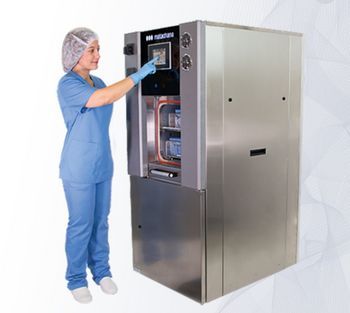
Matachana STEAM STERILIZERS S100
 Matachana · Model STEAM STERILIZERS S100
Useful chamber volume: 75-80l Capacity in S.M.: 1 Technology: new control system more powerful and more advanced. TFT touch screen for loading area with integrated PLC and PLC register that ensure autonomy from temperature and pressure readings. Front backlit with indicator icons that show the status of the sterilizer Ergonomics: more accessible displays with a modern and versatile interface Sustainability: energy and water consumption reduced thanks to built-in economizer systems Efficiency: vacuum system by Venturi ensuring a low water consumption Compatibility: perfect drying tested with the most demanding packaging on the market Connectivity: ready to connect with the most usual management and traceability systems via Ethernet port Comfort: new range of more functional accessories, adapted to the loading requirements Accessibility: full circuits and components redistribution that facilitates the accessibility of the Technical Service for easy maintenance procedures Remote diagnosis: remote connection via Ethernet port to know the sterilizer’s condition and enable the Technical Support Service to diagnose incidences/failures remotely for faster solution Quality: chamber, frame and generator made of stainless steel 1.4404 (AISI 316L). Additionally, the primary ducts in contact with the steam are also made of stainless steel 1.4404 (AISI 316L) Compact dimensions.
Key tips
- ·A failed biological indicator means the entire load is not sterile - no exceptions, regardless of how the cycle printout looks.
- ·Door gasket wear is the most common real cause of a failed vacuum/pressure test - check it before deeper diagnostics.
- ·Water quality directly affects steam-cycle validity - don't ignore scale or mineral buildup.
Typical Failure Modes
Compiled for this model from its own documentation and established engineering knowledge for this equipment class - not from a verified service record. Confirm against the manufacturer's service manual.
Cycle fault / will not reach sterilization parameters
HighSymptoms: Cycle aborts, temperature or pressure not reached / held, failed BI or chemical indicator.
Root cause: Heater / element fault, a door-gasket leak, a steam-generation or water-fill fault, a blocked chamber drain / strainer, or a temperature / pressure-sensor fault.
Door / gasket seal fault
MediumSymptoms: Steam leak at the door, door will not seal, lock or unlock, pressure will not build.
Root cause: Worn door gasket or a door-lock / interlock fault.
Poor drying / wet packs
MediumSymptoms: Instruments / packs come out wet.
Root cause: Drying-phase vacuum / heater fault, an overloaded chamber, or a clogged drain.
Water / reservoir / feedwater fault
MediumSymptoms: Low-water alarm, mineral scale, cloudy chamber, poor steam quality.
Root cause: Empty or scaled reservoir, a fill-valve / pump fault, or use of non-distilled water.
Steam-trap / air-removal / vacuum fault
MediumSymptoms: Failed Bowie-Dick / air-removal test, slow come-up, air pockets.
Root cause: Blocked steam trap, a vacuum-pump / ejector fault, or a check-valve fault.
Printer / recorder fault
LowSymptoms: No or faint cycle printout.
Root cause: Thermal print head or paper.
Serviceable Parts & Consumables
Serviceable items for this model, compiled from its documentation and engineering knowledge for this equipment class. Service class and relative cost are estimates, not manufacturer figures; no part numbers are given. Confirm intervals and pricing against the manufacturer.
Door gasket
Class Periodic replacementRel. cost $$R&R Fairly easy
Heating element / steam-generator element
Class Major service partRel. cost $$$R&R Difficult
Chamber / feedwater strainer & fill valve
Class Periodic replacementRel. cost $$R&R Moderate
Temperature / pressure sensor
Class Major service partRel. cost $$R&R Moderate
Steam trap / solenoid & check valves
Class Periodic replacementRel. cost $$R&R Moderate
Thermal print head / paper
Class Periodic replacementRel. cost $R&R Fairly easy
| Part | Service class | Relative cost | R&R difficulty |
|---|---|---|---|
| Door gasket | Periodic replacement | $$ | Fairly easy |
| Heating element / steam-generator element | Major service part | $$$ | Difficult |
| Chamber / feedwater strainer & fill valve | Periodic replacement | $$ | Moderate |
| Temperature / pressure sensor | Major service part | $$ | Moderate |
| Steam trap / solenoid & check valves | Periodic replacement | $$ | Moderate |
| Thermal print head / paper | Periodic replacement | $ | Fairly easy |
Relative cost: $ lowest · $$$$ highest service-part cost for this equipment class. Not a price.
PM Checklist
Preventive-maintenance tasks typical of this equipment class. Perform to the manufacturer's procedure and your facility's policy - this is general reference, not a schedule for this specific unit.
- ·Daily biological and chemical indicator test loads
- ·Door gasket / seal inspection
- ·Steam trap and drain strainer cleaning
- ·Annual full PM and pressure-vessel certification
Troubleshooting Approach
A starting sequence for this model, compiled from its documentation and engineering knowledge for this equipment class. Follow the manufacturer's service documentation for the actual procedure.
Symptom: Cycle fault or parameters not reached
- Note the fault code and the phase it aborted in.
- Confirm the reservoir has distilled water and the fill / feedwater path and strainer are clear.
- Inspect the door gasket for a leak and the door lock / interlock.
- Compare the displayed temperature / pressure to independent references.
- Replace the gasket, element or sensor as isolated, then run a BI and a leak / Bowie-Dick test.
Symptom: Wet packs / poor drying
- Reduce the load and re-space so steam and air can move.
- Check the drying-phase vacuum and heater.
- Clean the chamber drain / strainer.
- Confirm packaging is drying-compatible.
- Re-run and inspect for dryness.
Typical Location
Where this class of equipment is typically deployed - general reference, not this unit's own placement record.
- Central Sterile Supply Department (CSSD)
- OR sterile core
- Satellite reprocessing areas
Documents & Manuals
No documents available for this device yet.
Troubleshoot this device with Bio
Describe a symptom or error code. Bio answers from this device's own documented error codes, failure modes, parts, and guides.
Ask Bio