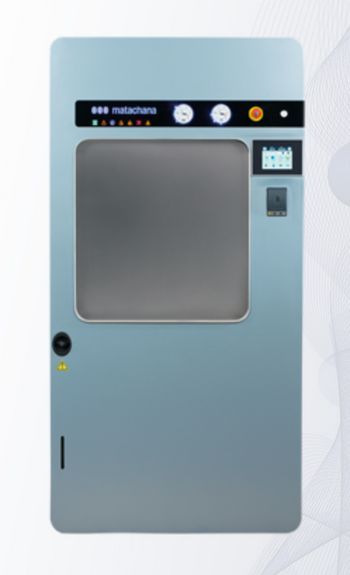
Matachana S1000
 Matachana · Model S1000
GENERAL FEATURES OF SERIES S1000 Technology: new control system more powerful and modern. TFT touch screen for loading area with integrated PLC, as well as register PLC which ensure independent readings between temperature and pressure. Frontal made of an innovative material that prevents dirt and reflections. Easy to clean. Frontal backlit indicator icons that show the status of the sterilizer. Ergonomics: more accessible displays with a modern and versatile interface. Sustainability: energy and water consumption reduced thanks to incorporated economizer systems. Efficiency: redesigning of vacuum system by Venturi ensuring a low water consumption. Compatibility: perfect drying tested with the most demanding packaging on the market. Connectivity: ready to connect with the most usual management and traceability systems via Ethernet port. Comfort: new range of more functional accessories, adapted to the loading requirements. Accessibility: full circuits and components redistribution that facilitates the accessibility of the Technical Service for easy maintenance procedures. Remote diagnosis: remote connection via Ethernet port to know the sterilizer’s condition and enable the Technical Support Service to diagnose incidences/failures remotely for faster solution. ACCESSORIES Manual or electrical loading/unloading trolley, adjustable in height Loading racks with adjustable levels loading platform Set of chamber shelves (lower and intermediate level) Automatic loading/unloading system Stainless steel basket.
Key tips
- ·A failed biological indicator means the entire load is not sterile - no exceptions, regardless of how the cycle printout looks.
- ·Door gasket wear is the most common real cause of a failed vacuum/pressure test - check it before deeper diagnostics.
- ·Water quality directly affects steam-cycle validity - don't ignore scale or mineral buildup.
Typical Failure Modes
Compiled for this model from its own documentation and established engineering knowledge for this equipment class - not from a verified service record. Confirm against the manufacturer's service manual.
Thermal / block uniformity fault
HighSymptoms: Wells at the edge vs centre give different Ct, failed thermal verification, ramp errors.
Root cause: Peltier block ageing / a failed Peltier zone, a heated-lid fault, or a fan / heatsink fault.
Optical / calibration fault (real-time)
HighSymptoms: High background, low signal, dye / ROI or pure-dye calibration fails, poor amplification curves.
Root cause: Excitation LED / lamp ageing, optics contamination, or an out-of-date calibration.
Heated lid / seal fault
MediumSymptoms: Evaporation, condensation on the seal, inconsistent replicates, lid-pressure error.
Root cause: Heated-lid heater or the lid-pressure mechanism / seal.
Software / instrument-comms fault
MediumSymptoms: Instrument not detected, runs will not start or export, firmware mismatch.
Root cause: USB / network link, driver, or the control PC.
Fan / cooling fault
LowSymptoms: Slow ramp-down, over-temperature warning, loud fan.
Root cause: Failed or clogged cooling fan.
Serviceable Parts & Consumables
Serviceable items for this model, compiled from its documentation and engineering knowledge for this equipment class. Service class and relative cost are estimates, not manufacturer figures; no part numbers are given. Confirm intervals and pricing against the manufacturer.
Peltier sample block
Class Major service partRel. cost $$$$R&R Difficult
Excitation LED / lamp module
Class Periodic replacementRel. cost $$$R&R Moderate
Heated-lid heater / seal
Class Major service partRel. cost $$R&R Moderate
Cooling fan
Class Periodic replacementRel. cost $R&R Fairly easy
Dye calibration kit
Class Frequent wear itemRel. cost $$R&R Easy
| Part | Service class | Relative cost | R&R difficulty |
|---|---|---|---|
| Peltier sample block | Major service part | $$$$ | Difficult |
| Excitation LED / lamp module | Periodic replacement | $$$ | Moderate |
| Heated-lid heater / seal | Major service part | $$ | Moderate |
| Cooling fan | Periodic replacement | $ | Fairly easy |
| Dye calibration kit | Frequent wear item | $$ | Easy |
Relative cost: $ lowest · $$$$ highest service-part cost for this equipment class. Not a price.
PM Checklist
Preventive-maintenance tasks typical of this equipment class. Perform to the manufacturer's procedure and your facility's policy - this is general reference, not a schedule for this specific unit.
- ·Daily biological and chemical indicator test loads
- ·Door gasket / seal inspection
- ·Steam trap and drain strainer cleaning
- ·Annual full PM and pressure-vessel certification
Troubleshooting Approach
A starting sequence for this model, compiled from its documentation and engineering knowledge for this equipment class. Follow the manufacturer's service documentation for the actual procedure.
Symptom: Poor uniformity or failed thermal check
- Run the temperature-verification / thermal-performance tool with a probe kit.
- Check the heated lid seals and applies even pressure.
- Confirm the cooling fan and heatsink are clear.
- If one block zone is off, plan a block / Peltier replacement.
- Re-verify with a known assay after service.
Symptom: High background or failed dye calibration (real-time)
- Run the background, pure-dye and (if applicable) uniformity calibrations in order.
- Clean the optical surfaces / sample block per the manual.
- Use fresh calibration plates within their expiry.
- Replace the excitation source if signal is low.
- Confirm a known control assay amplifies normally.
Typical Location
Where this class of equipment is typically deployed - general reference, not this unit's own placement record.
- Central Sterile Supply Department (CSSD)
- OR sterile core
- Satellite reprocessing areas
Documents & Manuals
- Matachana Steam Sterilizer S1000 User Manual and Technical DataUser Manual · External
- Steam SterilizerUser Manual and Technical DataUser Manual · External
- Matachana S1000 BrochureBrochure · External
- Matachana S1000 Brochure1Brochure · External
- BrochureBrochure · External
- Brochure1Brochure · External
- Matachana SC500S1000 Operating ManualDocument · External
- SC500 Operating ManualDocument · External
Troubleshoot this device with Bio
Describe a symptom or error code. Bio answers from this device's own documented error codes, failure modes, parts, and guides.
Ask Bio