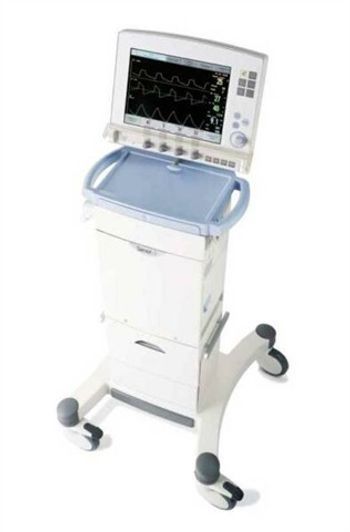
MAQUET Servo-i universal
 MAQUET · Model Servo-i universal
Neurally Adjusted Ventilatory Assist (NAVA) - Neurally controlled ventilation introducing SERVO-i with NAVA. A system that's as functional as your needs - Flexibility, efficiency and ease of training, operation and maintenance, are important considerations for any hospital. These are key factors in the design of SERVO-i. Comprehensive monitoring capabilities - The monitoring capabilities of SERVO-i are provided through a number of alternative waveforms such as Pressure, Flow, Volume and CO2 monitoring. The additional calculations of lung mechanics parameters include total PEEP, static and dynamic compliance, inspiratory/expiratory resistance, Shallow Breathing Index, Time Constant, Work of Breathing and P 0.1. Ventilation Record Card - The ventilation Record Card is the perfect tool for a clinician to facilitate research work and presentations. Automode® - The Automode option allows patient interaction. Set a controlled mode and let the ventilator adapt to the current patient situation, switching from controlled to supported breathing upon sensing a patient effort. It will also function the other way around. If the patient efforts become too feeble or disappear, the ventilator will switch to controlled ventilation. The control mode is initiated after an operator set time-out. This well-established mode provides smoother, safer patient transition. It provides documented shorter weaning times with less staff intervention. Open Lung Tool® - The Open Lung Tool provides an instrument for effectively determining the effect of a ventilator intervention. CO2 Analyzer - End tidal carbon dioxide measurement may give important insight into the efficiency of the ventilation. The minute production of CO2 will give a reliable indication of the metabolic load the patient is facing. CO2 can also be used as an indication of cardiac depression, which is especially helpful during recruitment maneuvers where high transpulmonary pressure may induce a fall in preload and Cardiac Output. NIV - The easy-to-use NIV option for infants and adults provide responsive and comfortable leakage compensation made possible by measuring and adjusting during the same breath, thus maintaining the set pressure to the patient. A waiting position from standby to start ventilation facilitate the work for the staff and increases patient comfort. The monitoring capabilities of the SERVO-i will enhance patient surveillance and guarantee smooth liberation from the ventilator. Nasal CPAP - Nasal CPAP provides noninvasive ventilation for patients from 0.5 to 10 kg. CPAP treatment improves oxygenation and recruits collapsed alveoli. The Nasal CPAP option optimizes patient comfort by maintaining a stable CPAP pressure and responding quickly to variations in pressure due to inhalation and exhalation. It is compatible with nasal prongs and nasal masks. Y-sensor measurement - This enables measurement of pressure and flow as close to the patient’s airway as possible. Based on fixed orifice technology, the sensor is small and gives a very low contribution to dead space volume (typically 0.75 ml for the neonatal/pediatric sensor). Y Sensors are available for neonatal/pediatric and adult patients.
Key tips
- ·Never disable a low-pressure/circuit-disconnect alarm while troubleshooting - silence it, don't disable it.
- ·Verify the O2 supply source and pressure before assuming an internal fault.
- ·Circuit type must match the patient population (adult/pediatric/neonatal) - a mismatched circuit invalidates delivered volumes.
Typical Failure Modes
Compiled for this model from its own documentation and established engineering knowledge for this equipment class - not from a verified service record. Confirm against the manufacturer's service manual.
Fails the pre-use self-test / circuit check
HighSymptoms: Self-test fault, circuit-leak or compliance-check failure, will not be released for use.
Root cause: Patient-circuit / expiratory-valve leak, a flow-sensor fault, an O2-cell fault, or an internal pneumatic fault.
Flow / volume delivery inaccurate
HighSymptoms: Delivered tidal volume or flow does not match the setting, or fails the annual verification.
Root cause: Flow-sensor drift / contamination, an inspiratory / expiratory valve fault, or a blender / proportioning-valve fault.
O2 / air supply or blender fault
MediumSymptoms: Low-supply alarm, FiO2 not matching the setting, O2-cell reads wrong.
Root cause: Wall / cylinder supply issue, an inlet filter / regulator fault, the blender, or an aged O2 cell.
PEEP not held / high circuit pressure
MediumSymptoms: PEEP drifts, auto-PEEP, high-pressure alarms, poor exhalation.
Root cause: Worn or wet expiratory valve / diaphragm, or a blocked exhalation path.
Battery / power fault
MediumSymptoms: Short internal-battery run time, will not charge, transfers to battery unexpectedly.
Root cause: Aged internal battery or a power-supply fault.
Turbine / compressor fault (turbine units)
MediumSymptoms: Noisy operation, cannot meet flow demand, turbine / compressor alarm.
Root cause: Worn turbine / compressor.
Serviceable Parts & Consumables
Serviceable items for this model, compiled from its documentation and engineering knowledge for this equipment class. Service class and relative cost are estimates, not manufacturer figures; no part numbers are given. Confirm intervals and pricing against the manufacturer.
Flow sensor(s)
Class Frequent wear itemRel. cost $$R&R Fairly easy
Expiratory valve / diaphragm
Class Frequent wear itemRel. cost $$R&R Fairly easy
O2 cell / sensor
Class Frequent wear itemRel. cost $$R&R Easy
Internal battery
Class Periodic replacementRel. cost $$R&R Fairly easy
Inlet filters / water traps
Class Frequent wear itemRel. cost $R&R Easy
Turbine / compressor (turbine units)
Class Major service partRel. cost $$$$R&R Difficult
| Part | Service class | Relative cost | R&R difficulty |
|---|---|---|---|
| Flow sensor(s) | Frequent wear item | $$ | Fairly easy |
| Expiratory valve / diaphragm | Frequent wear item | $$ | Fairly easy |
| O2 cell / sensor | Frequent wear item | $$ | Easy |
| Internal battery | Periodic replacement | $$ | Fairly easy |
| Inlet filters / water traps | Frequent wear item | $ | Easy |
| Turbine / compressor (turbine units) | Major service part | $$$$ | Difficult |
Relative cost: $ lowest · $$$$ highest service-part cost for this equipment class. Not a price.
PM Checklist
Preventive-maintenance tasks typical of this equipment class. Perform to the manufacturer's procedure and your facility's policy - this is general reference, not a schedule for this specific unit.
- ·Daily pre-use check: self-test, circuit integrity, alarm function
- ·Scheduled circuit and inspiratory filter replacement per manufacturer interval
- ·Flow and pressure sensor calibration verification
- ·Battery load test and runtime check
- ·Annual full PM and electrical safety test
Error Codes
Extracted directly from this unit's own service manual.
1 POWER_FAILURE_MINUS_12_VOLTS_TOO_LOWMonitoring error: Minus 12 volts too low
1. Check status of external battery (if connected). 2. Replace PC1778 Standard connectors & DC/DC.
2 POWER_FAILURE_MINUS_12_VOLTS_TOO_HIGHMonitoring error: Minus 12 volts too high
1. Replace PC1778 Standard connectors & DC/DC.
3 POWER_FAILURE_12_VOLTS_TOO_LOWMonitoring error: 12 volts too low
1. Check status of external battery (if connected). 2. Replace PC1778 Standard connectors & DC/DC.
4 POWER_FAILURE_12_VOLTS_TOO_HIGHMonitoring error: 12 volts too high
1. Replace PC1778 Standard connectors & DC/DC.
5 POWER_FAILURE_24_VOLTS_TOO_LOWMonitoring error: 24 volts too low
1. Replace PC1778 Standard connectors & DC/DC. 2. Replace gas modules.
6 POWER_FAILURE_24_VOLTS_TOO_HIGHMonitoring error: 24 volts too high
1. Replace PC1778 Standard connectors & DC/DC.
7 INSP_VALVE_RANGE_ERRMonitoring error: Inspiratory valve range error
1. Replace PC1771 Control. 2. Replace PC1772 Monitoring. 3. Replace gas modules.
8 TECH_ERR_INSP_PAUSE_HOLD_TIME_EXCEEDEDTechnical error: Inspiratory pause hold time exceeded
1. Replace PC1771 Control.
9 TECH_ERR_EXP_PAUSE_HOLD_TIME_EXCEEDEDTechnical error: Expiratory pause hold time exceeded
1. Replace PC1771 Control.
10 VALVES_DISABLEDValves disabled error
1. Replace PC1784 Expiratory channel. 2. Replace PC1771 Control. 3. Replace PC1778 Standard connectors & DC/DC.
11 SAFETY_VALVE_OPENSafety valve open error
1. Check inspiratory channel 2. Replace safety valve pull magnet. 3. Replace PC1784 Expiratory channel.
12 BRE_NODE_DISCONBreathing node disconnected
1. Replace PC1771 Control.
13 BRE_NODEID_CONFLICTBreathing node ID conflict
N/A
14 PANEL_NODE_DISCONPanel node disconnected
1. Check control cable 2. Replace PC1777 Panel.
15 PANEL_NODEID_CONFLICTPanel node ID conflict
N/A
16 EXP_FLOW_MTR_NODE_DISCONExpiratory flow meter node disconnected
1. Replace PC1784 Expiratory channel.
17 EXP_FLOW_MTR_NODEID_CONFLICTExpiratory flow meter node ID conflict
N/A
18 EXT_COM_DISCONExternal communication disconnected
N/A
19 EXT_COM_NODEID_CONFLICTExternal communication node ID conflict
N/A
22 BUZZER_SILENCERBuzzer silencer error
1. Replace PC1772 Monitoring.
24 BACKUP_CAP_ERR_MONBackup capacity error monitoring
1. Replace PC1772 Monitoring
25 TECH_MON_DEVICE_COMM_ERRTechnical monitoring device communication error
Depending on cause. If repeated, replace parts as follows: 0: PC 1770 Main back-plane. 1: PC 1772 Monitoring. 2: PC 1775 Plug-and-play back plane. 3: PC 1778 Standard connectors & DC/DC. 4: PC 1781 Inspiratory pressure transducer. 5: PC 1781 Expiratory pressure transducer. 6: O2 cell or O2 cell cable or PC 1772 Monitoring. 32: PC 1784 Expiratory channel or PC 1772 Monitoring. 33: Gas module Air or PC 1772 Monitoring. 34: Gas module O2 or PC 1772 Monitoring. 35: PC1772 Monitoring. 256: PC1771 Control. 512: PC 1777 Panel. 784: N/A 1024: PC 1784 Expiratory channel. 1025: PC 1786 Expiratory channel cassette.
26 TECH_ERR_INCONSISTENT_MAINS_FAILURETechnical error: Inconsistent mains failure
N/A
27 TECH_ERR_BUZZER_FAILURETechnical error: Buzzer failure
1. Replace PC1772 Monitoring. Note: If the Patient Unit front cover is removed, this error may be activated.
28 PANEL_AUDIO_FAILPanel audio failure
1. Replace loudspeaker. 2. Replace PC1777 Panel. Note: If the User Interface rear cover is removed, this error may be activated.
29 LITHIUM_BATTERY_LOWLithium battery low
1. Replace battery on PC1772 Monitoring.
30 BARO_PRESS_TOO_LOWBarometric pressure too low
1. Check/calibrate barometer. 2. Replace PC 1772 Monitoring. Note: This alarm will be activated if the ambient pressure is below 650 hPa, e.g. on a high altitude.
31 BARO_PRESS_TOO_HIGHBarometric pressure too high
1. Check/calibrate barometer. 2. Replace PC 1772 Monitoring.
32 ALARM_ID_MISMATCHAlarm ID mismatch
N/A
33 BRE_NODE_CONNECT_TIMEOUTBreathing node connect timeout
1. Replace PC1771 Control.
34 PANEL_NODE_CONNECT_TIMEOUTPanel node connect timeout
1. Check control cable. 2. Replace PC1777 Panel.
35 EXP_FLOW_MTR_NODE_CONNECT_TIMEOUTExpiratory flow meter node connect timeout
1. Replace PC1784 Expiratory channel.
37 EXP_FLOW_MTR_RANGE_ERRExpiratory flow meter range error
N/A
38 BARO_UPPER_LIMIT_EXCEEDEDBarometric upper limit exceeded
1. Technical error code corresponding to error code 30.
39 BARO_LOWER_LIMIT_EXCEEDEDBarometric lower limit exceeded
1. Technical error code corresponding to error code 31.
40 INVALID_METRICInvalid metric
N/A
41 REAL_TIME_CLOCK_ERRReal time clock error
1. Replace PC1772 Monitoring.
42 PERSISTENT_CHECKSUM_ERRPersistent checksum error
1. Restart the Servo…. 2. Replace 1772 Monitoring (if not LITHIUM_BATTERY_LOW).
43 POWER_COMM_ERRPower communication error
1. Check battery modules (if connected). 2. Replace PC1778 Standard connectors & DC/DC
44 ALARM_LIM_XOR_ERRAlarm limits XOR error
1. Restart the Servo…. 2. Replace 1772 Monitoring (if not LITHIUM_BATTERY_LOW).
10001 BATTERY_MIN_VOLTAGEBattery minimum voltage error
1. Replace battery on PC1771 Control.
10002 BRE_I2C_ERRORBreathing I2C error
1. Replace PC1771 Control.
10003 BRE_FATAL_MEMORY_ERRORBreathing fatal memory error
1. Restart the Servo…. 2. Replace PC1771 Control.
20001 PANEL_DEVICE_ERRORPanel device error
1. Replace PC1777 Panel.
20002 PANEL_BACKLIGHT_BROKENPanel backlight broken
1. Replace backlight lamps 2. Replace PC board Backlight Inverter
20003 PANEL_BUTTON_STUCKPanel button stuck
1. Check user interface membrane buttons. 2. Replace the touch screen. 3. Replace PC1777 Panel.
20004 PANEL_AUDIO_FAILEDPanel audio failed
1. Replace the loudspeaker 2. Replace PC1777 Panel.
Troubleshooting Approach
A starting sequence for this model, compiled from its documentation and engineering knowledge for this equipment class. Follow the manufacturer's service documentation for the actual procedure.
Symptom: Fails the pre-use self-test / circuit check
- Run the self-test with the exact circuit, filter and humidifier that will be used.
- Leak-test the circuit and the expiratory valve; fit fresh flow sensors and an O2 cell if due.
- Repeat the self-test and note which check fails.
- Calibrate the flow sensors and O2 cell per the manual.
- Remove from service and refer an internal pneumatic fault to the OEM / biomed.
Symptom: Delivered tidal volume / flow or FiO2 inaccurate
- Verify tidal volume and flow with a calibrated gas-flow analyser and FiO2 at the wye with an O2 analyser.
- Calibrate the flow sensors and the O2 cell.
- Inspect the inspiratory and expiratory valves / diaphragms.
- Check the air and O2 supply pressures and the inlet filters / water traps.
- Refer the blender / proportioning valve if the mix is still wrong.
Symptom: PEEP not held / high circuit-pressure or auto-PEEP
- Inspect the expiratory valve / diaphragm for wear or moisture and replace it.
- Check the exhalation path and the expiratory flow sensor.
- Confirm the circuit and water trap are not obstructed.
- Run the valve / compliance calibration.
- Re-verify PEEP against the analyser.
Symptom: Low-supply / O2 alarm or turbine / compressor fault
- Confirm wall / cylinder supply pressure and the inlet hose and filter.
- Check the internal blender / regulator.
- For a turbine unit, listen for turbine noise and check it can meet flow demand.
- Replace the O2 cell if the FiO2 reading is the issue.
- Refer the turbine / compressor for replacement if it cannot meet demand.
Technical Specs
- Height
- 415 mm (Patient Unit)
- Length
- 205 mm (Patient Unti
- Weight
- 15 kg (Patient Unit)
- Width
- 300 mm (Patient Unit)
Typical Location
Where this class of equipment is typically deployed - general reference, not this unit's own placement record.
- ICU / CCU
- Emergency Department
- Operating Room (anesthesia-adjacent)
- NICU
- Respiratory Therapy department
- Patient transport
Documents & Manuals
Related calculators
From BioLab, for work done with this kind of equipment.
Troubleshoot this device with Bio
Describe a symptom or error code. Bio answers from this device's own documented error codes, failure modes, parts, and guides.
Ask Bio