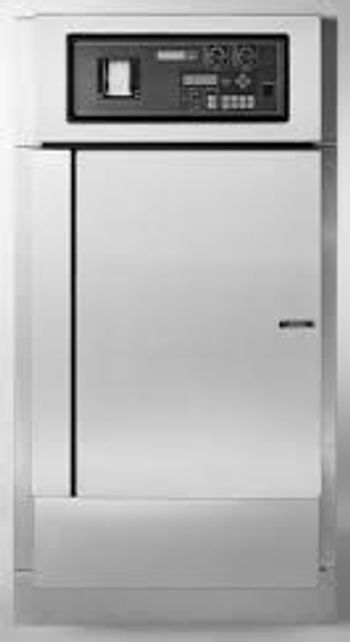
Getinge Castle 233 HC
 Getinge · Model Castle 233 HC
Vacuum and Gravity Steam Sterilizer for Healthcare Applications A microcomputer-controlled automatic steam sterilizer with six preprogrammed cycles that are operator selectable. The cycles employ either pre-vacuum conditioning by a series of pressure/vacuum pulses or gravity (downward displacement) with positive pulsing conditioning. Both processes dynamically remove air. All cycles are microprocessor controlled and pre-set at the factory. Times and temperatures are adjustable. There are up to 12 cycles, 6 of which are configurable by our service representative during installation. Custom names, up to eight characters in length, can be designated for each configured cycle. All cycle phases are sequenced and monitored by the control system, providing both audible and visual notification of deviation from certain operating parameters. For general-purpose pre-vacuum or gravity steam sterilization of hospital supplies, the temperature range is from 230°F to 275°F (110°C to 135°C). The temperature range for liquid cycles is from 219°F to 275°F (104°C to 135°C). Typical applications include wrapped and unwrapped hard goods, gowns or towel packs and liquids in self-venting or unsealed containers. The liquid exhaust is microcomputer controlled for linear and consistent liquid cool-down rate, which is programmable.
Key tips
- ·A failed biological indicator means the entire load is not sterile - no exceptions, regardless of how the cycle printout looks.
- ·Door gasket wear is the most common real cause of a failed vacuum/pressure test - check it before deeper diagnostics.
- ·Water quality directly affects steam-cycle validity - don't ignore scale or mineral buildup.
Typical Failure Modes
Compiled for this model from its own documentation and established engineering knowledge for this equipment class - not from a verified service record. Confirm against the manufacturer's service manual.
Cycle fault / will not reach sterilization parameters
HighSymptoms: Cycle aborts, temperature or pressure not reached / held, failed BI or chemical indicator.
Root cause: Heater / element fault, a door-gasket leak, a steam-generation or water-fill fault, a blocked chamber drain / strainer, or a temperature / pressure-sensor fault.
Door / gasket seal fault
MediumSymptoms: Steam leak at the door, door will not seal, lock or unlock, pressure will not build.
Root cause: Worn door gasket or a door-lock / interlock fault.
Poor drying / wet packs
MediumSymptoms: Instruments / packs come out wet.
Root cause: Drying-phase vacuum / heater fault, an overloaded chamber, or a clogged drain.
Water / reservoir / feedwater fault
MediumSymptoms: Low-water alarm, mineral scale, cloudy chamber, poor steam quality.
Root cause: Empty or scaled reservoir, a fill-valve / pump fault, or use of non-distilled water.
Steam-trap / air-removal / vacuum fault
MediumSymptoms: Failed Bowie-Dick / air-removal test, slow come-up, air pockets.
Root cause: Blocked steam trap, a vacuum-pump / ejector fault, or a check-valve fault.
Printer / recorder fault
LowSymptoms: No or faint cycle printout.
Root cause: Thermal print head or paper.
Serviceable Parts & Consumables
Serviceable items for this model, compiled from its documentation and engineering knowledge for this equipment class. Service class and relative cost are estimates, not manufacturer figures; no part numbers are given. Confirm intervals and pricing against the manufacturer.
Door gasket
Class Periodic replacementRel. cost $$R&R Fairly easy
Heating element / steam-generator element
Class Major service partRel. cost $$$R&R Difficult
Chamber / feedwater strainer & fill valve
Class Periodic replacementRel. cost $$R&R Moderate
Temperature / pressure sensor
Class Major service partRel. cost $$R&R Moderate
Steam trap / solenoid & check valves
Class Periodic replacementRel. cost $$R&R Moderate
Thermal print head / paper
Class Periodic replacementRel. cost $R&R Fairly easy
| Part | Service class | Relative cost | R&R difficulty |
|---|---|---|---|
| Door gasket | Periodic replacement | $$ | Fairly easy |
| Heating element / steam-generator element | Major service part | $$$ | Difficult |
| Chamber / feedwater strainer & fill valve | Periodic replacement | $$ | Moderate |
| Temperature / pressure sensor | Major service part | $$ | Moderate |
| Steam trap / solenoid & check valves | Periodic replacement | $$ | Moderate |
| Thermal print head / paper | Periodic replacement | $ | Fairly easy |
Relative cost: $ lowest · $$$$ highest service-part cost for this equipment class. Not a price.
PM Checklist
Preventive-maintenance tasks typical of this equipment class. Perform to the manufacturer's procedure and your facility's policy - this is general reference, not a schedule for this specific unit.
- ·Daily biological and chemical indicator test loads
- ·Door gasket / seal inspection
- ·Steam trap and drain strainer cleaning
- ·Annual full PM and pressure-vessel certification
Troubleshooting Approach
A starting sequence for this model, compiled from its documentation and engineering knowledge for this equipment class. Follow the manufacturer's service documentation for the actual procedure.
Symptom: Cycle aborts / fails / will not reach sterilization parameters
- Note the exact fault code / message and the phase it aborted in (heat-up, sterilise, exhaust, dry).
- Confirm the reservoir has distilled / deionised water and the feedwater path, fill valve and chamber strainer are clear.
- Inspect the door gasket for a steam leak and confirm the door lock / interlock; replace a worn gasket.
- Compare the displayed temperature and pressure to independent calibrated references; check the sensor and its calibration.
- Replace the failed element / valve / sensor as isolated, then run a biological indicator and a leak / Bowie-Dick test before returning to use.
Symptom: Wet packs / poor drying
- Reduce the load and re-space it so steam and air can move around every pack.
- Check the drying-phase vacuum and the door-open / drying setting.
- Clean the chamber drain and strainer.
- Confirm the steam trap and check valves are not blocked.
- Confirm packaging is drying-compatible and re-run, inspecting for dryness.
Symptom: Failed Bowie-Dick / air-removal or leak-rate test
- Run the automated leak-rate (vacuum-decay) test.
- Inspect and replace the door gasket; check all chamber fittings and the door-seal channel.
- Check the vacuum pump / ejector and the air / water separator.
- Clear a blocked steam trap or check valve.
- Re-run the Bowie-Dick test after the repair.
Technical Specs
- Orientation
- Floor Standing
Typical Location
Where this class of equipment is typically deployed - general reference, not this unit's own placement record.
- Central Sterile Supply Department (CSSD)
- OR sterile core
- Satellite reprocessing areas
Documents & Manuals
Troubleshoot this device with Bio
Describe a symptom or error code. Bio answers from this device's own documented error codes, failure modes, parts, and guides.
Ask Bio