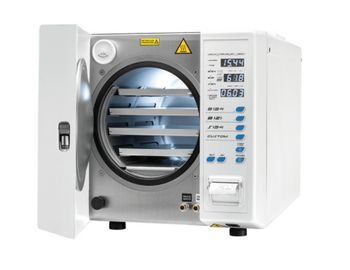
DXP Domina
 DXP · Model Domina
Autoclave DXP Domina has been designed based on the essential features a modern autoclave must be able to offer professionals and their team. This is clear from the moment you observe its elegant, compact design. Able to guarantee class B and class S sterilization cycles with impressive flexibility, it’s only through time that all this autoclave’s qualities really become evident, however. The most important of these is reliability, because DXP Domina is extremely robust, and the prime-quality materials and selected components reduce maintenance and therefore costs to a minimum. Paired with energy efficiency and low consumption, this makes DXP an autoclave capable of being inexpensive and environmentally-friendly at the same time.
Key tips
- ·A failed biological indicator means the entire load is not sterile - no exceptions, regardless of how the cycle printout looks.
- ·Door gasket wear is the most common real cause of a failed vacuum/pressure test - check it before deeper diagnostics.
- ·Water quality directly affects steam-cycle validity - don't ignore scale or mineral buildup.
Typical Failure Modes
Compiled for this model from its own documentation and established engineering knowledge for this equipment class - not from a verified service record. Confirm against the manufacturer's service manual.
Cycle fault / will not reach sterilization parameters
HighSymptoms: Cycle aborts, temperature or pressure not reached / held, failed BI or chemical indicator.
Root cause: Heater / element fault, a door-gasket leak, a steam-generation or water-fill fault, a blocked chamber drain / strainer, or a temperature / pressure-sensor fault.
Door / gasket seal fault
MediumSymptoms: Steam leak at the door, door will not seal, lock or unlock, pressure will not build.
Root cause: Worn door gasket or a door-lock / interlock fault.
Poor drying / wet packs
MediumSymptoms: Instruments / packs come out wet.
Root cause: Drying-phase vacuum / heater fault, an overloaded chamber, or a clogged drain.
Water / reservoir / feedwater fault
MediumSymptoms: Low-water alarm, mineral scale, cloudy chamber, poor steam quality.
Root cause: Empty or scaled reservoir, a fill-valve / pump fault, or use of non-distilled water.
Steam-trap / air-removal / vacuum fault
MediumSymptoms: Failed Bowie-Dick / air-removal test, slow come-up, air pockets.
Root cause: Blocked steam trap, a vacuum-pump / ejector fault, or a check-valve fault.
Printer / recorder fault
LowSymptoms: No or faint cycle printout.
Root cause: Thermal print head or paper.
Serviceable Parts & Consumables
Serviceable items for this model, compiled from its documentation and engineering knowledge for this equipment class. Service class and relative cost are estimates, not manufacturer figures; no part numbers are given. Confirm intervals and pricing against the manufacturer.
Door gasket
Class Periodic replacementRel. cost $$R&R Fairly easy
Heating element / steam-generator element
Class Major service partRel. cost $$$R&R Difficult
Chamber / feedwater strainer & fill valve
Class Periodic replacementRel. cost $$R&R Moderate
Temperature / pressure sensor
Class Major service partRel. cost $$R&R Moderate
Steam trap / solenoid & check valves
Class Periodic replacementRel. cost $$R&R Moderate
Thermal print head / paper
Class Periodic replacementRel. cost $R&R Fairly easy
| Part | Service class | Relative cost | R&R difficulty |
|---|---|---|---|
| Door gasket | Periodic replacement | $$ | Fairly easy |
| Heating element / steam-generator element | Major service part | $$$ | Difficult |
| Chamber / feedwater strainer & fill valve | Periodic replacement | $$ | Moderate |
| Temperature / pressure sensor | Major service part | $$ | Moderate |
| Steam trap / solenoid & check valves | Periodic replacement | $$ | Moderate |
| Thermal print head / paper | Periodic replacement | $ | Fairly easy |
Relative cost: $ lowest · $$$$ highest service-part cost for this equipment class. Not a price.
PM Checklist
Preventive-maintenance tasks typical of this equipment class. Perform to the manufacturer's procedure and your facility's policy - this is general reference, not a schedule for this specific unit.
- ·Daily biological and chemical indicator test loads
- ·Door gasket / seal inspection
- ·Steam trap and drain strainer cleaning
- ·Annual full PM and pressure-vessel certification
Error Codes
Extracted directly from this unit's own service manual.
OPEN DOORDoor not opened at the end of the cycle. Start command entered with the door open.
Open the door. Close the door
FAILFailed cycle See table C
DRY FAILDrying phase not completed due to manual interference (the load has been removed be- fore the drying cycle completion). However the sterilization process has been achieved. Push the key STOP.
ADD H2OInsufficient water in the main tank (the mes- ssage appears before starting a cycle)
Top up the main tank.
FULL H2OThe used water tank is full (the message ap- appears before starting a cycle)
Drain the used water tank
MANU STOPCycle manually interrupted. Sterilization pro- cess not completed
Wipe the chamber ( if wet) and start again the cycle
BLAC OUTBlack-out occurred during the cycle
Check the AC plug and socket. Wipe the chamber and repeat the cycle.
NEED CLEANING60 cycles carried out from the last automatic cleaning cycle
Perform the automatic cleaning cycle (see Chapter 6.1)
NEED SERVICEOne year from the installation or over 1500 cycles performed without any service check-up
The warning message disappears as soon as a cycle is selected, but will appear again at the next switching on. Call for a complete check-up by a qualified technical service; the message will be reset after the servicing.
NEED INSTNeed for the installation procedure. Perform the installation procedure (see Chapter 3.2)
NEED TESTDetected a pre-warning alarm
See table B
cd 1Drain filter dirty
Clean or replace the filter
cd 2Slow heating of the top wall of the chamber
Perform a cycle with reduced load. In case, call for a technical service. Check the mains voltage.
cd 3Slow heating of the bottom wall of the chamber
Perform a cycle with reduced load. In case, call for a technical service. Check the mains voltage.
cd 4Water dose distributor clogged Water inlet filter dirty Impurities in the main tank .
Carry out the filter maintenance (see § 6.3). Carry out the automatic cleaning cycle (see 6.1)
cd 5Water entry valve dirty
If the problem occurs more than 3 times, call for a technical service
cd 6Bacterial filter clogged
Replace the filter
cd 7Vacuum phase too slow
Wipe the chamber and perform the automatic cleaning cycle (see § 6.1).
AL 1Electro-valve 1 faulty
Call for a technical service
AL 2Electro-valve 2 faulty
Call for a technical service
AL 3Electro-valve 3 faulty
Call for a technical service
AL 4Electro-valve 4 faulty
Call for a technical service
AL 5The pressure has not reached the set-point value within the preset time Overload or pressure weak.
Perform the automatic cleaning cycle (§ 6.1)
AL 6Too long time of the initial vacuum phase
Perform the automatic cleaning cycle ( § 6.1)
AL 7Door not properly locked
Make sure that the door is correctly closed.
AL 8Air into the sterilization chamber
Check the door tightness. Clean the gasket.
AL 9Stop of the countdown for over 60 sec. during the sterilization phase
Check the door tightness. Perform, if needed, the automatic cleaning cycle (see § 6.1), and the Vacuum Test.
AL 10Pressure too high
Call for a technical service.
AL 11Pressure too low
Check the door tightness. Perform, if needed, the automatic cleaning cycle (see § 6.1).
AL 13Chamber's temperature sensor faulty
Call for a technical service
AL 14Chamber's top wall temperature sensor faulty
Call for a technical service
AL 15Chamber's bottom wall temperature sensor faulty
Call for a technical service
AL 16Pressure sensor faulty
Call for a technical service
AL 18Drying phase Drying interrupted
Dry the load
AL 31Drying phase Vacuum not sufficient Excess of load
Troubleshooting Approach
A starting sequence for this model, compiled from its documentation and engineering knowledge for this equipment class. Follow the manufacturer's service documentation for the actual procedure.
Symptom: Cycle aborts / fails / will not reach sterilization parameters
- Note the exact fault code / message and the phase it aborted in (heat-up, sterilise, exhaust, dry).
- Confirm the reservoir has distilled / deionised water and the feedwater path, fill valve and chamber strainer are clear.
- Inspect the door gasket for a steam leak and confirm the door lock / interlock; replace a worn gasket.
- Compare the displayed temperature and pressure to independent calibrated references; check the sensor and its calibration.
- Replace the failed element / valve / sensor as isolated, then run a biological indicator and a leak / Bowie-Dick test before returning to use.
Symptom: Wet packs / poor drying
- Reduce the load and re-space it so steam and air can move around every pack.
- Check the drying-phase vacuum and the door-open / drying setting.
- Clean the chamber drain and strainer.
- Confirm the steam trap and check valves are not blocked.
- Confirm packaging is drying-compatible and re-run, inspecting for dryness.
Symptom: Failed Bowie-Dick / air-removal or leak-rate test
- Run the automated leak-rate (vacuum-decay) test.
- Inspect and replace the door gasket; check all chamber fittings and the door-seal channel.
- Check the vacuum pump / ejector and the air / water separator.
- Clear a blocked steam trap or check valve.
- Re-run the Bowie-Dick test after the repair.
Typical Location
Where this class of equipment is typically deployed - general reference, not this unit's own placement record.
- Central Sterile Supply Department (CSSD)
- OR sterile core
- Satellite reprocessing areas
Documents & Manuals
Troubleshoot this device with Bio
Describe a symptom or error code. Bio answers from this device's own documented error codes, failure modes, parts, and guides.
Ask Bio