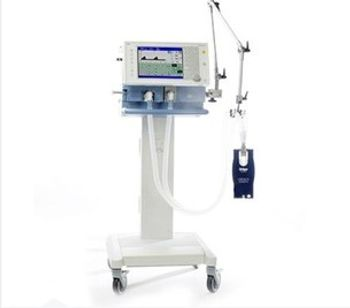
Draeger Evita 4
 Dräger · Model Evita 4
One ventilator for every patient population - Neonatal, pediatric, adult – Evita 4 can be used to ventilate any patient category, reducing the amount of staff training required and ensuring greater resource flexibility. Intuitive user interface - Configurable trends, loops, measured values, curves and logbook are displayed on the full-color screen for a complete customized overview of the ventilation therapy. The user-friendly display shows only the active control elements to ensure immediate recognition of the required settings. The robust touch screen combines highly flexible operation with direct access to rotary knobs and keys. Excellent weaning performance - PCV+/ BIPAPTM*, the universal mode for ventilation and weaning, gives a patient the freedom to breathe spontaneously at any time, reducing the need for sedation and invasiveness of ventilation to optimize the patient’s ability to wean off the ventilator. Automatic Tube Compensation (ATC™) gives a patient the feeling of virtual extubation by eliminating the work involved in breathing through an endotracheal tube, improving the weaning process. Conventional and mask ventilation - Mask ventilation can complement the weaning process by reducing the reintubation rate or even preventing intubation in the first place. The fact that Evita 4 offers the alternative of mask ventilation (NIV) means you only need one device for conventional and non-invasive ventilation. Upgradeability - Evita 4 is based on a concept of innovative continuity. The device’s modular design ensures upgradeability and upward compatibility while the user interface and sensors, for example, are based on the continuity principle to guarantee a high degree of familiarity. A record of innovation - The Evita 4 story has been marked by a series of advances in ventilation therapy, ATC was introduced in 1997 to achieve virtual extubation, NeoFlow in 1998 for neonatal ventilation, and NIV in 2001 to make mask and conventional ventilation possible from a single device. Safe investment - Even the first Evita 4 machines can be upgraded to include all the features of the latest models – clear evidence that Evita 4 is a good investment. Basic research - Dräger Medical still invests a significant proportion of its human and financial resources in basic research – because we know this is a vital prerequisite for innovation and will continue to be so in the future.
Key tips
- ·Never disable a low-pressure/circuit-disconnect alarm while troubleshooting - silence it, don't disable it.
- ·Verify the O2 supply source and pressure before assuming an internal fault.
- ·Circuit type must match the patient population (adult/pediatric/neonatal) - a mismatched circuit invalidates delivered volumes.
Typical Failure Modes
Compiled for this model from its own documentation and established engineering knowledge for this equipment class - not from a verified service record. Confirm against the manufacturer's service manual.
Fails the pre-use self-test / circuit check
HighSymptoms: Self-test fault, circuit-leak or compliance-check failure, will not be released for use.
Root cause: Patient-circuit / expiratory-valve leak, a flow-sensor fault, an O2-cell fault, or an internal pneumatic fault.
Flow / volume delivery inaccurate
HighSymptoms: Delivered tidal volume or flow does not match the setting, or fails the annual verification.
Root cause: Flow-sensor drift / contamination, an inspiratory / expiratory valve fault, or a blender / proportioning-valve fault.
O2 / air supply or blender fault
MediumSymptoms: Low-supply alarm, FiO2 not matching the setting, O2-cell reads wrong.
Root cause: Wall / cylinder supply issue, an inlet filter / regulator fault, the blender, or an aged O2 cell.
PEEP not held / high circuit pressure
MediumSymptoms: PEEP drifts, auto-PEEP, high-pressure alarms, poor exhalation.
Root cause: Worn or wet expiratory valve / diaphragm, or a blocked exhalation path.
Battery / power fault
MediumSymptoms: Short internal-battery run time, will not charge, transfers to battery unexpectedly.
Root cause: Aged internal battery or a power-supply fault.
Turbine / compressor fault (turbine units)
MediumSymptoms: Noisy operation, cannot meet flow demand, turbine / compressor alarm.
Root cause: Worn turbine / compressor.
Serviceable Parts & Consumables
Serviceable items for this model, compiled from its documentation and engineering knowledge for this equipment class. Service class and relative cost are estimates, not manufacturer figures; no part numbers are given. Confirm intervals and pricing against the manufacturer.
Flow sensor(s)
Class Frequent wear itemRel. cost $$R&R Fairly easy
Expiratory valve / diaphragm
Class Frequent wear itemRel. cost $$R&R Fairly easy
O2 cell / sensor
Class Frequent wear itemRel. cost $$R&R Easy
Internal battery
Class Periodic replacementRel. cost $$R&R Fairly easy
Inlet filters / water traps
Class Frequent wear itemRel. cost $R&R Easy
Turbine / compressor (turbine units)
Class Major service partRel. cost $$$$R&R Difficult
| Part | Service class | Relative cost | R&R difficulty |
|---|---|---|---|
| Flow sensor(s) | Frequent wear item | $$ | Fairly easy |
| Expiratory valve / diaphragm | Frequent wear item | $$ | Fairly easy |
| O2 cell / sensor | Frequent wear item | $$ | Easy |
| Internal battery | Periodic replacement | $$ | Fairly easy |
| Inlet filters / water traps | Frequent wear item | $ | Easy |
| Turbine / compressor (turbine units) | Major service part | $$$$ | Difficult |
Relative cost: $ lowest · $$$$ highest service-part cost for this equipment class. Not a price.
PM Checklist
Preventive-maintenance tasks typical of this equipment class. Perform to the manufacturer's procedure and your facility's policy - this is general reference, not a schedule for this specific unit.
- ·Daily pre-use check: self-test, circuit integrity, alarm function
- ·Scheduled circuit and inspiratory filter replacement per manufacturer interval
- ·Flow and pressure sensor calibration verification
- ·Battery load test and runtime check
- ·Annual full PM and electrical safety test
Troubleshooting Approach
A starting sequence for this model, compiled from its documentation and engineering knowledge for this equipment class. Follow the manufacturer's service documentation for the actual procedure.
Symptom: Fails the pre-use self-test
- Run the self-test with the exact circuit and humidifier that will be used.
- Leak-test the circuit and the expiratory valve; fit fresh flow sensors and an O2 cell if due.
- Repeat the self-test.
- Calibrate the O2 cell and flow sensors per the manual.
- Remove from service and refer an internal pneumatic fault to the OEM / biomed.
Symptom: Delivered volume or FiO2 wrong
- Verify tidal volume / flow with a calibrated gas-flow analyser and FiO2 with an analyser at the wye.
- Calibrate the flow sensors and O2 cell.
- Inspect the inspiratory / expiratory valves.
- Check the air / O2 supply pressures and inlet filters.
- Refer the blender / proportioning valve for service if the mix is still wrong.
Typical Location
Where this class of equipment is typically deployed - general reference, not this unit's own placement record.
- ICU / CCU
- Emergency Department
- Operating Room (anesthesia-adjacent)
- NICU
- Respiratory Therapy department
- Patient transport
Documents & Manuals
Related calculators
From BioLab, for work done with this kind of equipment.
Troubleshoot this device with Bio
Describe a symptom or error code. Bio answers from this device's own documented error codes, failure modes, parts, and guides.
Ask Bio