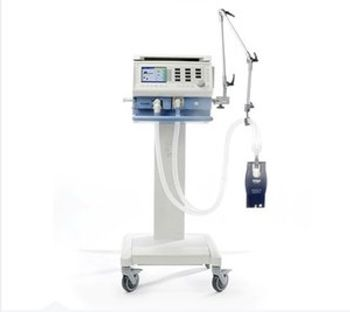
Draeger Evita 2 Dura
 Dräger · Model Evita 2 Dura
Spontaneous breathing strategy - One of Evita 2 dura’s strengths is its implementation of our "Room to Breathe" concept. Spontaneous breathing reduces the risk of atelectasis and improves the ventilation/perfusion ratio by maintaining a higher functional residual capacity. BIPAPTM*/PCV+, the universal mode for ventilation and weaning, gives a patient the freedom to breathe spontaneously at any time. AutoFlow®, the next step in volume-oriented ventilation, encourages spontaneous breathing in all volume modes and another option, Automatic Tube Compensation (ATC), gives a patient the feeling of virtual extubation by eliminating the work involved in breathing with a tracheal tube. The right mode for every patient - Since an Evita 2 dura can be used to ventilate neonatal, pediatric or adult patients, it is the ideal “workhorse” for everyday clinical routine. The wide range of patients covered also reduces the amount of staff training required and ensures a greater flexibility in the use of resources. Two-in-one ventilation - Mask ventilation can assist the weaning process by reducing the reintubation rate or even preventing intubation in the first place. The option of mask ventilation (NIV) adds to an Evita 2 dura’s versatility so an ICU only requires one device for conventional and non-invasive ventilation. Everything in view - The Evita 2 dura provides patient and ventilator-related monitoring with user interaction reduced to a minimum. The high-resolution full-color screen displays comprehensive information on a patient’s status, always showing two ventilation curves and six monitored values, and the screen configuration can be customized to show the most important values for a particular ICU. One knob, simplified settings - This ventilator has a clearly arranged front panel consisting of a monitoring screen and various setting soft keys. The rotary knob plays a key role. The active setting parameters are visible at a glance and changes can be made by the well-established “select-adjust-confirm” principle. Ventilation at a glance - The principle of only showing the necessary parameters reduces the complexity of everyday monitoring. Additional functions are located in the various screen menus. The ventilator provides you with a full-text message in the event of alarms so you have a clear idea of the problem. Simpler and speedier standard procedures - The Evita 2 dura contains numerous functions to speed up and simplify routine procedures. Start-up settings can be configured to specific ICU practices. Suction procedures are simplified with the touch of a button, the exhalation valve can be changed in seconds to minimize downtime and sensors are automatically calibrated daily. However, manual calibration is also possible without interruption to ventilation. All these functions assist in reducing time for standard procedures.
Key tips
- ·Never disable a low-pressure/circuit-disconnect alarm while troubleshooting - silence it, don't disable it.
- ·Verify the O2 supply source and pressure before assuming an internal fault.
- ·Circuit type must match the patient population (adult/pediatric/neonatal) - a mismatched circuit invalidates delivered volumes.
Typical Failure Modes
Compiled for this model from its own documentation and established engineering knowledge for this equipment class - not from a verified service record. Confirm against the manufacturer's service manual.
Fails the pre-use self-test / circuit check
HighSymptoms: Self-test fault, circuit-leak or compliance-check failure, will not be released for use.
Root cause: Patient-circuit / expiratory-valve leak, a flow-sensor fault, an O2-cell fault, or an internal pneumatic fault.
Flow / volume delivery inaccurate
HighSymptoms: Delivered tidal volume or flow does not match the setting, or fails the annual verification.
Root cause: Flow-sensor drift / contamination, an inspiratory / expiratory valve fault, or a blender / proportioning-valve fault.
O2 / air supply or blender fault
MediumSymptoms: Low-supply alarm, FiO2 not matching the setting, O2-cell reads wrong.
Root cause: Wall / cylinder supply issue, an inlet filter / regulator fault, the blender, or an aged O2 cell.
PEEP not held / high circuit pressure
MediumSymptoms: PEEP drifts, auto-PEEP, high-pressure alarms, poor exhalation.
Root cause: Worn or wet expiratory valve / diaphragm, or a blocked exhalation path.
Battery / power fault
MediumSymptoms: Short internal-battery run time, will not charge, transfers to battery unexpectedly.
Root cause: Aged internal battery or a power-supply fault.
Turbine / compressor fault (turbine units)
MediumSymptoms: Noisy operation, cannot meet flow demand, turbine / compressor alarm.
Root cause: Worn turbine / compressor.
Serviceable Parts & Consumables
Serviceable items for this model, compiled from its documentation and engineering knowledge for this equipment class. Service class and relative cost are estimates, not manufacturer figures; no part numbers are given. Confirm intervals and pricing against the manufacturer.
Flow sensor(s)
Class Frequent wear itemRel. cost $$R&R Fairly easy
Expiratory valve / diaphragm
Class Frequent wear itemRel. cost $$R&R Fairly easy
O2 cell / sensor
Class Frequent wear itemRel. cost $$R&R Easy
Internal battery
Class Periodic replacementRel. cost $$R&R Fairly easy
Inlet filters / water traps
Class Frequent wear itemRel. cost $R&R Easy
Turbine / compressor (turbine units)
Class Major service partRel. cost $$$$R&R Difficult
| Part | Service class | Relative cost | R&R difficulty |
|---|---|---|---|
| Flow sensor(s) | Frequent wear item | $$ | Fairly easy |
| Expiratory valve / diaphragm | Frequent wear item | $$ | Fairly easy |
| O2 cell / sensor | Frequent wear item | $$ | Easy |
| Internal battery | Periodic replacement | $$ | Fairly easy |
| Inlet filters / water traps | Frequent wear item | $ | Easy |
| Turbine / compressor (turbine units) | Major service part | $$$$ | Difficult |
Relative cost: $ lowest · $$$$ highest service-part cost for this equipment class. Not a price.
PM Checklist
Preventive-maintenance tasks typical of this equipment class. Perform to the manufacturer's procedure and your facility's policy - this is general reference, not a schedule for this specific unit.
- ·Daily pre-use check: self-test, circuit integrity, alarm function
- ·Scheduled circuit and inspiratory filter replacement per manufacturer interval
- ·Flow and pressure sensor calibration verification
- ·Battery load test and runtime check
- ·Annual full PM and electrical safety test
Error Codes
Extracted directly from this unit's own service manual.
!!! ApnoeaThe red LED flashes. Warning messages are marked with three exclamation marks. Example: !!! Apnoea. Evita 2 dura generates a five-tone sequence that is sounded twice and repeated every 7 seconds.
! Malfunction fanCaution messages are marked with one exclamation mark. Example: ! Malfunction fan. Evita 2 dura generates a 2-tone sequence that sounds only once.
Troubleshooting Approach
A starting sequence for this model, compiled from its documentation and engineering knowledge for this equipment class. Follow the manufacturer's service documentation for the actual procedure.
Symptom: Fails the pre-use self-test / circuit check
- Run the self-test with the exact circuit, filter and humidifier that will be used.
- Leak-test the circuit and the expiratory valve; fit fresh flow sensors and an O2 cell if due.
- Repeat the self-test and note which check fails.
- Calibrate the flow sensors and O2 cell per the manual.
- Remove from service and refer an internal pneumatic fault to the OEM / biomed.
Symptom: Delivered tidal volume / flow or FiO2 inaccurate
- Verify tidal volume and flow with a calibrated gas-flow analyser and FiO2 at the wye with an O2 analyser.
- Calibrate the flow sensors and the O2 cell.
- Inspect the inspiratory and expiratory valves / diaphragms.
- Check the air and O2 supply pressures and the inlet filters / water traps.
- Refer the blender / proportioning valve if the mix is still wrong.
Symptom: PEEP not held / high circuit-pressure or auto-PEEP
- Inspect the expiratory valve / diaphragm for wear or moisture and replace it.
- Check the exhalation path and the expiratory flow sensor.
- Confirm the circuit and water trap are not obstructed.
- Run the valve / compliance calibration.
- Re-verify PEEP against the analyser.
Symptom: Low-supply / O2 alarm or turbine / compressor fault
- Confirm wall / cylinder supply pressure and the inlet hose and filter.
- Check the internal blender / regulator.
- For a turbine unit, listen for turbine noise and check it can meet flow demand.
- Replace the O2 cell if the FiO2 reading is the issue.
- Refer the turbine / compressor for replacement if it cannot meet demand.
Typical Location
Where this class of equipment is typically deployed - general reference, not this unit's own placement record.
- ICU / CCU
- Emergency Department
- Operating Room (anesthesia-adjacent)
- NICU
- Respiratory Therapy department
- Patient transport
Documents & Manuals
Related calculators
From BioLab, for work done with this kind of equipment.
Troubleshoot this device with Bio
Describe a symptom or error code. Bio answers from this device's own documented error codes, failure modes, parts, and guides.
Ask Bio