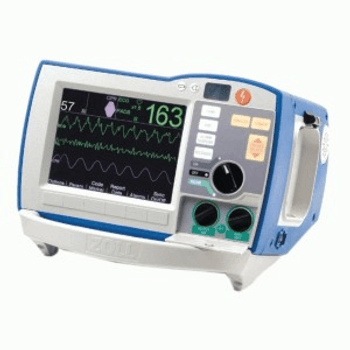
Zoll R Series Plus

The R Series is a reliable and affordable option for those who need pacing options that are easy to use and understand. The ECG electrodes are incorporated with an anterior OneStep electrode. The electrodes are triangular and incorporate a circular multi-function therapy electrode in the middle, and three ECG electrodes at the ends of the triangular electrode pad shape. The ECG electrodes are used to monitor the electrical activity of the heart, and the anterior OneStep electrode is used to deliver electrical therapy to the heart.
Key tips
- ·Never skip the daily/shift ready-check - a defibrillator found dead during a code is a real, repeated root-cause finding.
- ·Pads and batteries have real expiration dates - check them on every PM, not just at annual service.
- ·Verify energy-delivery accuracy with a real defibrillator analyzer, not just a self-test pass.
Typical Failure Modes
Compiled for this model from its own documentation and established engineering knowledge for this equipment class - not from a verified service record. Confirm against the manufacturer's service manual.
Fails the delivered-energy / discharge test
HighSymptoms: Delivered energy outside tolerance on the analyser, will not charge, or charges slowly.
Root cause: HV capacitor / charging-circuit ageing, or an output-relay fault.
Battery will not hold charge / fails readiness
HighSymptoms: Short standby, readiness indicator shows service, unit fails the self-test on battery.
Root cause: Aged battery pack or a charging fault.
Therapy cable / pads or paddles fault
MediumSymptoms: "Check pads", "connect electrodes", no ECG through pads, poor paceing capture.
Root cause: Worn therapy cable, expired pads, or a paddle / connector fault.
ECG / SpO2 / NIBP / CO2 parameter fault (defib-monitors)
MediumSymptoms: A monitoring parameter drops or is implausible.
Root cause: Patient cable / sensor or the parameter module.
Recorder / data fault
LowSymptoms: No printout, event data will not transfer.
Root cause: Thermal recorder or the data / Wi-Fi interface.
Serviceable Parts & Consumables
Serviceable items for this model, compiled from its documentation and engineering knowledge for this equipment class. Service class and relative cost are estimates, not manufacturer figures; no part numbers are given. Confirm intervals and pricing against the manufacturer.
Battery pack
Class Periodic replacementRel. cost $$R&R Easy
Therapy / defib cable
Class Periodic replacementRel. cost $$R&R Fairly easy
Multifunction pads
Class Frequent wear itemRel. cost $R&R Easy
HV / charging board
Class Major service partRel. cost $$$$R&R Difficult
Thermal recorder / print head
Class Periodic replacementRel. cost $$R&R Fairly easy
| Part | Service class | Relative cost | R&R difficulty |
|---|---|---|---|
| Battery pack | Periodic replacement | $$ | Easy |
| Therapy / defib cable | Periodic replacement | $$ | Fairly easy |
| Multifunction pads | Frequent wear item | $ | Easy |
| HV / charging board | Major service part | $$$$ | Difficult |
| Thermal recorder / print head | Periodic replacement | $$ | Fairly easy |
Relative cost: $ lowest · $$$$ highest service-part cost for this equipment class. Not a price.
PM Checklist
Preventive-maintenance tasks typical of this equipment class. Perform to the manufacturer's procedure and your facility's policy - this is general reference, not a schedule for this specific unit.
- ·Daily/shift visual and self-test check (AAMI EQ56 daily-ready standard)
- ·Battery and pad expiration-date tracking
- ·Energy-delivery accuracy test against a defibrillator analyzer
- ·Paddle/cable continuity check
- ·Annual full PM
Error Codes
Extracted directly from this unit's own service manual.
NOISY ECGThe unit detects a noisy ECG signal during ECG analysis.
Check and adjust electrode placement and cable connections to help eliminate the noise source. Keep patient motionless during ECG analysis. Press the ANALYZE button again to begin ECG analysis.
CHECK PATIENTThe unit has detected a shockable rhythm during continuous background ECG analysis (i.e., Smart Alarms™). The prompt is given only when the heart rate alarms are enabled and the unit detects a shockable rhythm. The screen message persists as long as a shockable rhythm is being detected.
Press the ANALYZE button to begin ECG analysis.
DEFIB PAD SHORTA short circuit exists between the electrodes.
Not specified in text.
TRANSFER FAILED - Server RejectionThe server rejected the unit's request.
Contact the Network Administrator for assistance.
Troubleshooting Approach
A starting sequence for this model, compiled from its documentation and engineering knowledge for this equipment class. Follow the manufacturer's service documentation for the actual procedure.
Symptom: Fails the delivered-energy / discharge test or charges slowly
- Run the full delivered-energy test at several settings into a defib analyser.
- Test synchronised cardioversion and, if fitted, pacing capture and output.
- Inspect the therapy cable and paddles / pads connector.
- If energy is out of tolerance or charge time is long, remove from service.
- Refer the HV / charging board and capacitor to the OEM.
Symptom: Fails readiness / self-test or dies on battery
- Fit a fully charged battery and repeat the self-test.
- Run a battery capacity / calibration cycle.
- Check the charger, the charging contacts and the auto-test log.
- Replace the battery pack when capacity is low.
- Record a passing readiness self-test before returning to service.
Symptom: "Check pads / connect electrodes" or no ECG through pads
- Fit fresh, in-date pads and confirm the connector seats fully.
- Swap the therapy cable.
- Check ECG through pads and through the 3/5-lead cable on a simulator.
- Inspect the pads port for damage.
- Replace the therapy cable; refer the front end if both paths fail.
Symptom: A monitoring parameter (ECG / SpO2 / NIBP / CO2) drops or is implausible
- Reseat and swap the patient cable / sensor for that parameter.
- Verify against a simulator.
- Check the parameter module connection.
- Update the device software if a known issue applies.
- Refer the parameter module as isolated.
Typical Location
Where this class of equipment is typically deployed - general reference, not this unit's own placement record.
- Crash carts (every unit)
- Emergency Department
- ICU
- OR
- Code-blue response areas
Documents & Manuals
Troubleshoot this device with Bio
Describe a symptom or error code. Bio answers from this device's own documented error codes, failure modes, parts, and guides.
Ask Bio