Class II
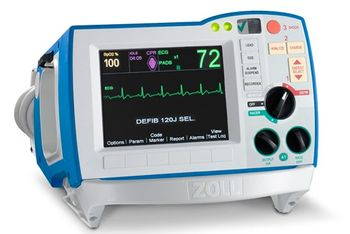
ZOLL R Series Defibrillator/Monitor

Uniform Operating System between the two models Shares common electrodes, cables, paddles, and batteries Only one therapy cable needed for defibrillation, cardioversion and pacing no separate 3 lead cable required. Real CPR Help® to coach to the proper compression rate and depth during CPR as well as See-Thru CPR® to minimize pauses during CPR compressions The only defibrillator that recognizes the OneStep Pediatric electrode and automatically lowers the energy setting to 50J to prevent accidental overdose of energy Defibrillator event documentation via internal memory, as well as a removable Compact Flash card for easy data transfer and archiving. Conducts an automated self-test once a day. Patented external pacing offers superior capture at lower mean thresholds, reducing muscle artifact and ensuring more patient comfort and better patient tolerance.
Key tips
- ·Never skip the daily/shift ready-check - a defibrillator found dead during a code is a real, repeated root-cause finding.
- ·Pads and batteries have real expiration dates - check them on every PM, not just at annual service.
- ·Verify energy-delivery accuracy with a real defibrillator analyzer, not just a self-test pass.
Typical Failure Modes
Compiled for this model from its own documentation and established engineering knowledge for this equipment class - not from a verified service record. Confirm against the manufacturer's service manual.
Error message on the display
HighSymptoms: A named error on the display, function inhibited (defib, pacing, or a parameter).
Root cause: The R Series Service Manual lists each error and the technician action - a stuck key, a module, a cable, or a board.
Defibrillation / pacing energy delivery fault
HighSymptoms: Will not charge / pace, charges slowly, or delivered energy fails the analyser test.
Root cause: HV charging circuit, capacitor, or the therapy-cable / paddle path.
Battery will not hold charge / not recognised
HighSymptoms: Short run time, low-battery early, battery-fault indication.
Root cause: Aged SurePower battery pack, or a charging-system fault.
Parameter fault (ECG / SpO2 / NIBP / EtCO2)
MediumSymptoms: Noisy or absent trace, no reading, NIBP times out.
Root cause: Worn patient cable / sensor, or a parameter-module fault.
Printer fault
LowSymptoms: No or faint strip, paper jam.
Root cause: Thermal print head or paper handling.
Serviceable Parts & Consumables
Serviceable items for this model, compiled from its documentation and engineering knowledge for this equipment class. Service class and relative cost are estimates, not manufacturer figures; no part numbers are given. Confirm intervals and pricing against the manufacturer.
SurePower battery pack
Class Periodic replacementRel. cost $$$R&R Easy
Therapy cable / paddles
Class Periodic replacementRel. cost $$$R&R Easy
ECG / SpO2 / EtCO2 accessories
Class Periodic replacementRel. cost $$R&R Easy
NIBP cuff and hose
Class Frequent wear itemRel. cost $R&R Easy
Thermal print head / paper
Class Periodic replacementRel. cost $R&R Fairly easy
| Part | Service class | Relative cost | R&R difficulty |
|---|---|---|---|
| SurePower battery pack | Periodic replacement | $$$ | Easy |
| Therapy cable / paddles | Periodic replacement | $$$ | Easy |
| ECG / SpO2 / EtCO2 accessories | Periodic replacement | $$ | Easy |
| NIBP cuff and hose | Frequent wear item | $ | Easy |
| Thermal print head / paper | Periodic replacement | $ | Fairly easy |
Relative cost: $ lowest · $$$$ highest service-part cost for this equipment class. Not a price.
PM Checklist
Preventive-maintenance tasks typical of this equipment class. Perform to the manufacturer's procedure and your facility's policy - this is general reference, not a schedule for this specific unit.
- ·Daily/shift visual and self-test check (AAMI EQ56 daily-ready standard)
- ·Battery and pad expiration-date tracking
- ·Energy-delivery accuracy test against a defibrillator analyzer
- ·Paddle/cable continuity check
- ·Annual full PM
Error Codes
Extracted directly from this unit's own service manual.
ALARM SETALARM SET status message when setting alarms.
ANALYSIS HALTEDECG analysis halted due to user interaction such as: Lead/size change Analyze button was pressed again Impedance fault Charging error detected in auto defib mode
ASYNC PACE ONLYPosted along with other faults. Indicates that the PD module cannot detect sync pulses.
ATTACH PADSAED: No pads on Auto Defib power-up. Verify proper OneStep cable/hands-free therapy electrode connection by disconnecting and reconnecting the OneStep cable and hands-free therapy-electrodes.
AUDIO QUEUE FULLIndicates that the audio output queue is full. Additional voice prompts can't be queued at this time. None.
BATT HIGH CURRENTBattery is not charged and battery current is greater than 1.6 A. Replace battery or AC charger.
BATT HIGH VOLTAGEIndicates that the charger voltage is too high. Replace battery or AC charger.
BATT LOW VOLTAGEIndicates that the charger voltage is too low. Replace battery or AC charger.
BATTERY COMMS ERRORBattery is not communicating with the host. Replace battery interconnect board.
BATTERY FAULTReplace battery.
BATTERY ID FAULTReplace battery.
CAL. BARO. PRESSUREBarometric pressure reading is out of range. Calibrate the barometric pressure.
CALIBRATE NIBPNIBP calibration is incomplete or failed. Cycle power and retry; if problem persist calibrate NIBP system.
CANNOT CHARGECannot charge when charge button pressed. Replace high voltage module or capacitor. R Series Service Manual 9650-0903-01 Rev. L 2-3
CF TRANSFER FAILEDSummary/DVCK/ALOG data file transfer error – either no CF card or CF card transfer failed Reseat CF Communication cable or replace Communication Module.
CHANGE LEADSUnit is in Defib Sync mode and heart rate is less than 20 BPM.
CHARGE FAILEDUnit failed to perform the requested charge. Replace PD Engineer or Analog Board.
CHECK CO2 ADAPTERAirway adapter is removed, occluded or adapter zeroing needs to be performed or was performed incorrectly. Replace/Clean airway adapter. Zeroing performed automatically.
CHECK CO2 SENSOREtCO 2 Sensor is unplugged or defective. Check that sensor cable is plugged in and seated properly. Check that sensor is not exposed to excessive heat. If problem persists, replace the sensor.
CHECK CUFF/HOSEBlood pressure cuff or hose is not installed correctly. Cuff or hose is faulty. Hose is kinked or disconnected. Inflation rate too fast or too slow. Verify the hose and cuff is properly connected and not leaking. Replace cuff and hose. Replace NIBP module or parameter power supply.
CHECK ECG CABLEInvalid ECG cable Id is detected. Verify that the ECG Cable is property connected. Replace ECG Cable. Replace Analog Board.
CHECK ELECTRODEEither Can read ID Chip or the checksum failed. Replace Electrodes or replace Analog board.
CHECK PADSMessage displayed in conjunction with either POOR PAD CONTACT or DEFIB PAD SHORT. Ensure pads are coupled to patient. Check/ replace pads and universal cable. Replace system board.
CHECK PATIENTBackground ECG analysis detects shockable rhythm.
CHECK PULSEAlternate message for NO SHOCK ADV. message, or displayed in addition to it according to the configuration option selected. Also shown after delivering last shock when Auto Analyze option is enabled. R Series Service Manual 2-4 9650-0903-01 Rev. L
CHECK RECORDERProduced when paper tray is empty, paper jams or recorder door is opened.
CHECK SPO2 SENSORReposition SpO 2 sensor on patient.
CLOCK BATTERY FAULTThe RTC coin battery has failed. Replace lithium coin battery or digital board.
CLOCK FAULT 11Real time clock oscillator failure Replace lithium coin battery or digital board.
CLOCK FAULT 12Real time clock back-up power supply failure. Found oscillator stopped at power-up, but oscillator now running when the system is running (oscillator only runs when main power is applied). Replace lithium coin battery or digital board.
CLOCK FAULT 13One of the set time units (seconds, minutes, year, etc.) is out of range. Replace lithium coin battery or digital board.
CO2 COMM ERRORNo or invalid communication from the EtCO2 module. Replace EtCO 2 module and or system board.
CO2 DEVICE NOT READYThere is CO 2 in the airway adapter when attempting to zero. Zeroing was attempted within 20 seconds of previous zero operation. Remove airway adapter from CO 2 source including the patient’s, and your own exhaled breaths, and ventilator exhaust valves. Wait up to 20 seconds before retrying a mainstream airway adapter zero, as described in “Zeroing the Mainstream CAPNOSTAT 5 CO2 Sensor/Airway Adapter” CO2 IN LINE: WAIT Adapter zero attempted with CO2 in the adapter.
CO2 MODULE NOT VALIDSidestream sensor connected (not supported by the R Series unit’s operating software) Use mainstream sensor.
CO2 UNIT ERRORThe EtCO 2 sensor or module has detected a hardware error. Check that the sensor is properly plugged in. Re-insert the sensor. Turn R Series unit off, then on again to reset. perform a mainstream airway adapter or module zero, as described in “Zeroing the Mainstream CAPNOSTAT 5 CO2 Sensor/ Airway Adapter”. If the problem persists, contact ZOLL Technical Support.
CO2 WARM UPThe mainstream sensor is warming up. This may take up to 5 minutes. Wait for sensor or module to warm up. If the message persists more than 5 minutes, replace the sensor.
CPR FAULT 8ECG processor not receiving CPR data Replace analog board.
DATA TRANSFERREDTransfer done message
DEFIB DISABLEDUser prompt issued simultaneously with other faults if defib is disabled. Possible configuration problem. Replace high voltage module. Call ZOLL Technical Support.
DEFIB FAULT 76PD Defib failure during POST. Replace PD engine.
DEFIB FAULT 77PD Defib failure while running. Replace PD engine.
DEFIB FAULT 78PD Defib functional safety error while running. Replace PD engine.
DEFIB FAULT 79PD module Defib/Pace failure during POST. Replace PD engine.
DEFIB FAULT 80Undefined error received from the PD module. Replace PD engine.
DEFIB FAULT 94PD module reset 3 times without being requested to. Replace PD engine.
DEFIB FAULT 95PD module not communicating. Replace PD engine.
DEFIB FAULT 96PD module reported an error on the discharge. Replace PD engine.
DEFIB MAINT. REQ.More than 5000 discharges of 200J have occurred. Maintenance is required. Replace PD engine. R Series Service Manual 2-6 9650-0903-01 Rev. L
DEFIB NOT CHARGEDDischarge button is pressed in a Defib mode but the unit is not charged.
DEFIB OVERUSEMore than 50 shocks were delivered in less than 20 minutes. Unit needs to cool down, wait approximately 5 minutes.
DEFIB PAD SHORTMeasured impedance between high voltage leads of MFC. Ensure pads are coupled to patient. Check/ replace pads or universal cable. Replace system board.
DISK FORMAT REQ.Report error if any problem with DOC file access occurred. Replace digital board.
ECG DISABLEDPersistent Critical Hardware Failure on ECG module. Replace analog board.
ECG FAULT 200No ECG applicable available. Reload MCU Software and ECG App. Software.
ECG FAULT 3ECG processor reset failure. Replace analog board.
ECG FAULT 4Excessive number of missed samples from ECG processor. Replace analog board.
ECG FAULT 5ECG processor power up failure. Replace analog board.
ECG FAULT 6ECG processor Hardware failure. Replace analog board.
ECG FAULT 7ECG processor is not responding. Replace analog board.
Troubleshooting Approach
A starting sequence for this model, compiled from its documentation and engineering knowledge for this equipment class. Follow the manufacturer's service documentation for the actual procedure.
Symptom: Error message on the display
- Note the exact error text.
- Look it up in the R Series Service Manual error-message table and follow the Technical Action column.
- Power-cycle to clear transient faults.
- Verify defib / pacing energy with a defibrillator analyser.
- Contact ZOLL Technical Service if the error is not listed or persists.
Symptom: Defib / battery problem
- Fully charge an in-date SurePower pack and check its status.
- Verify defib / pacing energy with a defibrillator analyser at several levels.
- Swap in a second known-good battery.
- Confirm the charger brings the pack to full.
- Remove from service and refer to ZOLL if energy delivery or self-test fails.
Technical Specs
- Energy
- Up to 200 J biphasic rectangular waveform
- Modes
- Manual defib, AED, pacing, 12-lead ECG, SpO2, NIBP, EtCO2
- IP rating
- IP55 splash resistant
- Battery
- Duointelligent battery with runtime gauge
Typical Location
Where this class of equipment is typically deployed - general reference, not this unit's own placement record.
- Crash carts (every unit)
- Emergency Department
- ICU
- OR
- Code-blue response areas
Documents & Manuals
Troubleshoot this device with Bio
Describe a symptom or error code. Bio answers from this device's own documented error codes, failure modes, parts, and guides.
Ask Bio