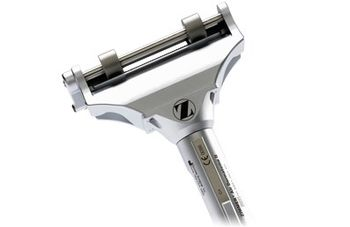
Zimmer Air Dermatome
 Zimmer · Model Air Dermatome
Exceptional maneuverability with less hand fatigue Graft thicknesses up to.030 inch (0.76mm) in easily adjustable.002 inch (0.05mm) increments Safety lever to help prevent accidental activation Width plates range from one to four inches (2.5 to 10cm) in one inch increments Blades are supplied sterile and don’t require lubrication 5,000 – 6,000 cycles/minute high speed cutting action.
Key tips
- ·Never defeat or bypass a return-electrode monitoring (REM) alarm to finish a case - it's a direct burn risk.
- ·Verify OR table battery backup - a table that loses power mid-procedure is a real, documented incident type.
- ·Track surgical light lamp-hours rather than waiting for failure - a sudden failure mid-case is avoidable.
Typical Failure Modes
Compiled for this model from its own documentation and established engineering knowledge for this equipment class - not from a verified service record. Confirm against the manufacturer's service manual.
Weak or no power / stalls under load
HighSymptoms: Handpiece runs slow, stalls when drilling / cutting, or does not run at all.
Root cause: Worn motor / turbine, worn gears / bearings, a low or aged battery, or (pneumatic) low supply pressure / a worn hose.
Overheats in use
MediumSymptoms: Handpiece or attachment gets hot quickly, burn / thermal-necrosis risk.
Root cause: Worn bearings / gears, a dry / seized attachment, or over-duty use.
Battery will not hold charge (battery tools)
HighSymptoms: Few cases per charge, will not reach full charge, sudden shutdown.
Root cause: Aged battery pack or a charger fault.
Chuck / coupling / attachment fault
MediumSymptoms: Bur / blade / pin slips or will not lock, attachment wobbles, quick-coupler worn.
Root cause: Worn chuck / collet or coupling.
Trigger / control fault
MediumSymptoms: Speed will not vary, forward/reverse or oscillate will not select, trigger sticks.
Root cause: Worn trigger / control mechanism or its seals.
Serviceable Parts & Consumables
Serviceable items for this model, compiled from its documentation and engineering knowledge for this equipment class. Service class and relative cost are estimates, not manufacturer figures; no part numbers are given. Confirm intervals and pricing against the manufacturer.
Motor / turbine assembly
Class Periodic replacementRel. cost $$$R&R Difficult
Gear / bearing service kit
Class Periodic replacementRel. cost $$R&R Difficult
Battery pack (battery tools)
Class Periodic replacementRel. cost $$$R&R Fairly easy
Chuck / collet / quick-coupler
Class Periodic replacementRel. cost $$R&R Moderate
Trigger / seal kit
Class Periodic replacementRel. cost $$R&R Moderate
| Part | Service class | Relative cost | R&R difficulty |
|---|---|---|---|
| Motor / turbine assembly | Periodic replacement | $$$ | Difficult |
| Gear / bearing service kit | Periodic replacement | $$ | Difficult |
| Battery pack (battery tools) | Periodic replacement | $$$ | Fairly easy |
| Chuck / collet / quick-coupler | Periodic replacement | $$ | Moderate |
| Trigger / seal kit | Periodic replacement | $$ | Moderate |
Relative cost: $ lowest · $$$$ highest service-part cost for this equipment class. Not a price.
PM Checklist
Preventive-maintenance tasks typical of this equipment class. Perform to the manufacturer's procedure and your facility's policy - this is general reference, not a schedule for this specific unit.
- ·Pre-case functional check
- ·Electrosurgical return-electrode cable inspection
- ·Table hydraulic / mechanical inspection
- ·Annual electrical safety test and full PM
Troubleshooting Approach
A starting sequence for this model, compiled from its documentation and engineering knowledge for this equipment class. Follow the manufacturer's service documentation for the actual procedure.
Symptom: No or low RF output / high-impedance cut-out
- Confirm good electrode-tissue contact and an adequately wetted field.
- Inspect the handpiece / instrument and its cable for damage; substitute a known-good one.
- Check the split dispersive (return) pad is well applied over well-perfused muscle with a sound cable.
- Verify output into a resistive test load with an electrosurgical analyser.
- Replace the RF output board and recalibrate on a non-conductive surface if output is confirmed absent (anti-static handling).
Symptom: Return-electrode (REM / NESSY / CQM) contact-quality alarm
- Re-apply a fresh split dispersive pad with full skin contact.
- Check the pad cable and its connector.
- Try a known-good pad.
- Run the contact-quality-monitor calibration with a good pad fitted.
- Refer the CQM circuit if it still alarms.
Symptom: Output will not activate from the footswitch or handswitch
- Test the other activation method to isolate the pedal from the handpiece.
- Inspect the footswitch and its cable / connector for damage or moisture.
- Check the handswitch leads on the handpiece.
- Substitute a known-good footswitch.
- Refer the activation input board if both methods fail.
Symptom: Fails calibration / output drifts after a repair
- Verify cut and coag output at several settings into a test load with an analyser.
- Verify the REM / CQM circuit against its spec.
- Recalibrate per the service manual on a non-conductive bench with anti-static precautions.
- Check the cooling fan and thermal path.
- Re-verify all outputs and the REM alarm before returning to service.
Typical Location
Where this class of equipment is typically deployed - general reference, not this unit's own placement record.
- Operating rooms
- Procedure rooms
- Interventional suites
Documents & Manuals
Safety & Recalls
Synced live from the FDA openFDA API.
- RECALL
The devices may have a misaligned thickness control bar.
- RECALL
Skin grafts thin and non-uniform when using the affected blades. The issue would be identified at the time of use and may result in the need for additional harvests to adequately cover the area
- RECALL
Zimmer Biomet Surgical has received product complaints reporting that the surface coating applied to the device is blistering, peeling and discoloring after usage over time (see Image 1). There have been no injuries associated with the reported complaints. In addition, an independent assessment determined that the blistering, peeling and potentially flaking of the surface coating is not expected to result in any long range health consequences. Given that the frequency of this surface coating condition can worsen with age, Zimmer Biomet Surgical is currently making preparations for replacement activities to follow in order to prevent future complaints. This document is provided to alert all users of the potential for the surface coating to exhibit blistering, peeling, and discoloring after usage over time. A separate recall removal notice will be issued to facilities, in phases, with deta
- RECALL
The surface coating applied to the device is blistering, peeling and discoloring after usage over time
- RECALL
Non-injury complaints from Europe identified a malfunction that made it possible for a handpiece to start by itself when the power source is connected.
- RECALL
This removal is in response to complaints alleging that the Zimmer Air Dermatomes and Zimmer Air Dermatome II products would either not operate or operate intermittently. Zimmer's investigation determined that the planetary gear teeth were broken. This may cause a delay or postponement of the surgery or result in a suboptimal graft retrieval with potential of requiring an additional donor site.
Troubleshoot this device with Bio
Describe a symptom or error code. Bio answers from this device's own documented error codes, failure modes, parts, and guides.
Ask Bio