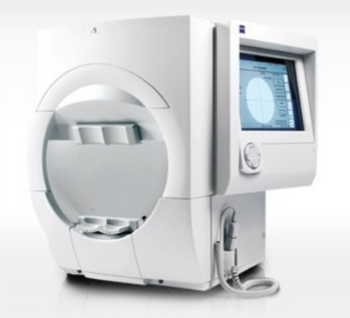
ZEISS HFA II-i
 ZEISS · Model HFA II-i
Gaze tracking is a unique fixation tracking system that records if patient is fixating properly while each stimulus is presented. Head tracking ensures proper alignment of the head and eye relative to the trial lens holder. Video eye monitoring helps to position the test eye in the center of the trial lens holder and monitor the patient during testing. Vertex monitoring uses the distance between two corneal reflexes to determine if the patient has moved too far back from the trial lens. The software will flag the movement and ask the operator to realign the patient or re-initialize the system. SITA Standard: A threshold testing method which collects the same amount of information in half the time as the original Humphrey® Full Threshold standard algorithm, without compromising test reproducibility. SITA Fast: A threshold testing method that collects the same amount of information in half the time as FastPac, without compromising test reproducibility.
Key tips
- ·Verify laser output with a real power meter, not the unit's own display - the display can drift independently of true output.
- ·Take "the image looks a little off" reports seriously - optical alignment drift is usually gradual, not sudden.
Typical Failure Modes
Compiled for this model from its own documentation and established engineering knowledge for this equipment class - not from a verified service record. Confirm against the manufacturer's service manual.
Projection / stimulus fault
HighSymptoms: Stimuli not projected, wrong intensity, or the bowl illumination is uneven; patient cannot see the fixation target.
Root cause: Projection lamp / bowl-illumination lamp at end of life, a filter-wheel / shutter fault, or the projection-mirror galvo.
Gaze / eye-tracking / fixation-monitor fault
MediumSymptoms: Excessive fixation losses, gaze tracker will not calibrate, video eye monitor blank.
Root cause: Eye-monitor camera / IR illuminator, or the trial-lens holder position.
Patient-response / trial-lens-holder fault
MediumSymptoms: Response-button presses not registered, trial-lens holder will not move to position.
Root cause: Response button / cable, or the trial-lens-holder drive.
Printer / data / connectivity fault
MediumSymptoms: No printout, tests will not save or transfer to FORUM / the review software.
Root cause: Printer, storage, or network configuration.
Chin-rest / head-positioning motor fault
LowSymptoms: Chin rest will not move to command.
Root cause: Chin-rest drive motor or its control.
Serviceable Parts & Consumables
Serviceable items for this model, compiled from its documentation and engineering knowledge for this equipment class. Service class and relative cost are estimates, not manufacturer figures; no part numbers are given. Confirm intervals and pricing against the manufacturer.
Projection / bowl-illumination lamp
Class Periodic replacementRel. cost $$R&R Moderate
Filter wheel / shutter assembly
Class Major service partRel. cost $$$R&R Difficult
Eye-monitor camera / IR illuminator
Class Major service partRel. cost $$R&R Moderate
Trial-lens-holder / chin-rest drive
Class Major service partRel. cost $$R&R Moderate
Printer
Class Periodic replacementRel. cost $$R&R Fairly easy
| Part | Service class | Relative cost | R&R difficulty |
|---|---|---|---|
| Projection / bowl-illumination lamp | Periodic replacement | $$ | Moderate |
| Filter wheel / shutter assembly | Major service part | $$$ | Difficult |
| Eye-monitor camera / IR illuminator | Major service part | $$ | Moderate |
| Trial-lens-holder / chin-rest drive | Major service part | $$ | Moderate |
| Printer | Periodic replacement | $$ | Fairly easy |
Relative cost: $ lowest · $$$$ highest service-part cost for this equipment class. Not a price.
PM Checklist
Preventive-maintenance tasks typical of this equipment class. Perform to the manufacturer's procedure and your facility's policy - this is general reference, not a schedule for this specific unit.
- ·Optical alignment / calibration check
- ·Lamp or laser output verification
- ·Annual full PM
Error Codes
Extracted directly from this unit's own service manual.
130009A value stored within the EEPROM is out of tolerance.
1) Print out the Cal/Wedge printout. Look for the phrase "INVALID DATA" beneath NVM Data. Recalibrate as required. 2) If equipped with Blue-Yellow, recalibrate the Wedge calibration first, and then recalibrate the Blue Correction second.
% 1 thru % 14Motor, Flag or Illumination Errors
%81 thru %93Flash Memory Loader Errors
Troubleshooting Approach
A starting sequence for this model, compiled from its documentation and engineering knowledge for this equipment class. Follow the manufacturer's service documentation for the actual procedure.
Symptom: Projection / stimulus fault
- Confirm the bowl illumination is even and the fixation target is visible.
- Replace the projection / bowl-illumination lamp if dim or out.
- Run the instrument's self-test / calibration.
- Check the filter wheel and shutter operate.
- Escalate a galvo / projection-mirror fault to ZEISS service (consult Field Service Bulletins).
Symptom: Gaze / fixation-monitor fault
- Confirm the patient is correctly positioned at the chin rest with the correct trial lens.
- Clean the eye-monitor camera window.
- Re-run gaze-tracker initialization / calibration.
- Check the eye-monitor camera and IR illuminator.
- Replace the camera module if calibration still fails.
Typical Location
Where this class of equipment is typically deployed - general reference, not this unit's own placement record.
- Eye clinic / ophthalmology suite
- Operating Room (ophthalmic surgery)
Documents & Manuals
Troubleshoot this device with Bio
Describe a symptom or error code. Bio answers from this device's own documented error codes, failure modes, parts, and guides.
Ask Bio