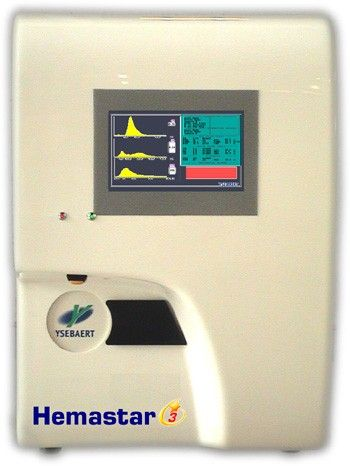
Ysebaert Hema Star 3
 Ysebaert · Model Hema Star 3
Allows user to archive more than 1 million results with patient identifications. A smart system of solenoid valves combined with a unique automatic cleaning system makes this virtually maintenance-free. Large colour display, the Hema Star 3 is easy-to-use and really user-friendly. All the functions are so simply accessible that you’ll get used to and enjoy it a few minutes! The analysis of 8 different species, with preset normal ranges. Reliable and repeatable results, the software, integrated in the instrument, draws and prints the histograms of the red and white blood cells, as well as the platelets which threshold is adjusted automatically. The software contains a system of alarms and warnings enabled in case of pathological results. The level of the isotonic diluent, lyse and detergent are indicated. The function errors are also indicated. It is possible to carry out veterinary analysis thanks to the specific program included in the software. Just by pressing a single button, the full CBC is made within 1 minute. The software gives detailed results from few microliters of blood: RBC, WBC, Hgb, Hct, MCV, etc. (see technical characteristics). Some automatic alarms allow the detection of anomalies in the cell population (such as eosinophils, basophils, lymphocytes, RBC and platelets) for a perfect diagnosis.
Key tips
- ·Run QC controls before trusting any repair - an analyzer that passes self-test can still report clinically wrong results.
- ·Rule out a reagent lot change before opening the instrument - it can look exactly like a hardware fault.
- ·Centrifuge rotors have a hard retirement age/cycle limit regardless of visible condition - don't eyeball it.
Typical Failure Modes
Compiled for this model from its own documentation and established engineering knowledge for this equipment class - not from a verified service record. Confirm against the manufacturer's service manual.
Aperture / flow-cell blockage or partial obstruction
HighSymptoms: Flagged or implausible CBC counts, voteouts, clog alarms, poor precision.
Root cause: Debris or a clot partially blocking a counting aperture or the flow cell.
Sample probe / piercer / valve wear
MediumSymptoms: Short samples, aspiration errors, cap-piercing failures, carryover.
Root cause: Worn or bent sample probe / closed-vial piercer, or a worn shear / segment valve.
Reagent / lyse delivery fault
MediumSymptoms: WBC, HGB or diff results shifted, high background, reagent alarms.
Root cause: Reagent depleted or wrong lot, or a pinch-valve / tubing fault.
Optics / laser fault (diff)
MediumSymptoms: Diff scattergrams abnormal, missing populations, flow-cell or laser alarm.
Root cause: Contaminated or aged flow cell, or the laser / optics.
Vacuum / pressure out of range
MediumSymptoms: Multiple parameter errors, priming failures.
Root cause: Pump or regulator drift.
Serviceable Parts & Consumables
Serviceable items for this model, compiled from its documentation and engineering knowledge for this equipment class. Service class and relative cost are estimates, not manufacturer figures; no part numbers are given. Confirm intervals and pricing against the manufacturer.
Sample probe / closed-vial piercer
Class Periodic replacementRel. cost $$R&R Moderate
Shear / segment valve
Class Periodic replacementRel. cost $$$R&R Difficult
Pinch-valve / peristaltic tubing
Class Frequent wear itemRel. cost $R&R Moderate
Flow cell
Class Periodic replacementRel. cost $$$R&R Difficult
System reagents / controls
Class ConsumableRel. cost $$R&R Easy
| Part | Service class | Relative cost | R&R difficulty |
|---|---|---|---|
| Sample probe / closed-vial piercer | Periodic replacement | $$ | Moderate |
| Shear / segment valve | Periodic replacement | $$$ | Difficult |
| Pinch-valve / peristaltic tubing | Frequent wear item | $ | Moderate |
| Flow cell | Periodic replacement | $$$ | Difficult |
| System reagents / controls | Consumable | $$ | Easy |
Relative cost: $ lowest · $$$$ highest service-part cost for this equipment class. Not a price.
PM Checklist
Preventive-maintenance tasks typical of this equipment class. Perform to the manufacturer's procedure and your facility's policy - this is general reference, not a schedule for this specific unit.
- ·Daily QC controls run and reviewed
- ·Calibration verification per assay
- ·Routine cleaning and decontamination
- ·Scheduled reagent-path and pump-tubing maintenance
Troubleshooting Approach
A starting sequence for this model, compiled from its documentation and engineering knowledge for this equipment class. Follow the manufacturer's service documentation for the actual procedure.
Symptom: Clog alarm or flagged counts
- Run the instrument's aperture / flow-cell clear and flush cycles.
- Run a background count and confirm it is within limits.
- Run controls at all levels.
- Clean or replace the aperture bath / flow cell if clogs recur.
- Confirm precision on a replicate sample before releasing results.
Symptom: Short samples or aspiration errors
- Inspect the sample probe / piercer for wear or a bend.
- Check the shear / segment valve and tubing for leaks or wear.
- Verify vacuum and pressure against the service spec.
- Replace the probe / piercer, valve or tubing as found.
- Re-run controls.
Typical Location
Where this class of equipment is typically deployed - general reference, not this unit's own placement record.
- Central / core laboratory
- Point-of-care testing stations
- Blood bank
- Microbiology lab
Documents & Manuals
Related calculators
From BioLab, for work done with this kind of equipment.
Troubleshoot this device with Bio
Describe a symptom or error code. Bio answers from this device's own documented error codes, failure modes, parts, and guides.
Ask Bio