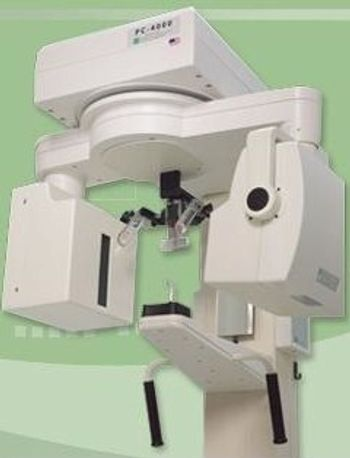
Panoramic Corporation
YOUNG PS ACQUISITION, LLC · Model PC-4000
Unit, X-ray, Extraoral with Timer- PC-4000.
Intended use: A diagnostic dental x-ray system designed for permanent fixture in one location to generate and control x-ray beams. It records the absorption pattern of x-ray beams used for general-purpose, routine, dental radiography examinations involving the diagnosis and treatment (e.g., surgical or interventional) of diseases of the teeth, jaw and oral cavity structures. The sensor is placed outside the mouth, the purpose being to visualize the entire mouth area showing teeth on both the upper and lower jaws. The data is either from analogue imaging and digitized afterwards or by digital imaging.
Key tips
- ·Never bypass a radiation interlock to "just get the image" - this is one of the few true zero-tolerance rules in BMET work.
- ·Trend image-quality phantom results over time - drift shows up before an outright failure does.
- ·Portable/mobile units take real physical abuse from transport - check wheel locks and cable strain reliefs more often than fixed units.
Typical Failure Modes
Compiled for this model from its own documentation and established engineering knowledge for this equipment class - not from a verified service record. Confirm against the manufacturer's service manual.
No or inconsistent exposure
HighSymptoms: No image, exposure will not trigger, images consistently under- or over-exposed, error code.
Root cause: Tube-head fault, an exposure-switch / timer fault, HV / generator fault, or a sensor / PSP-plate fault.
Sensor / imaging-plate fault (digital)
MediumSymptoms: Dead lines, artefacts, no image from the sensor, PSP plate scratched / fogged.
Root cause: Damaged intraoral sensor / cable, or worn PSP plates.
Pano / CBCT motion or reconstruction fault
MediumSymptoms: Blurred or distorted panoramic image, layer / focal-trough errors, reconstruction fails.
Root cause: Rotation drive / belt / encoder, patient-positioning error, or the reconstruction PC.
Tube-arm / balance fault
MediumSymptoms: Tube head drifts, will not stay positioned, arm joints loose.
Root cause: Worn arm springs / friction joints.
Software / acquisition fault
LowSymptoms: Images will not acquire, save or display in the practice-management software.
Root cause: TWAIN / driver, the acquisition PC, or the software.
Serviceable Parts & Consumables
Serviceable items for this model, compiled from its documentation and engineering knowledge for this equipment class. Service class and relative cost are estimates, not manufacturer figures; no part numbers are given. Confirm intervals and pricing against the manufacturer.
Intraoral sensor & cable / PSP plates
Class Periodic replacementRel. cost $$$R&R Fairly easy
Tube head / HV components
Class Major service partRel. cost $$$$R&R Difficult
Exposure switch / timer board
Class Major service partRel. cost $$R&R Moderate
Pano rotation drive / belt / encoder
Class Major service partRel. cost $$$R&R Difficult
Tube-arm spring / friction-joint kit
Class Major service partRel. cost $$R&R Moderate
| Part | Service class | Relative cost | R&R difficulty |
|---|---|---|---|
| Intraoral sensor & cable / PSP plates | Periodic replacement | $$$ | Fairly easy |
| Tube head / HV components | Major service part | $$$$ | Difficult |
| Exposure switch / timer board | Major service part | $$ | Moderate |
| Pano rotation drive / belt / encoder | Major service part | $$$ | Difficult |
| Tube-arm spring / friction-joint kit | Major service part | $$ | Moderate |
Relative cost: $ lowest · $$$$ highest service-part cost for this equipment class. Not a price.
PM Checklist
Preventive-maintenance tasks typical of this equipment class. Perform to the manufacturer's procedure and your facility's policy - this is general reference, not a schedule for this specific unit.
- ·Daily QC per modality: image-quality phantom test
- ·Tube and detector inspection
- ·Annual state-required radiation safety survey
- ·Vendor-scheduled preventive maintenance
Troubleshooting Approach
A starting sequence for this model, compiled from its documentation and engineering knowledge for this equipment class. Follow the manufacturer's service documentation for the actual procedure.
Symptom: No or inconsistent exposure
- Confirm the exposure switch is held for the full exposure and the door / warning light works.
- Check the selected technique factors and any error code.
- Test the sensor / plate on a phantom.
- Verify tube output and timer accuracy with a dental X-ray meter.
- Escalate a confirmed tube-head / HV fault to the OEM.
Symptom: Poor sensor or pano image
- Swap in a known-good sensor / fresh PSP plate.
- Inspect the sensor cable for kinks / breaks.
- For pano, confirm patient positioning and the focal trough / layer selection.
- Run any image-calibration routine.
- Replace the sensor or refer the pano drive as isolated.
Technical Specs
- X-ray Type
- Digital
- MRI safety
- Labeling does not contain MRI Safety Information
- Sterile
- No
- Single use
- No
- FDA distribution status
- In Commercial Distribution
- Device type (GMDN)
- Stationary extraoral dental x-ray system, digital
- FDA product classification
- Unit, X-Ray, Extraoral With Timer
Typical Location
Where this class of equipment is typically deployed - general reference, not this unit's own placement record.
- Radiology / Imaging department
- Emergency Department (portable units)
- Operating Room (C-arms)
- Cath lab
- Bedside ICU (portable X-ray)
Documents & Manuals
Troubleshoot this device with Bio
Describe a symptom or error code. Bio answers from this device's own documented error codes, failure modes, parts, and guides.
Ask Bio