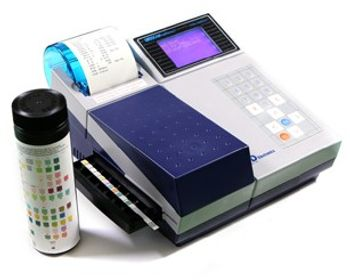
YD Diagnostics URiSCAN Optima II
 YD Diagnostics · Model URiSCAN Optima II
Software available in English, German, Spanish, Italian, Polish, French, Chinese and Russian Memory capacity: 1000 test results Simple calibration Easy data management & various data printing format Workable with 4-11 parameter strips Reflection photometer: CCD color image sensor and LED for light source Color and clarity reading available Two different test modes: Routine Test Mode, Quick Test Mode Easy access to review test results Automatic memory function (Memory: up to 1,000 test results) Simple Id management (Registration via keyboard, barcode reader or PC) Communication interface With host computer by RS232C port Automatic selection of 8 different strip products Easy to read wide LCD (8 lines, 40 characters/line)
Key tips
- ·Run QC controls before trusting any repair - an analyzer that passes self-test can still report clinically wrong results.
- ·Rule out a reagent lot change before opening the instrument - it can look exactly like a hardware fault.
- ·Centrifuge rotors have a hard retirement age/cycle limit regardless of visible condition - don't eyeball it.
Typical Failure Modes
Compiled for this model from its own documentation and established engineering knowledge for this equipment class - not from a verified service record. Confirm against the manufacturer's service manual.
Result / QC failure
HighSymptoms: Strip results flagged or biased, QC out of range, colour blocks misread.
Root cause: Expired or mishandled strips, a dirty / aged optics head, or a calibration issue.
Strip transport / feed fault
MediumSymptoms: Strip not transported, jams, or read at the wrong position.
Root cause: Worn strip-transport belt / tray or a position-sensor fault.
Optics / reflectance-head fault
MediumSymptoms: Repeated optics errors, non-uniform reads across the pads.
Root cause: Contaminated or aged reflectance LEDs / optics.
Sediment / microscopy module fault (if fitted)
MediumSymptoms: Poor particle images, flow-cell or camera errors.
Root cause: Flow-cell contamination, a pump fault, or the camera / focus.
Printer / LIS fault
LowSymptoms: No printout, results not sent to the LIS.
Root cause: Printer or the interface configuration.
Serviceable Parts & Consumables
Serviceable items for this model, compiled from its documentation and engineering knowledge for this equipment class. Service class and relative cost are estimates, not manufacturer figures; no part numbers are given. Confirm intervals and pricing against the manufacturer.
Strip transport belt / tray
Class Periodic replacementRel. cost $$R&R Moderate
Optics / reflectance head
Class Major service partRel. cost $$R&R Moderate
Calibration strips / QC
Class Frequent wear itemRel. cost $R&R Easy
Sediment flow cell / pump tubing (if fitted)
Class Frequent wear itemRel. cost $$R&R Moderate
Printer / paper
Class Periodic replacementRel. cost $R&R Fairly easy
| Part | Service class | Relative cost | R&R difficulty |
|---|---|---|---|
| Strip transport belt / tray | Periodic replacement | $$ | Moderate |
| Optics / reflectance head | Major service part | $$ | Moderate |
| Calibration strips / QC | Frequent wear item | $ | Easy |
| Sediment flow cell / pump tubing (if fitted) | Frequent wear item | $$ | Moderate |
| Printer / paper | Periodic replacement | $ | Fairly easy |
Relative cost: $ lowest · $$$$ highest service-part cost for this equipment class. Not a price.
PM Checklist
Preventive-maintenance tasks typical of this equipment class. Perform to the manufacturer's procedure and your facility's policy - this is general reference, not a schedule for this specific unit.
- ·Daily QC controls run and reviewed
- ·Calibration verification per assay
- ·Routine cleaning and decontamination
- ·Scheduled reagent-path and pump-tubing maintenance
Troubleshooting Approach
A starting sequence for this model, compiled from its documentation and engineering knowledge for this equipment class. Follow the manufacturer's service documentation for the actual procedure.
Symptom: Result or QC failure
- Repeat with a fresh strip from a correctly stored, in-date pack.
- Run the calibration strip / grey check.
- Run QC controls at each level.
- Clean the optics head and strip tray.
- Quarantine the strip lot if QC fails; refer the analyzer if QC passes but results still look wrong.
Symptom: Strip transport fault
- Clear any jammed strip.
- Clean and inspect the transport belt / tray.
- Check the position sensor.
- Cycle several test strips.
- Replace the transport belt if feed is unreliable.
Typical Location
Where this class of equipment is typically deployed - general reference, not this unit's own placement record.
- Central / core laboratory
- Point-of-care testing stations
- Blood bank
- Microbiology lab
Documents & Manuals
Troubleshoot this device with Bio
Describe a symptom or error code. Bio answers from this device's own documented error codes, failure modes, parts, and guides.
Ask Bio