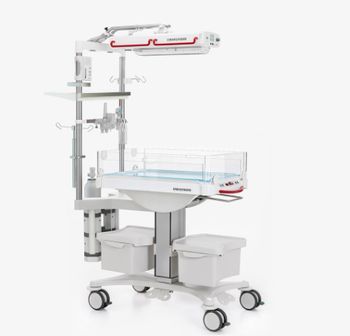
Weyer Variotherm
WEWeyer · Model Variotherm
Disc height optionally 170 mm or 250 mm, can be folded down on three sides, always with 2 safety discs. A one-piece or two-piece hinged cover is optionally available for the VARIOTHERM care unit with 250 mm high panes. Cozy warmth The long-wave infrared radiation is not visible and has a particularly gentle effect on the epidermis and the underlying dermis as well as in the bloodstream. The integrated high-performance reflector distributes the heat radiation efficiently and evenly over the entire lying surface Homogeneous lighting The lying surface can be easily tilted in both directions with one hand. The EPR function (Each Position Radiation) guarantees optimal thermal comfort for the patient, as the patient is in the area of heat radiation in every position and is therefore not exposed to temperature fluctuations at any time.
Key tips
- ·Never skip temperature-accuracy verification to save time - it's the one check that directly prevents burns.
- ·Hose/blanket connector wear is the most common real fault and the easiest to miss on a quick visual check.
Typical Failure Modes
Compiled for this model from its own documentation and established engineering knowledge for this equipment class - not from a verified service record. Confirm against the manufacturer's service manual.
Air- or radiant-heater control fault
HighSymptoms: Chamber / patient will not reach or hold the set temperature, temperature alarm, self-test / "Check" fault.
Root cause: Heater element / infrared rod, the air- or skin-temperature sensor, the fan (incubator), or a control-board fault.
Skin-temperature (servo) control fault
HighSymptoms: Servo mode does not regulate to the skin probe, deviation alarm, probe-fault alarm.
Root cause: Damaged skin temperature probe or its connector, or the servo-control circuit.
Alarm / audible / power-fail-alarm fault
MediumSymptoms: No or quiet audible alarm, alarm lamp does not light on the self-test.
Root cause: Buzzer / speaker or the alarm board - a safety-critical failure.
Humidity / airflow fault (incubator)
MediumSymptoms: Set humidity not reached, uneven chamber temperature, airflow alarm.
Root cause: Humidifier reservoir / heater, or a worn circulation fan / blocked air filter.
Mattress / weigh-scale / tilt / access-port fault
LowSymptoms: In-bed scale inaccurate, tilt mechanism stiff, port latches or iris sleeves worn.
Root cause: Load cell, tilt actuator, or worn access-port hardware.
Serviceable Parts & Consumables
Serviceable items for this model, compiled from its documentation and engineering knowledge for this equipment class. Service class and relative cost are estimates, not manufacturer figures; no part numbers are given. Confirm intervals and pricing against the manufacturer.
Air / skin temperature sensors
Class Frequent wear itemRel. cost $$R&R Fairly easy
Heater element / infrared rod
Class Major service partRel. cost $$R&R Difficult
Circulation fan (incubator)
Class Major service partRel. cost $$R&R Moderate
Humidifier heater / reservoir (incubator)
Class Periodic replacementRel. cost $$R&R Moderate
Buzzer / alarm board
Class Major service partRel. cost $R&R Moderate
| Part | Service class | Relative cost | R&R difficulty |
|---|---|---|---|
| Air / skin temperature sensors | Frequent wear item | $$ | Fairly easy |
| Heater element / infrared rod | Major service part | $$ | Difficult |
| Circulation fan (incubator) | Major service part | $$ | Moderate |
| Humidifier heater / reservoir (incubator) | Periodic replacement | $$ | Moderate |
| Buzzer / alarm board | Major service part | $ | Moderate |
Relative cost: $ lowest · $$$$ highest service-part cost for this equipment class. Not a price.
PM Checklist
Preventive-maintenance tasks typical of this equipment class. Perform to the manufacturer's procedure and your facility's policy - this is general reference, not a schedule for this specific unit.
- ·Hose / blanket connector inspection
- ·Temperature-accuracy verification
- ·Annual electrical safety test
Troubleshooting Approach
A starting sequence for this model, compiled from its documentation and engineering knowledge for this equipment class. Follow the manufacturer's service documentation for the actual procedure.
Symptom: Heater / temperature control fault
- Run the readiness / self-test and confirm the alarm lamp and buzzer.
- Set a target temperature and confirm the unit reaches it.
- Compare the chamber / skin temperature to an independent calibrated reference.
- Check the fan runs and the air filter is clean (incubator).
- Replace the temperature sensor, heater element or infrared rod as isolated.
Symptom: Servo / skin-probe fault
- Fit a known-good skin temperature probe with good skin contact.
- Check the probe connector and cable.
- Verify the servo regulates to the probe with a warm reference.
- Replace the probe.
- Refer the servo-control circuit for service if it still will not regulate.
Typical Location
Where this class of equipment is typically deployed - general reference, not this unit's own placement record.
- Operating Room
- PACU
- Emergency Department
- Labor & Delivery
- NICU
Documents & Manuals
No documents available for this device yet.
Troubleshoot this device with Bio
Describe a symptom or error code. Bio answers from this device's own documented error codes, failure modes, parts, and guides.
Ask Bio