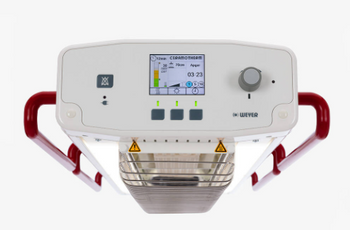
Weyer Ceramotherm 3000
WEWeyer · Model Ceramotherm 3000
Integrated patient temperature measurement and skin temperature control Impressive thermal efficiency Convenient operation Intensity setting as required Homogeneous lighting Integrated timer Integrated security Automatic distance detection for consistent radiation intensity.
Key tips
- ·Never skip temperature-accuracy verification to save time - it's the one check that directly prevents burns.
- ·Hose/blanket connector wear is the most common real fault and the easiest to miss on a quick visual check.
Typical Failure Modes
Compiled for this model from its own documentation and established engineering knowledge for this equipment class - not from a verified service record. Confirm against the manufacturer's service manual.
Not delivering warm air / temperature fault
HighSymptoms: Air not warm, temperature alarm, over-temp shutdown, blows cold.
Root cause: Heater element, a temperature-sensor / thermal-cutout fault, or a control-board fault.
Low airflow / blower fault
MediumSymptoms: Weak airflow, blanket will not inflate, blower noisy.
Root cause: Worn blower, a blocked intake filter, or a kinked / disconnected hose.
Hose / adapter fault
LowSymptoms: Hose cracked, will not connect to the blanket, air leaks at the coupling.
Root cause: Worn hose or end fitting.
Filter overdue / dirty
LowSymptoms: Reduced airflow, longer warm-up.
Root cause: Clogged intake / HEPA filter.
Over-temperature safety fault
MediumSymptoms: Repeated over-temp alarms even with good airflow.
Root cause: Sensor or thermal-cutout fault.
Serviceable Parts & Consumables
Serviceable items for this model, compiled from its documentation and engineering knowledge for this equipment class. Service class and relative cost are estimates, not manufacturer figures; no part numbers are given. Confirm intervals and pricing against the manufacturer.
Heater element
Class Major service partRel. cost $$R&R Moderate
Blower / motor
Class Major service partRel. cost $$R&R Moderate
Temperature sensor / thermal cutout
Class Major service partRel. cost $$R&R Moderate
Intake / HEPA filter
Class Frequent wear itemRel. cost $R&R Easy
Delivery hose / adapter
Class Periodic replacementRel. cost $$R&R Easy
| Part | Service class | Relative cost | R&R difficulty |
|---|---|---|---|
| Heater element | Major service part | $$ | Moderate |
| Blower / motor | Major service part | $$ | Moderate |
| Temperature sensor / thermal cutout | Major service part | $$ | Moderate |
| Intake / HEPA filter | Frequent wear item | $ | Easy |
| Delivery hose / adapter | Periodic replacement | $$ | Easy |
Relative cost: $ lowest · $$$$ highest service-part cost for this equipment class. Not a price.
PM Checklist
Preventive-maintenance tasks typical of this equipment class. Perform to the manufacturer's procedure and your facility's policy - this is general reference, not a schedule for this specific unit.
- ·Hose / blanket connector inspection
- ·Temperature-accuracy verification
- ·Annual electrical safety test
Troubleshooting Approach
A starting sequence for this model, compiled from its documentation and engineering knowledge for this equipment class. Follow the manufacturer's service documentation for the actual procedure.
Symptom: Blows cold or over-temp alarm
- Confirm the intake filter is clean and airflow is unobstructed.
- Run the self-test and note any code.
- Check the heater draws current and the temperature sensor reads correctly.
- Verify delivered air temperature at the hose end with a thermometer.
- Replace the heater or sensor / thermal cutout as isolated.
Symptom: Weak airflow
- Replace the intake / HEPA filter.
- Check the hose for kinks or splits.
- Confirm the blanket is an approved type and connected correctly.
- Inspect the blower and impeller.
- Replace the blower if airflow is still low.
Typical Location
Where this class of equipment is typically deployed - general reference, not this unit's own placement record.
- Operating Room
- PACU
- Emergency Department
- Labor & Delivery
- NICU
Documents & Manuals
No documents available for this device yet.
Troubleshoot this device with Bio
Describe a symptom or error code. Bio answers from this device's own documented error codes, failure modes, parts, and guides.
Ask Bio