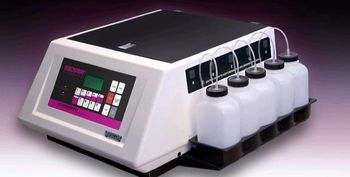
Wescor Acid Fast Bacteria 7720
 Wescor · Model Acid Fast Bacteria 7720
The Cytopro Rotor allows you to turn your Aerospray® Stainer into a full-featured cytocentrifuge system. The Cytopro is truly simple to load and unload chambers and it is autoclavable for complete sterilization. You can also use this advanced rotor in most Shandon Cytospin systems with purchase of the Cytopro Rotor Adapter (AC-080). Compressed flow control ring in the Cytopad® yields the highest cell recovery in the industry. Automatic pad alignment. Parts snap together easily and correctly every time. Convenient pre-wetting port for increased and more consistent cell yields. Superior clamping mechanism for consistently reliable performance. Sample protection cutout for trouble free chamber removal. Smooth and positive push-lever chamber retraction. Fast and easy loading and unloading. Compact, lightweight rotor for ease of handling, storing and transporting. Shallow rotor profile for easy access. Slide label visible during sample loading. Generous 7 mm sample display area (36% larger than the 6 mm Shandon Cytospin™ single). Internal clamping-no loose parts. Disposable/reusable chambers. Choice of fast or slow absorbent pads. Choice of single or double chambers each giving the same excellent results. Using the Wescor Hub Adapter (AC-080), the Wescor Cytopro rotor can be used on the Thermo Shandon Cytospin® 2, 3 or 4. Stand-alone cytocentrifuge (Model 7620) Alcohol-based hematology stainer (Model 7150) Aqueous-based hematology stainer (Model 7120) Microbiology Gram stainer (Model 7320) Microbiology Acid Fast Bacteria (AFB) stainer (Model 7720)
Key tips
- ·Run QC controls before trusting any repair - an analyzer that passes self-test can still report clinically wrong results.
- ·Rule out a reagent lot change before opening the instrument - it can look exactly like a hardware fault.
- ·Centrifuge rotors have a hard retirement age/cycle limit regardless of visible condition - don't eyeball it.
Typical Failure Modes
Compiled for this model from its own documentation and established engineering knowledge for this equipment class - not from a verified service record. Confirm against the manufacturer's service manual.
Reagent / paraffin transfer or handling fault
HighSymptoms: Stations not filling or draining, retort not filling (processor), transport arm mis-places baskets, error alarm halts the run.
Root cause: Worn pump / valve, a blocked line, a level-sensor fault, or a transport-drive / gripper fault.
Retort / chamber pressure or vacuum fault (processor)
MediumSymptoms: Pressure / vacuum not achieved, poor infiltration, seal alarm.
Root cause: Worn retort door seal, a vacuum / pressure-pump fault, or a valve.
Poor or inconsistent staining
MediumSymptoms: Slides over- / under-stained, uneven, station-time drift.
Root cause: Exhausted reagents, wrong programme, incorrect agitation, or a timing / arm fault.
Heater / paraffin-bath / oven fault
MediumSymptoms: Paraffin not molten or too hot, oven not at temperature, bath alarm.
Root cause: Heater or temperature-sensor fault.
Fume-extraction / carbon-filter fault
LowSymptoms: Reagent fumes in the room, filter-change overdue.
Root cause: Saturated carbon filter or a fan fault.
Serviceable Parts & Consumables
Serviceable items for this model, compiled from its documentation and engineering knowledge for this equipment class. Service class and relative cost are estimates, not manufacturer figures; no part numbers are given. Confirm intervals and pricing against the manufacturer.
Reagent / paraffin pump & valves
Class Periodic replacementRel. cost $$$R&R Difficult
Retort / reagent-vessel seals
Class Periodic replacementRel. cost $$R&R Fairly easy
Transport-arm drive / gripper (stainer)
Class Periodic replacementRel. cost $$$R&R Difficult
Bath / oven heater & temperature sensor
Class Major service partRel. cost $$R&R Moderate
Activated-carbon fume filter
Class Frequent wear itemRel. cost $R&R Easy
| Part | Service class | Relative cost | R&R difficulty |
|---|---|---|---|
| Reagent / paraffin pump & valves | Periodic replacement | $$$ | Difficult |
| Retort / reagent-vessel seals | Periodic replacement | $$ | Fairly easy |
| Transport-arm drive / gripper (stainer) | Periodic replacement | $$$ | Difficult |
| Bath / oven heater & temperature sensor | Major service part | $$ | Moderate |
| Activated-carbon fume filter | Frequent wear item | $ | Easy |
Relative cost: $ lowest · $$$$ highest service-part cost for this equipment class. Not a price.
PM Checklist
Preventive-maintenance tasks typical of this equipment class. Perform to the manufacturer's procedure and your facility's policy - this is general reference, not a schedule for this specific unit.
- ·Daily QC controls run and reviewed
- ·Calibration verification per assay
- ·Routine cleaning and decontamination
- ·Scheduled reagent-path and pump-tubing maintenance
Troubleshooting Approach
A starting sequence for this model, compiled from its documentation and engineering knowledge for this equipment class. Follow the manufacturer's service documentation for the actual procedure.
Symptom: Error alarm halts a run
- Note the alarm / error code and check the history log.
- Confirm reagent, paraffin and water levels and correct vessel placement.
- Check the affected station / retort fills and drains fully.
- Inspect seals and the transport arm.
- Follow the service manual for the specific alarm; replace the pump, valve or seal as isolated.
Symptom: Poor or inconsistent staining / processing
- Confirm the correct programme and station times.
- Fit fresh reagents and confirm fill levels.
- Check agitation / dwell and the water supply where used.
- Run a control slide / block and compare to a reference.
- Escalate a timing or transport-arm fault to the OEM.
Typical Location
Where this class of equipment is typically deployed - general reference, not this unit's own placement record.
- Central / core laboratory
- Point-of-care testing stations
- Blood bank
- Microbiology lab
Documents & Manuals
No documents available for this device yet.
Troubleshoot this device with Bio
Describe a symptom or error code. Bio answers from this device's own documented error codes, failure modes, parts, and guides.
Ask Bio