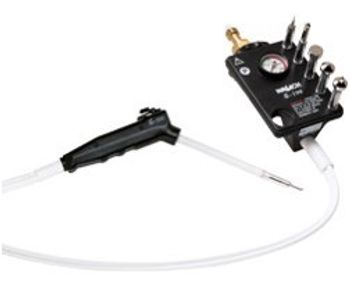
Wallach LL100
 Wallach · Model LL100
Two-Trigger Design. The two triggers are the key to the LL 100's superiority. Not only do they allow the physician to independently trigger freeze or defrost functions, they provide the fastest freeze or defrost of any freezer. Fast Application. Maximum freeze means fewer failed procedures. The LL100's fast freeze and fast defrost mean fast, certain application of maximum freezing power. The most powerful freezer permits a complete, tissue destroying freeze every time. Versatile. Multi-procedural versatility is another important Wallach benefit. The LL100 offers the widest range of interchangeable, sterilizable cryotips for OB / GYN. Unobtrusive. You can hardly notice that the freezer is between you and the patient. Lightweight, well balanced and maneuverable, the LL100 is ergonomically designed to provide full view of the target tissue for greater precision. The extremely flexible, memory-free gas hose allows for unimpeded surgical movement. Safe. Wallach built in safety features. The only time there is any gas in the tip is when one of the triggers is pressed, and can be stopped instantly. Highly conductive, reusable, and sterilizable cryotips can be interchanged at any time and the stem of the freezer is insulated to protect non-target tissue. More effective freeze/defrost in less time. Freeze and defrost only when triggered. Lightweight, well-balanced and maneuverable. Use with Wallach’s large selection of cryotips and disposable plastic shields. The gas hose allowes for unimpeded surgical movement. Wallach Cryotips can be changed at any time without venting.
Typical Failure Modes
Compiled for this model from its own documentation and established engineering knowledge for this equipment class - not from a verified service record. Confirm against the manufacturer's service manual.
Weak or no freeze at the cryotip
HighSymptoms: Slow or shallow ice ball, tip not reaching cryo temperature, failed procedures.
Root cause: Low CO2/N2O cylinder pressure, a blocked tip orifice or in-line filter, or moisture / non-medical-grade gas icing the flow path.
Trigger valve leak or stick (two-trigger design)
HighSymptoms: Gas flows without a trigger pressed, freeze or defrost trigger does not release, continuous hiss.
Root cause: Worn seat / O-rings in the freeze or defrost trigger valve.
Gas hose / cylinder-fitting leak
MediumSymptoms: Audible leak at the cylinder connection or along the flexible hose, reduced tip power.
Root cause: Cracked memory-free hose, worn cylinder washer, or a loose connector.
Slow or failed defrost
MediumSymptoms: Tip stays frozen after the defrost trigger is released, sticks to tissue.
Root cause: Blocked defrost path or a stuck defrost valve.
Serviceable Parts & Consumables
Serviceable items for this model, compiled from its documentation and engineering knowledge for this equipment class. Service class and relative cost are estimates, not manufacturer figures; no part numbers are given. Confirm intervals and pricing against the manufacturer.
Freeze / defrost trigger valve seat & O-ring kit
Class Periodic replacementRel. cost $$R&R Moderate
Interchangeable sterilizable cryotip
Reusable tips have a limited service life; inspect the orifice.
Class Frequent wear itemRel. cost $$R&R Easy
Memory-free gas hose
Class Periodic replacementRel. cost $$R&R Fairly easy
Cylinder connection washer / gasket
Class Frequent wear itemRel. cost $R&R Easy
In-line gas filter / drier
Class Frequent wear itemRel. cost $R&R Fairly easy
| Part | Service class | Relative cost | R&R difficulty |
|---|---|---|---|
| Freeze / defrost trigger valve seat & O-ring kit | Periodic replacement | $$ | Moderate |
| Interchangeable sterilizable cryotip Reusable tips have a limited service life; inspect the orifice. | Frequent wear item | $$ | Easy |
| Memory-free gas hose | Periodic replacement | $$ | Fairly easy |
| Cylinder connection washer / gasket | Frequent wear item | $ | Easy |
| In-line gas filter / drier | Frequent wear item | $ | Fairly easy |
Relative cost: $ lowest · $$$$ highest service-part cost for this equipment class. Not a price.
Troubleshooting Approach
A starting sequence for this model, compiled from its documentation and engineering knowledge for this equipment class. Follow the manufacturer's service documentation for the actual procedure.
Symptom: Poor or no freeze
- Confirm the gas cylinder is medical grade and above minimum pressure; fit a full cylinder.
- Inspect the cryotip orifice and in-line filter for a blockage or ice; clean or replace the tip.
- Check the cylinder connection washer and connection for leaks.
- Bench-test freeze and defrost and time the ice ball.
- Replace the trigger valve kit if flow is adequate but freezing is still weak.
Symptom: Gas leaks with both triggers released
- Isolate the cylinder and vent residual pressure.
- Use leak solution to locate the leak - cylinder fitting, hose, or a trigger valve.
- Reseal the cylinder connection or replace the hose for external leaks.
- Rebuild the affected trigger valve with the seat / O-ring kit for an internal leak.
- Re-pressurise and confirm gas flows only when a trigger is pressed.
Documents & Manuals
Safety & Recalls
Synced live from the FDA openFDA API.
- RECALL
The tip may separate from the probe.
Troubleshoot this device with Bio
Describe a symptom or error code. Bio answers from this device's own documented error codes, failure modes, parts, and guides.
Ask Bio