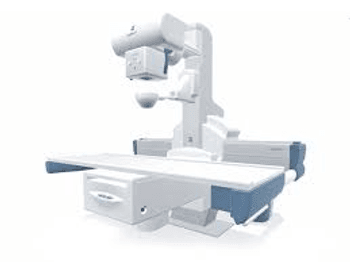
Villa Sistemi Apollo EZ/DRF
 Villa Sistemi · Model Apollo EZ/DRF
Compact Apollo EZ DRF is available with either 2-way tabletop movement, for the maximum compactness, and with 4 way tabletop movement, in order to maximize patient coverage area, combining tabletop and tube/detector longitudinal movement. Tabletop can also be made of carbon fiber for further reduction of the X-ray dose to the patient. Versatile Rapid and concurrent movements reduce dramatically the patient preparation time and increase workflow. Although its compactness, Apollo EZ DRF can extend the focus-detector distance up to 180cm, allowing to obtain chest images comparable to those done on a chest stand, making the remote controlled room suitable also for routine exams. Dynamic Flat Panel Technology The innovative Dynamic Flat Panel detector delivers sharp and accurate images to support your diagnosis and is not affected by geometric distortion which is typical of Image Intensifiers. The large 43x43cm - 17"x17" active area is suitable for examination of any anatomic region and provides almost 50% more coverage than a 16" Image Intensifier. The combination of wide coverage and high image resolution extends the application of the fluoro suite to areas such as chest, pelvis and extremities, which can't be done with conventional image intensifier based systems. The high sensitivity of the flat panel technology, the use of low absorption materials and the grid parking capability, allow a consistent dose reduction, especially for pediatric applications. Great versatility for radiographic applications The use of one single detector for both fluoroscopy and radiography offers an unparalleled range of applications that includes all the most common general radiographic procedures, gastro-intestinal studies, tomography and vascular studies. Exams can be taken on the table with source to image distance up to 180cm - 71".
Key tips
- ·Never bypass a radiation interlock to "just get the image" - this is one of the few true zero-tolerance rules in BMET work.
- ·Trend image-quality phantom results over time - drift shows up before an outright failure does.
- ·Portable/mobile units take real physical abuse from transport - check wheel locks and cable strain reliefs more often than fixed units.
Typical Failure Modes
Compiled for this model from its own documentation and established engineering knowledge for this equipment class - not from a verified service record. Confirm against the manufacturer's service manual.
Fluoro dose-rate / image-brightness fault
HighSymptoms: Fluoro image too dark or bright, dose creep, ABC / ADRC not tracking.
Root cause: Image-intensifier or flat-panel degradation, or the dose-control loop.
No or inconsistent exposure / generator error
HighSymptoms: Exposure inhibited, generator error code, spot images under/over-exposed.
Root cause: HV generator / tank, tube, filament supply, or an interlock.
Table motion / tilt / spot-film device fault
MediumSymptoms: Table will not tilt or move, the spot-film / carriage will not position.
Root cause: Table drive, tilt motor, or the spot-film device drive.
Tube overload / cooling fault
MediumSymptoms: Exposures inhibited after a series, tube-heat alarm.
Root cause: Tube heat limit reached or a heat-exchanger / cooling fault.
Console / image-chain / PACS fault
MediumSymptoms: Console unresponsive, image freeze, images will not archive.
Root cause: Console PC, the image-processing chain, or the network.
Serviceable Parts & Consumables
Serviceable items for this model, compiled from its documentation and engineering knowledge for this equipment class. Service class and relative cost are estimates, not manufacturer figures; no part numbers are given. Confirm intervals and pricing against the manufacturer.
X-ray tube assembly
Class Major service partRel. cost $$$$R&R Expert-level
Image intensifier / flat-panel detector
Class Major service partRel. cost $$$$R&R Expert-level
HV generator / tank components
Class Major service partRel. cost $$$$R&R Expert-level
Table / tilt drive components
Class Major service partRel. cost $$$R&R Difficult
Heat exchanger / cooling components
Class Major service partRel. cost $$$R&R Difficult
| Part | Service class | Relative cost | R&R difficulty |
|---|---|---|---|
| X-ray tube assembly | Major service part | $$$$ | Expert-level |
| Image intensifier / flat-panel detector | Major service part | $$$$ | Expert-level |
| HV generator / tank components | Major service part | $$$$ | Expert-level |
| Table / tilt drive components | Major service part | $$$ | Difficult |
| Heat exchanger / cooling components | Major service part | $$$ | Difficult |
Relative cost: $ lowest · $$$$ highest service-part cost for this equipment class. Not a price.
PM Checklist
Preventive-maintenance tasks typical of this equipment class. Perform to the manufacturer's procedure and your facility's policy - this is general reference, not a schedule for this specific unit.
- ·Daily QC per modality: image-quality phantom test
- ·Tube and detector inspection
- ·Annual state-required radiation safety survey
- ·Vendor-scheduled preventive maintenance
Troubleshooting Approach
A starting sequence for this model, compiled from its documentation and engineering knowledge for this equipment class. Follow the manufacturer's service documentation for the actual procedure.
Symptom: Fluoro too dark/bright or dose creeping
- Image a phantom at a fixed field and distance and compare to baseline.
- Check the image-intensifier / detector performance via service diagnostics.
- Review the dose / ABC trend.
- Escalate an intensifier or detector degradation to the OEM.
- Re-verify dose rate against the room baseline after correction.
Symptom: Generator error / no exposure
- Record the exact generator error code.
- Confirm mains supply is within spec and all room interlocks are satisfied.
- Confirm the tube is not in a thermal lockout.
- Check the HT connections and exposure contactor.
- Escalate a confirmed HV-tank / tube fault; verify output after repair.
Typical Location
Where this class of equipment is typically deployed - general reference, not this unit's own placement record.
- Radiology / Imaging department
- Emergency Department (portable units)
- Operating Room (C-arms)
- Cath lab
- Bedside ICU (portable X-ray)
Documents & Manuals
No documents available for this device yet.
Safety & Recalls
Synced live from the FDA openFDA API.
- RECALL
An amendment to the IFU and Service Manual is being issued to prescribe the replacement of the angulation chain after 8 years of service of the of the unit. After testing, it was found that due to metal fatigue under sever workload conditions, the angulation chain might fail before the expected lifetime of 10 years.
- RECALL
Patient fell from the table because the footrest of the device detached from the table top while the patient was positioned on the table and table was moving from vertical position.
- RECALL
The analysis showed that the incident was caused by a chain of four faults: 1.) The injured person overcame a physical barrier (the tabletop support arm. height ca. 60 em) to access a prohibited area not intended as a working position. 2) The directions for use (device labeling and instructions for use) did not contain an explicit exclusion of the prohibited area. 3.) The movement was activated inadvertently and continuously. and it was not released (the movement requires continuous activation). 4.) Delayed activation of the emergency stop.
- RECALL
It has been discovered that due to lack of information accompanying documents the product fails to comply with 21CfR 1020.33(c),1020.33(d),1020.33(g),and 1020.330).
- RECALL
It has been discovered that the Air Kerma rate information is inconsistent in Continuous Fluoro modes 30x30 (12"x12") and 15x15 (6"x6). This could result in a deviation of the displayed values of Air Kerma Rate and Cumulated Air Kerma from the actual values greater then +/-35% and then in a failure to comply with the requirements of 21 CFR 1020.32(k)(6
Troubleshoot this device with Bio
Describe a symptom or error code. Bio answers from this device's own documented error codes, failure modes, parts, and guides.
Ask Bio