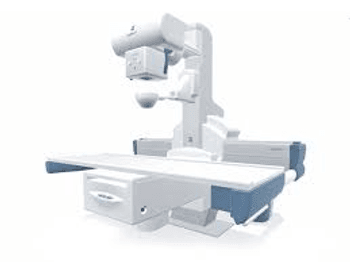
Villa Sistemi Apollo EZ
 Villa Sistemi · Model Apollo EZ
In the spirit of renewal Based on an upgraded, high performance hardware architecture, the new remote control console introduces features and solutions that further increase ease of use and efficiency of the system, thus helping to speed up the workflow and increase productivity in the R/F room. Versatility and efficiency Rapid and concurrent movements reduce dramatically the patient preparation time and increase workflow. On the film-based versions, the powerful spot film device, available with either line or cross divisions, can fit virtually any application need, while the one-hand cassette loading and unloading mechanism grants a maximized speed for this frequent operation. Safety and patient care Special attention is always by us given to patient's dose reduction, by employing a number of provisions, such as reduced skin-to-film-distance, automatic collimation, fully automatic parameter settings in both fluoro and exposure. Additionally, in order to grant the highest level of safety, a dedicated anti-collision device on the vertical tilting movement stops the motion in case of contact with foreign objects The spot film device, compatible with numerous formats of radiographic cassettes, makes the preparation of the examination simple and fast through the automatic cassette loading and alignment mechanism, thus allowing multiple images to be acquired in succession on the same film through the line and cross divisions.
Key tips
- ·Never bypass a radiation interlock to "just get the image" - this is one of the few true zero-tolerance rules in BMET work.
- ·Trend image-quality phantom results over time - drift shows up before an outright failure does.
- ·Portable/mobile units take real physical abuse from transport - check wheel locks and cable strain reliefs more often than fixed units.
Typical Failure Modes
Compiled for this model from its own documentation and established engineering knowledge for this equipment class - not from a verified service record. Confirm against the manufacturer's service manual.
Fluoro dose-rate / image-brightness fault
HighSymptoms: Fluoro image too dark or bright, dose creep, ABC / ADRC not tracking.
Root cause: Image-intensifier or flat-panel degradation, or the dose-control loop.
No or inconsistent exposure / generator error
HighSymptoms: Exposure inhibited, generator error code, spot images under/over-exposed.
Root cause: HV generator / tank, tube, filament supply, or an interlock.
Table motion / tilt / spot-film device fault
MediumSymptoms: Table will not tilt or move, the spot-film / carriage will not position.
Root cause: Table drive, tilt motor, or the spot-film device drive.
Tube overload / cooling fault
MediumSymptoms: Exposures inhibited after a series, tube-heat alarm.
Root cause: Tube heat limit reached or a heat-exchanger / cooling fault.
Console / image-chain / PACS fault
MediumSymptoms: Console unresponsive, image freeze, images will not archive.
Root cause: Console PC, the image-processing chain, or the network.
Serviceable Parts & Consumables
Serviceable items for this model, compiled from its documentation and engineering knowledge for this equipment class. Service class and relative cost are estimates, not manufacturer figures; no part numbers are given. Confirm intervals and pricing against the manufacturer.
X-ray tube assembly
Class Major service partRel. cost $$$$R&R Expert-level
Image intensifier / flat-panel detector
Class Major service partRel. cost $$$$R&R Expert-level
HV generator / tank components
Class Major service partRel. cost $$$$R&R Expert-level
Table / tilt drive components
Class Major service partRel. cost $$$R&R Difficult
Heat exchanger / cooling components
Class Major service partRel. cost $$$R&R Difficult
| Part | Service class | Relative cost | R&R difficulty |
|---|---|---|---|
| X-ray tube assembly | Major service part | $$$$ | Expert-level |
| Image intensifier / flat-panel detector | Major service part | $$$$ | Expert-level |
| HV generator / tank components | Major service part | $$$$ | Expert-level |
| Table / tilt drive components | Major service part | $$$ | Difficult |
| Heat exchanger / cooling components | Major service part | $$$ | Difficult |
Relative cost: $ lowest · $$$$ highest service-part cost for this equipment class. Not a price.
PM Checklist
Preventive-maintenance tasks typical of this equipment class. Perform to the manufacturer's procedure and your facility's policy - this is general reference, not a schedule for this specific unit.
- ·Daily QC per modality: image-quality phantom test
- ·Tube and detector inspection
- ·Annual state-required radiation safety survey
- ·Vendor-scheduled preventive maintenance
Troubleshooting Approach
A starting sequence for this model, compiled from its documentation and engineering knowledge for this equipment class. Follow the manufacturer's service documentation for the actual procedure.
Symptom: Fluoro too dark/bright or dose creeping
- Image a phantom at a fixed field and distance and compare to baseline.
- Check the image-intensifier / detector performance via service diagnostics.
- Review the dose / ABC trend.
- Escalate an intensifier or detector degradation to the OEM.
- Re-verify dose rate against the room baseline after correction.
Symptom: Generator error / no exposure
- Record the exact generator error code.
- Confirm mains supply is within spec and all room interlocks are satisfied.
- Confirm the tube is not in a thermal lockout.
- Check the HT connections and exposure contactor.
- Escalate a confirmed HV-tank / tube fault; verify output after repair.
Typical Location
Where this class of equipment is typically deployed - general reference, not this unit's own placement record.
- Radiology / Imaging department
- Emergency Department (portable units)
- Operating Room (C-arms)
- Cath lab
- Bedside ICU (portable X-ray)
Documents & Manuals
No documents available for this device yet.
Safety & Recalls
Synced live from the FDA openFDA API.
- RECALL
It has been discovered that due to lack of information accompanying documents the product fails to comply with 21CfR 1020.33(c),1020.33(d),1020.33(g),and 1020.330).
Troubleshoot this device with Bio
Describe a symptom or error code. Bio answers from this device's own documented error codes, failure modes, parts, and guides.
Ask Bio