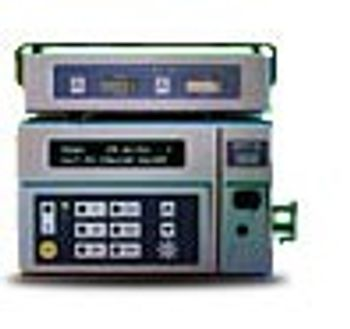
Via Medical BLOOD GAS AND CHEM MONITOR
 Via Medical · Model BLOOD GAS AND CHEM MONITOR
PATIENT ATTACHED, NO MORE MANUAL SAMPLES The changing face of healthcare puts your time at a premium. The current method of manual blood gas sampling and analysis involves many steps – increasing the chance for errors and delays. The VIA Patient Attached Blood Gas and Chemistry Monitor combines automation with proven electrode technology to meet your clinical needs in a variety of critical care settings. FAST, SAFE, SIMPLE The VIA Blood Gas and Chemistry Monitor combines state-of-the-art technology with safety. This simple closed system eliminates blood loss and blood handling, reducing the risks to both patient and clinician. ACCURATE RESULTS AND COST EFFECTIVENESS Analysis can now be performed at the bedside – automatically or on demand. Accurate test results can now be reported every 10 minutes over a 72-hour period – all with one VIA Blood Gas and Chemistry Sensor. Your cost goes down with each test. RAPID RESPONSE TO CHANGING PATIENT STATUS You can now observe dynamic and sometimes rapid changes in patient blood gases and chemistries absolutely a critical clinical advantage, which may lead to improved patient outcomes and shorter hospital stays.
Key tips
- ·Run QC controls before trusting any repair - an analyzer that passes self-test can still report clinically wrong results.
- ·Rule out a reagent lot change before opening the instrument - it can look exactly like a hardware fault.
- ·Centrifuge rotors have a hard retirement age/cycle limit regardless of visible condition - don't eyeball it.
Typical Failure Modes
Compiled for this model from its own documentation and established engineering knowledge for this equipment class - not from a verified service record. Confirm against the manufacturer's service manual.
Sensor / electrode fault or drift
HighSymptoms: pH, pCO2, pO2, electrolyte, glucose / lactate or CO-oximetry results flagged, QC fails, stability / response errors.
Root cause: An electrode / membrane at end of life, an air bubble or protein in the measuring path, or a calibration fault.
Sample-path / inlet clog or clot
MediumSymptoms: Sample not aspirated, clot detected, inlet / preheater alarm.
Root cause: Clot in the inlet probe / preheater, or a worn inlet gasket.
Solution / cartridge / gas / waste fault
MediumSymptoms: Reagent-empty, gas-supply or waste-full alarm, calibration fails.
Root cause: Empty or expired solution pack / cartridge, an empty / expired gas cylinder, or a full waste container.
Pump / valve / pneumatic fault
MediumSymptoms: Poor sample transport, calibration or rinse failures, pressure alarms.
Root cause: Worn peristaltic pump tubing, a pinch-valve fault, or a pneumatic-pressure fault.
CO-oximetry / optical fault
MediumSymptoms: tHb, sO2 or dyshaemoglobin results implausible, optics / lamp error.
Root cause: Optics contamination, a lamp fault, or the haemolyser.
Serviceable Parts & Consumables
Serviceable items for this model, compiled from its documentation and engineering knowledge for this equipment class. Service class and relative cost are estimates, not manufacturer figures; no part numbers are given. Confirm intervals and pricing against the manufacturer.
Sensor cassette / individual electrodes & membranes
Class Frequent wear itemRel. cost $$$R&R Fairly easy
Solution pack / reagent cartridge
Class ConsumableRel. cost $$R&R Easy
Calibration gas cylinder
Class Frequent wear itemRel. cost $$R&R Easy
Peristaltic pump tubing / pinch valves
Class Frequent wear itemRel. cost $R&R Moderate
Inlet probe / preheater gasket
Class Frequent wear itemRel. cost $R&R Fairly easy
| Part | Service class | Relative cost | R&R difficulty |
|---|---|---|---|
| Sensor cassette / individual electrodes & membranes | Frequent wear item | $$$ | Fairly easy |
| Solution pack / reagent cartridge | Consumable | $$ | Easy |
| Calibration gas cylinder | Frequent wear item | $$ | Easy |
| Peristaltic pump tubing / pinch valves | Frequent wear item | $ | Moderate |
| Inlet probe / preheater gasket | Frequent wear item | $ | Fairly easy |
Relative cost: $ lowest · $$$$ highest service-part cost for this equipment class. Not a price.
PM Checklist
Preventive-maintenance tasks typical of this equipment class. Perform to the manufacturer's procedure and your facility's policy - this is general reference, not a schedule for this specific unit.
- ·Daily QC controls run and reviewed
- ·Calibration verification per assay
- ·Routine cleaning and decontamination
- ·Scheduled reagent-path and pump-tubing maintenance
Troubleshooting Approach
A starting sequence for this model, compiled from its documentation and engineering knowledge for this equipment class. Follow the manufacturer's service documentation for the actual procedure.
Symptom: Sensor flagged or QC fails
- Run the relevant calibration and check the sensor / electrode status screen.
- De-bubble / rinse the measuring path and check for protein deposits.
- Replace an electrode / membrane at end of life or that fails calibration.
- Confirm the solution pack and calibration gas are in date and not empty.
- Re-run QC at the relevant levels before releasing results.
Symptom: Sample not aspirated / clot
- Run the inlet / preheater clot-removal or rinse routine.
- Inspect the inlet probe and gasket.
- Replace the inlet gasket or probe.
- Confirm free sample aspiration with a QC sample.
- Replace worn pump tubing if transport is still poor.
Technical Specs
- Height
- 8.5 in
- Length
- 9 in
- Weight
- 16 lbs
- Width
- 9.5 in
Typical Location
Where this class of equipment is typically deployed - general reference, not this unit's own placement record.
- Central / core laboratory
- Point-of-care testing stations
- Blood bank
- Microbiology lab
Documents & Manuals
No documents available for this device yet.
Troubleshoot this device with Bio
Describe a symptom or error code. Bio answers from this device's own documented error codes, failure modes, parts, and guides.
Ask Bio