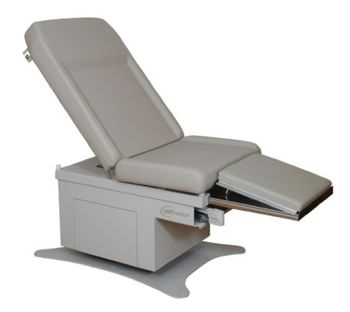
UMF 5080 Power Exam Table
 UMF · Model 5080 Power Exam Table
5080 Power Exam Table One of our most economical power exam tables, the UMF Medical lowers to a height of 24 inches (61.0 cm) from the floor and can support a patient weighing up to 400 pounds (181.4kg). The 5080 Power Exam Table utilizes a single function foot control to adjust the height of the table, and a manual release back section (with gas spring cylinder) to adjust the angle of the backrest. It can also be used as a chair in its fully upright position. The 5080 Power Exam Table features a painted steel leg section with a removable upholstered leg cushion. The leg section elevates 10 degrees for added patient comfort. As with all of our power tables and chairs, the 5080 utilizes the vacuum formed UMF Medical Ultra Comfort Seamless Top which provides security and comfort for patients, allows for easy cleaning and helps prevent cross-contamination.
Key tips
- ·Always leak-test under load - a regulator that reads correctly at rest can still leak and fail in real use.
- ·Canister and tubing changes are an infection-control issue as much as a mechanical one.
Typical Failure Modes
Compiled for this model from its own documentation and established engineering knowledge for this equipment class - not from a verified service record. Confirm against the manufacturer's service manual.
A powered movement will not run or hold
HighSymptoms: Height, tilt, back or leg section will not move from the pendant / foot control, or drifts under load.
Root cause: Linear actuator, a hand / foot control fault, a control-board fault, or (hydraulic) a valve / seal leak.
Hand / foot control fault
MediumSymptoms: Intermittent or dead control, one function unresponsive.
Root cause: Worn control or a damaged cable.
Table-top / drive fault (imaging / uro tables)
MediumSymptoms: Float / longitudinal / lateral drive will not move or lock, radiolucent top damaged.
Root cause: Drive motor, brake, or the float-release solenoid.
Battery back-up fault (where fitted)
LowSymptoms: No movement on a power interruption.
Root cause: Aged back-up battery.
Upholstery / accessory fault
LowSymptoms: Torn pads, loose stirrups / arm boards, paper-roll holder broken.
Root cause: Worn upholstery or accessory hardware.
Serviceable Parts & Consumables
Serviceable items for this model, compiled from its documentation and engineering knowledge for this equipment class. Service class and relative cost are estimates, not manufacturer figures; no part numbers are given. Confirm intervals and pricing against the manufacturer.
Linear actuator
Class Major service partRel. cost $$$R&R Difficult
Hand / foot control
Class Periodic replacementRel. cost $$R&R Fairly easy
Control board
Class Major service partRel. cost $$$R&R Moderate
Hydraulic pump / seal kit (hydraulic tables)
Class Major service partRel. cost $$R&R Moderate
Upholstery / pad set
Class Periodic replacementRel. cost $$R&R Fairly easy
| Part | Service class | Relative cost | R&R difficulty |
|---|---|---|---|
| Linear actuator | Major service part | $$$ | Difficult |
| Hand / foot control | Periodic replacement | $$ | Fairly easy |
| Control board | Major service part | $$$ | Moderate |
| Hydraulic pump / seal kit (hydraulic tables) | Major service part | $$ | Moderate |
| Upholstery / pad set | Periodic replacement | $$ | Fairly easy |
Relative cost: $ lowest · $$$$ highest service-part cost for this equipment class. Not a price.
PM Checklist
Preventive-maintenance tasks typical of this equipment class. Perform to the manufacturer's procedure and your facility's policy - this is general reference, not a schedule for this specific unit.
- ·Regulator calibration and leak check
- ·Canister / tubing replacement
- ·Annual full PM
Troubleshooting Approach
A starting sequence for this model, compiled from its documentation and engineering knowledge for this equipment class. Follow the manufacturer's service documentation for the actual procedure.
Symptom: A powered movement is dead or drifts
- Confirm mains / battery and any lock-out.
- Operate the function and listen for the actuator or pump.
- Substitute a known-good hand / foot control.
- Check the control cable and connectors.
- Replace the actuator, valve or control board as isolated and load-test.
Symptom: Table-top will not float or lock
- Check the float-release control and its solenoid / cable.
- Inspect the drive and brake for that axis.
- Confirm the radiolucent top and rails are not damaged.
- Replace the solenoid or drive component as isolated.
- Confirm smooth motion and a firm lock.
Technical Specs
- Patient Weight Capacity
- 400 lbs
Typical Location
Where this class of equipment is typically deployed - general reference, not this unit's own placement record.
- Operating Room
- Emergency Department
- Patient floors (wall suction regulators)
- Central vacuum plant
Documents & Manuals
Troubleshoot this device with Bio
Describe a symptom or error code. Bio answers from this device's own documented error codes, failure modes, parts, and guides.
Ask Bio