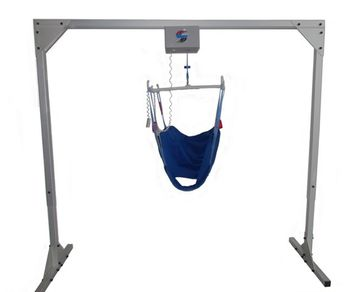
Traxx Mobility Systems Titan 500
 Traxx Mobility Systems · Model Titan 500
A freestanding overhead track patient lift system The Traxx Mobility Systems Titan 500 is a freestanding overhead track patient lift system. Our lift system allows a single caregiver to effortlessly transfer a patient, weighing up to 500 pounds, in and out of bed. The rechargeable electric lift motor works with the touch of a button and glides along a free-standing overhead track with a gentle push. A four point lift bar ensures a comfortable and safe transfer while rechargeable batteries allow for worry-free use, even in the event of a power outage. The Titan 500 is a complete lift package and includes a freestanding aluminum frame, a lift motor with rechargeable batteries, a lift bar, one sling and an easy to use remote control. The safe and secure system is durable, dependable and simple.
Key tips
- ·Mounting and securement hardware takes real fatigue from vibration and road shock - inspect it as carefully as the device itself.
- ·Post-call battery and function checks catch transport-induced faults that a scheduled PM would miss for months.
Typical Failure Modes
Compiled for this model from its own documentation and established engineering knowledge for this equipment class - not from a verified service record. Confirm against the manufacturer's service manual.
Hand control not responding / no powered movement
HighSymptoms: Lift / lower or traverse does not respond to the hand control.
Root cause: Discharged or mis-inserted battery, an active emergency stop, an obstruction or overload, or a faulty hand control / cable.
Lift actuator / strap / mast fault
MediumSymptoms: Will not raise or lower, runs one direction only, noisy or slow, strap frays.
Root cause: Worn lift actuator / motor, or a frayed / twisted lifting strap or chain.
Battery will not hold charge
MediumSymptoms: Short run time, frequent low-battery, unit dies mid-transfer.
Root cause: Aged battery pack or a charger / charging-contact fault.
Traverse / rail-carriage fault (ceiling)
MediumSymptoms: Carriage will not move along the rail, or binds.
Root cause: Worn carriage wheels, a rail obstruction, or the traverse motor.
Overload / slack-strap / emergency-lowering fault
HighSymptoms: Lift stops with an overload indication, slack-strap cut-off active, or emergency lowering does not work.
Root cause: Load over the rated limit, the slack-strap sensor, or the emergency-lowering mechanism.
Serviceable Parts & Consumables
Serviceable items for this model, compiled from its documentation and engineering knowledge for this equipment class. Service class and relative cost are estimates, not manufacturer figures; no part numbers are given. Confirm intervals and pricing against the manufacturer.
Rechargeable battery pack
Class Periodic replacementRel. cost $$R&R Easy
Hand control
Class Periodic replacementRel. cost $$R&R Easy
Lifting strap / chain
Inspect before every use; retire on any fraying.
Class Periodic replacementRel. cost $$R&R Fairly easy
Lift actuator / motor assembly
Class Major service partRel. cost $$$R&R Difficult
Rail-carriage wheel set (ceiling)
Class Major service partRel. cost $$R&R Moderate
| Part | Service class | Relative cost | R&R difficulty |
|---|---|---|---|
| Rechargeable battery pack | Periodic replacement | $$ | Easy |
| Hand control | Periodic replacement | $$ | Easy |
| Lifting strap / chain Inspect before every use; retire on any fraying. | Periodic replacement | $$ | Fairly easy |
| Lift actuator / motor assembly | Major service part | $$$ | Difficult |
| Rail-carriage wheel set (ceiling) | Major service part | $$ | Moderate |
Relative cost: $ lowest · $$$$ highest service-part cost for this equipment class. Not a price.
PM Checklist
Preventive-maintenance tasks typical of this equipment class. Perform to the manufacturer's procedure and your facility's policy - this is general reference, not a schedule for this specific unit.
- ·Post-call function and battery check
- ·Mounting / securement inspection
- ·Annual full PM and vibration-tolerance check
Troubleshooting Approach
A starting sequence for this model, compiled from its documentation and engineering knowledge for this equipment class. Follow the manufacturer's service documentation for the actual procedure.
Symptom: Hand control not responding
- Confirm a charged, correctly inserted battery.
- Clear any obstruction and check the load is within the rated limit.
- Confirm the emergency stop is inactivated.
- Reseat the hand-control plug; try the up/down buttons on the unit if fitted.
- If the unit buttons work, replace the hand control; if not, use the emergency lowering and call qualified personnel.
Symptom: Will not raise or lower
- Check the strap / chain is not twisted, frayed or fouled at the drum.
- Listen for the lift actuator / motor.
- Confirm the slack-strap cut-off is not active (strap under tension).
- Replace a damaged strap immediately.
- Replace the actuator / motor if it will not run under command, then load-test to the rated limit.
Typical Location
Where this class of equipment is typically deployed - general reference, not this unit's own placement record.
- Ambulance / transport vehicles
- Emergency Department
- Inter-facility transport teams
Documents & Manuals
Troubleshoot this device with Bio
Describe a symptom or error code. Bio answers from this device's own documented error codes, failure modes, parts, and guides.
Ask Bio