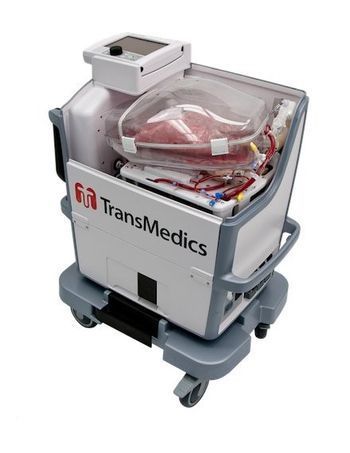
TransMedics Organ Care System (OCS) Lung System
 TransMedics · Model Organ Care System (OCS) Lung System
How does it work? The OCS Lung System works by supplying donor lungs with oxygen and nutrients through ventilation and perfusion. The device also measures and displays preservation parameters, such as temperature and pressure. When is it used? The TransMedics OCS Lung System is used by trained medical personnel during the retrieval and transportation of donor lungs. What will it accomplish? Compared to the standard of care cold storage method for preservation of donor lungs, the OCS System reduces the time during which the lungs lack blood and oxygen support outside of the body. In a clinical study that compared the OCS System to cold storage, a lower rate of Primary Graft Dysfunction Grade 3 (PGD3) within 72 hours post-transplantation was observed in patients transplanted with lungs preserved by the OCS System. PGD3 is a severe form of acute lung injury that is associated with poor clinical outcomes. Other clinical outcomes, such as survival and rate of bronchiolitis obliterans syndrome (BOS) at two years post-transplantation, were similar between the two study groups. BOS is a common long-term complication after lung transplantation. When should it not be used? The TransMedics OCS Lung System cannot be used with donor lungs that have suffered moderate to severe traumatic injury with air leak, as seen on radiological studies, bronchial examination or final visual assessment in donor’s chest.
Key tips
- ·Never defeat or bypass a return-electrode monitoring (REM) alarm to finish a case - it's a direct burn risk.
- ·Verify OR table battery backup - a table that loses power mid-procedure is a real, documented incident type.
- ·Track surgical light lamp-hours rather than waiting for failure - a sudden failure mid-case is avoidable.
Typical Failure Modes
Compiled for this model from its own documentation and established engineering knowledge for this equipment class - not from a verified service record. Confirm against the manufacturer's service manual.
Roller / centrifugal pump fault
HighSymptoms: A pump will not run at set flow, speed unstable, occlusion out of adjustment, flow-probe error.
Root cause: Worn roller-pump raceway / rollers, a centrifugal drive-motor / coupling fault, or a flow-probe fault.
Console / control-module fault
HighSymptoms: A pump module unresponsive, display errors, module not recognised by the console.
Root cause: Module electronics or the console-to-module link.
Battery / UPS fault
HighSymptoms: Short back-up run time, will not transfer cleanly on a power interruption.
Root cause: Aged battery / UPS pack.
Pressure / level / bubble-monitoring fault
MediumSymptoms: Pressure, reservoir-level or bubble-detector alarms implausible or not triggering.
Root cause: Transducer, level-sensor, or bubble-detector fault.
Heater-cooler / temperature fault
MediumSymptoms: Blood / cardioplegia temperature not tracking, heater-cooler alarm, flow fault.
Root cause: Heater-cooler pump / refrigeration or a temperature-probe fault.
Serviceable Parts & Consumables
Serviceable items for this model, compiled from its documentation and engineering knowledge for this equipment class. Service class and relative cost are estimates, not manufacturer figures; no part numbers are given. Confirm intervals and pricing against the manufacturer.
Roller-pump raceway / roller kit
Class Periodic replacementRel. cost $$$R&R Difficult
Centrifugal drive motor / coupling
Class Major service partRel. cost $$$R&R Difficult
Battery / UPS pack
Class Periodic replacementRel. cost $$$R&R Moderate
Pressure / level / bubble sensors
Class Periodic replacementRel. cost $$R&R Moderate
Flow probe
Class Periodic replacementRel. cost $$R&R Fairly easy
| Part | Service class | Relative cost | R&R difficulty |
|---|---|---|---|
| Roller-pump raceway / roller kit | Periodic replacement | $$$ | Difficult |
| Centrifugal drive motor / coupling | Major service part | $$$ | Difficult |
| Battery / UPS pack | Periodic replacement | $$$ | Moderate |
| Pressure / level / bubble sensors | Periodic replacement | $$ | Moderate |
| Flow probe | Periodic replacement | $$ | Fairly easy |
Relative cost: $ lowest · $$$$ highest service-part cost for this equipment class. Not a price.
PM Checklist
Preventive-maintenance tasks typical of this equipment class. Perform to the manufacturer's procedure and your facility's policy - this is general reference, not a schedule for this specific unit.
- ·Pre-case functional check
- ·Electrosurgical return-electrode cable inspection
- ·Table hydraulic / mechanical inspection
- ·Annual electrical safety test and full PM
Troubleshooting Approach
A starting sequence for this model, compiled from its documentation and engineering knowledge for this equipment class. Follow the manufacturer's service documentation for the actual procedure.
Symptom: A pump will not run correctly
- Move the function to a spare pump module / mast position to isolate module vs console.
- Check the roller occlusion setting and inspect the raceway / rollers (roller pumps).
- Check the centrifugal drive coupling and flow probe.
- Verify flow against an independent flow probe.
- Replace the roller kit or drive components as isolated; a CPB console must pass a full functional check before clinical use.
Symptom: Monitoring alarm implausible or not triggering
- Verify each pressure channel against a reference.
- Test the level and bubble detectors per the service procedure.
- Reseat the sensor connectors.
- Calibrate the pressure channels.
- Replace a sensor that fails its functional test - these are safety systems.
Typical Location
Where this class of equipment is typically deployed - general reference, not this unit's own placement record.
- Operating rooms
- Procedure rooms
- Interventional suites
Documents & Manuals
Troubleshoot this device with Bio
Describe a symptom or error code. Bio answers from this device's own documented error codes, failure modes, parts, and guides.
Ask Bio