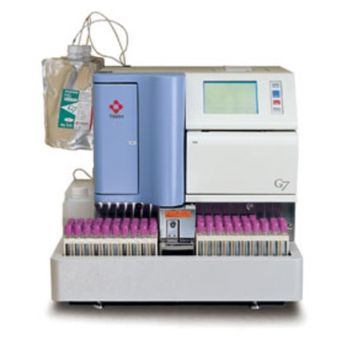
Tosoh Bioscience G7 HPLC Analyzer
 Tosoh Bioscience · Model G7 HPLC Analyzer
HbA1c and Β-thalassemia in one analyzer HbA1c results in 2.2 minutes NGSP certified Direct determination of stable HbA1c.
Key tips
- ·Run QC controls before trusting any repair - an analyzer that passes self-test can still report clinically wrong results.
- ·Rule out a reagent lot change before opening the instrument - it can look exactly like a hardware fault.
- ·Centrifuge rotors have a hard retirement age/cycle limit regardless of visible condition - don't eyeball it.
Typical Failure Modes
Compiled for this model from its own documentation and established engineering knowledge for this equipment class - not from a verified service record. Confirm against the manufacturer's service manual.
QC / calibration failure on an assay
HighSymptoms: Controls out of range, calibration fails, flagged results on one or more assays.
Root cause: Reagent pack issue, a probe / dispense fault, incubation-temperature drift, or a detector / optics fault.
Sample / reagent probe or pipettor fault
MediumSymptoms: Short aspiration, no dispense, clot / level-sense errors, carryover.
Root cause: Clogged or bent probe, a syringe / pump fault, or a level-sense fault.
Wash / aspiration station fault
MediumSymptoms: High background / noise, poor precision, elevated blanks.
Root cause: Blocked wash-station nozzles or a wash-pump / vacuum fault.
Incubator temperature fault
MediumSymptoms: Assay drift or bias, incubation-temperature alarm.
Root cause: Incubator heater or temperature-sensor fault.
Detector / luminometer / photometer fault
MediumSymptoms: Low signal, high CV, detector-error message.
Root cause: PMT / detector ageing or an optics fault.
Serviceable Parts & Consumables
Serviceable items for this model, compiled from its documentation and engineering knowledge for this equipment class. Service class and relative cost are estimates, not manufacturer figures; no part numbers are given. Confirm intervals and pricing against the manufacturer.
Sample / reagent probe
Class Periodic replacementRel. cost $$R&R Moderate
Syringe / dispense pump
Class Periodic replacementRel. cost $$R&R Moderate
Wash-station nozzles / pump tubing
Class Frequent wear itemRel. cost $R&R Moderate
Incubator heater / temperature sensor
Class Major service partRel. cost $$R&R Moderate
Detector / PMT module
Class Major service partRel. cost $$$R&R Difficult
| Part | Service class | Relative cost | R&R difficulty |
|---|---|---|---|
| Sample / reagent probe | Periodic replacement | $$ | Moderate |
| Syringe / dispense pump | Periodic replacement | $$ | Moderate |
| Wash-station nozzles / pump tubing | Frequent wear item | $ | Moderate |
| Incubator heater / temperature sensor | Major service part | $$ | Moderate |
| Detector / PMT module | Major service part | $$$ | Difficult |
Relative cost: $ lowest · $$$$ highest service-part cost for this equipment class. Not a price.
PM Checklist
Preventive-maintenance tasks typical of this equipment class. Perform to the manufacturer's procedure and your facility's policy - this is general reference, not a schedule for this specific unit.
- ·Daily QC controls run and reviewed
- ·Calibration verification per assay
- ·Routine cleaning and decontamination
- ·Scheduled reagent-path and pump-tubing maintenance
Troubleshooting Approach
A starting sequence for this model, compiled from its documentation and engineering knowledge for this equipment class. Follow the manufacturer's service documentation for the actual procedure.
Symptom: QC or calibration failure
- Run fresh controls and recalibrate the affected assay.
- Confirm the reagent pack is in date, mixed and correctly loaded.
- Clean the probes and wash stations.
- Check the incubator temperature against a reference.
- Escalate a detector / optics fault to the OEM.
Symptom: Probe or pipettor fault
- Inspect the probe for a bend or clog and clear it.
- Run the fluidics prime.
- Check the syringe / pump and tubing for leaks or air.
- Verify level sensing and probe position.
- Replace the probe or syringe as found and re-run QC.
Typical Location
Where this class of equipment is typically deployed - general reference, not this unit's own placement record.
- Central / core laboratory
- Point-of-care testing stations
- Blood bank
- Microbiology lab
Documents & Manuals
No documents available for this device yet.
Safety & Recalls
Synced live from the FDA openFDA API.
- RECALL
Analyzers were distributed with software which lacks a 510K
- RECALL
HbAE is known to interfere with the HbA1c assay on the current version of software, Ver. 5.23. Customers should exercise caution when reviewing chromatograms and ensure that Flag 43 is enabled on their device to avoid reporting invalid test results in the presence of HbAE.
- RECALL
The assay can potentially generate erroneously elevated or erroneously decreased HbA1c patient results.
- RECALL
Power outages causes reporting software to shutdown.
- RECALL
The device defect associated with this recall may result in HbA1c values with a negative bias in patients with the hemoglobin variants C, D, E and S. The negative bias occurs at the higher levels of HbA1c, e.g. 9%, but not at the diagnostic medical decision point of 6.5%.
- RECALL
The G7 Variant Elution Buffer HiS no. 1 (M) is incorrectly labeled with an expiration date of October 2015. The correct expiration date is October 2014.
- RECALL
The value after reconstitution appeared to be lower than the assigned value on the label. The measured value for Lot BCAL05R was 5.3%, whereas the value on the label is 5.7%. The criteria of the value is +/- 0.3%.
- RECALL
The Beta-thalessemia Mode of the G7 Analyzer-Beta Thalassemia Mode is an automated High Performance Liquid Chromatography (HPLC) system that separates and reports HbF and HbA2 quantitative percentages in whole blood. The firm received complaints that the A2 peak could not be detected with the G7 Beta-thalessemia columns.
- RECALL
A software upgrade was released by the firm for its AIA-600 II analyzers, in that washing deficiencies caused by the analyzer were corrected.
Troubleshoot this device with Bio
Describe a symptom or error code. Bio answers from this device's own documented error codes, failure modes, parts, and guides.
Ask Bio