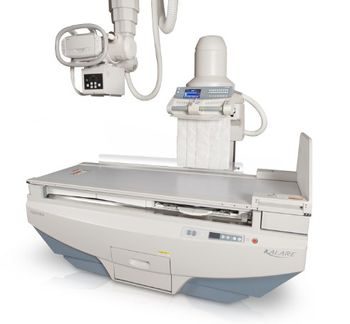
Toshiba Kalare R&F
 Toshiba · Model Kalare R&F
Complete tableside control to optimize procedural and clinical management. Ergonomic controls for fast and comfortable single-handed operation. Color LCD display allows you to review exam parameters at a glance and change settings with simple touch-screen control. Smart user interface helps you to perform tasks efficiently. Feature rich to meet clinical and economic needs.
Key tips
- ·Never bypass a radiation interlock to "just get the image" - this is one of the few true zero-tolerance rules in BMET work.
- ·Trend image-quality phantom results over time - drift shows up before an outright failure does.
- ·Portable/mobile units take real physical abuse from transport - check wheel locks and cable strain reliefs more often than fixed units.
Typical Failure Modes
Compiled for this model from its own documentation and established engineering knowledge for this equipment class - not from a verified service record. Confirm against the manufacturer's service manual.
Fluoro dose-rate / image-brightness fault
HighSymptoms: Fluoro image too dark or bright, dose creep, ABC / ADRC not tracking.
Root cause: Image-intensifier or flat-panel degradation, or the dose-control loop.
No or inconsistent exposure / generator error
HighSymptoms: Exposure inhibited, generator error code, spot images under/over-exposed.
Root cause: HV generator / tank, tube, filament supply, or an interlock.
Table motion / tilt / spot-film device fault
MediumSymptoms: Table will not tilt or move, the spot-film / carriage will not position.
Root cause: Table drive, tilt motor, or the spot-film device drive.
Tube overload / cooling fault
MediumSymptoms: Exposures inhibited after a series, tube-heat alarm.
Root cause: Tube heat limit reached or a heat-exchanger / cooling fault.
Console / image-chain / PACS fault
MediumSymptoms: Console unresponsive, image freeze, images will not archive.
Root cause: Console PC, the image-processing chain, or the network.
Serviceable Parts & Consumables
Serviceable items for this model, compiled from its documentation and engineering knowledge for this equipment class. Service class and relative cost are estimates, not manufacturer figures; no part numbers are given. Confirm intervals and pricing against the manufacturer.
X-ray tube assembly
Class Major service partRel. cost $$$$R&R Expert-level
Image intensifier / flat-panel detector
Class Major service partRel. cost $$$$R&R Expert-level
HV generator / tank components
Class Major service partRel. cost $$$$R&R Expert-level
Table / tilt drive components
Class Major service partRel. cost $$$R&R Difficult
Heat exchanger / cooling components
Class Major service partRel. cost $$$R&R Difficult
| Part | Service class | Relative cost | R&R difficulty |
|---|---|---|---|
| X-ray tube assembly | Major service part | $$$$ | Expert-level |
| Image intensifier / flat-panel detector | Major service part | $$$$ | Expert-level |
| HV generator / tank components | Major service part | $$$$ | Expert-level |
| Table / tilt drive components | Major service part | $$$ | Difficult |
| Heat exchanger / cooling components | Major service part | $$$ | Difficult |
Relative cost: $ lowest · $$$$ highest service-part cost for this equipment class. Not a price.
PM Checklist
Preventive-maintenance tasks typical of this equipment class. Perform to the manufacturer's procedure and your facility's policy - this is general reference, not a schedule for this specific unit.
- ·Daily QC per modality: image-quality phantom test
- ·Tube and detector inspection
- ·Annual state-required radiation safety survey
- ·Vendor-scheduled preventive maintenance
Troubleshooting Approach
A starting sequence for this model, compiled from its documentation and engineering knowledge for this equipment class. Follow the manufacturer's service documentation for the actual procedure.
Symptom: Fluoro too dark/bright or dose creeping
- Image a phantom at a fixed field and distance and compare to baseline.
- Check the image-intensifier / detector performance via service diagnostics.
- Review the dose / ABC trend.
- Escalate an intensifier or detector degradation to the OEM.
- Re-verify dose rate against the room baseline after correction.
Symptom: Generator error / no exposure
- Record the exact generator error code.
- Confirm mains supply is within spec and all room interlocks are satisfied.
- Confirm the tube is not in a thermal lockout.
- Check the HT connections and exposure contactor.
- Escalate a confirmed HV-tank / tube fault; verify output after repair.
Typical Location
Where this class of equipment is typically deployed - general reference, not this unit's own placement record.
- Radiology / Imaging department
- Emergency Department (portable units)
- Operating Room (C-arms)
- Cath lab
- Bedside ICU (portable X-ray)
Documents & Manuals
Safety & Recalls
Synced live from the FDA openFDA API.
- RECALL
During an examination images were displayed on the live monitor,but the images were not displayed on the system monitor nor were they saved to the hard disk.
- RECALL
It was discovered that the generator of the system could possibly terminate the exposure prematurely during an examination
- RECALL
Firm initiated recall because when radiographic conditions with the small focus are set and the radiography ready switch is held down, the large focus is also heated after a few seconds or more. This occurs when the Automatic Exposure Function (AEC) function is used. As a result, a radiographic tube current exceeding the set value flows and a brighter image than expected is acquired.
- RECALL
Top table lateral movement on their DUA-450F Kalare Table cannot be performed, or the table top lateral movement is performed at an extremely low speed. As a result, positioning of the patient cannot be performed by tabletop movement.
Troubleshoot this device with Bio
Describe a symptom or error code. Bio answers from this device's own documented error codes, failure modes, parts, and guides.
Ask Bio