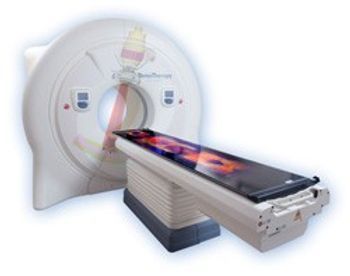
TomoTherapy Hi-Art Treatment System
 TomoTherapy · Model Hi-Art Treatment System
Incorporates easy-to-use software for treatment planning, quality assurance, patient set-up and treatment delivery, all using the same secure centralized database. Includes a powerful, 32-processor computer system that rapidly creates sophisticated IMRT plans. Stores all patient and plan information in a single location; removing the risk of data transfer errors. Delivers helical (continuous 360º) IMRT that uses tens of thousands of narrow beamlets, all targeting the tumor and individually-optimized to contribute to the total tumor dose. Offers by far the most beamlets of any form of IMRT, which translates to the most precise conformal radiotherapy available. Ensures accurate delivery of precise helical IMRT plans via 3D image-guided set-up, based on daily pre-treatment CT scans. Increases clinical confidence because it integrates imaging into the treatment geometry; images are fundamentally in the same frame-of-reference as the treatment beams.
Typical Failure Modes
Compiled for this model from its own documentation and established engineering knowledge for this equipment class - not from a verified service record. Confirm against the manufacturer's service manual.
Linac RF / magnetron output instability
HighSymptoms: Beam-on faults, dose-rate low or unstable, RF/HV interlocks.
Root cause: Magnetron at end of life, HV supply, or waveguide arcing.
Binary MLC leaf fault
HighSymptoms: Leaf stuck open or closed, delivery interlock, QA fluence errors.
Root cause: Pneumatic leaf actuator or valve fault in the binary multileaf collimator.
Jaw position fault
HighSymptoms: Jaw error, and (per an Accuray recall) the system may not monitor jaw position after a jaw error occurs.
Root cause: Jaw drive or position-sensing fault; ensure the corrective software/field-action is applied.
Gantry ring / slip-ring drive fault
MediumSymptoms: Rotation error, data or power dropouts during a helical delivery.
Root cause: Slip-ring brushes or the ring drive.
MVCT detector degradation
MediumSymptoms: Poor daily image quality for IGRT setup, registration difficulty.
Root cause: Detector aging or calibration drift.
Chiller / thermal fault
MediumSymptoms: Over-temperature interlocks, dose-rate instability.
Root cause: Chiller pump or heat-exchanger fouling.
Serviceable Parts & Consumables
Serviceable items for this model, compiled from its documentation and engineering knowledge for this equipment class. Service class and relative cost are estimates, not manufacturer figures; no part numbers are given. Confirm intervals and pricing against the manufacturer.
Magnetron
OEM service; dosimetry re-commissioning required.
Class Periodic replacementRel. cost $$$$R&R Expert-level
Binary MLC valve bank / leaves
Class Major service partRel. cost $$$$R&R Expert-level
MVCT detector
Class Major service partRel. cost $$$$R&R Difficult
Slip-ring brushes
Class Periodic replacementRel. cost $$R&R Difficult
Chiller pump / heat exchanger
Class Major service partRel. cost $$$R&R Difficult
Jaw drive assembly
Class Major service partRel. cost $$$R&R Expert-level
| Part | Service class | Relative cost | R&R difficulty |
|---|---|---|---|
| Magnetron OEM service; dosimetry re-commissioning required. | Periodic replacement | $$$$ | Expert-level |
| Binary MLC valve bank / leaves | Major service part | $$$$ | Expert-level |
| MVCT detector | Major service part | $$$$ | Difficult |
| Slip-ring brushes | Periodic replacement | $$ | Difficult |
| Chiller pump / heat exchanger | Major service part | $$$ | Difficult |
| Jaw drive assembly | Major service part | $$$ | Expert-level |
Relative cost: $ lowest · $$$$ highest service-part cost for this equipment class. Not a price.
Troubleshooting Approach
A starting sequence for this model, compiled from its documentation and engineering knowledge for this equipment class. Follow the manufacturer's service documentation for the actual procedure.
Symptom: Beam-on / RF fault
- This is an OEM-service linac - the BMET role is triage and coordination.
- Record the exact fault codes from the operator station and equipment-room logs.
- Check chiller status and coolant flow first.
- Confirm all Accuray field-safety corrective actions (jaw-monitoring, software anomalies) are applied.
- Escalate a confirmed magnetron/waveguide fault to Accuray; keep the unit down until physics re-verifies output.
Symptom: MLC or jaw delivery interlock
- Note which leaf or jaw and the exact interlock.
- Review the daily QA and delivery-log trend.
- Check air supply/pressure to the binary MLC.
- Escalate a confirmed leaf or jaw fault to Accuray.
- Coordinate with physics before resuming clinical use.
Documents & Manuals
Safety & Recalls
Synced live from the FDA openFDA API.
- RECALL
Accuray has become aware of a potential safety issue related to the TomoTherapy Treatment System caused by a failure to monitor the jaw position after a jaw error occurs. This may result in an incorrect jaw position during treatment, without generating system interruption.
- RECALL
Accuray is voluntarily recalling TomoTherapy H Series software versions 1.2.0, 1.2.1 and 1.2.2 (Hi-Art 4.2.0, 4.2.1 and 4.2.2). Accuray has identified potential safety issues (anomalies) with these software versions.
- RECALL
Accuray is voluntarily recalling TomoTherapy H Series software versions 2.0.0 and 2.0.1 (Hi-Art 5.0.0 and 5.0.1). Accuray has identified potential safety issues (anomalies) with these software versions.
- RECALL
It was determined that the Treatment Planning Station (TPS) can potentially under dose.
- RECALL
TomoTherapy Inc. is sending this Field Safety Notice to make you aware of an anomaly which may affect the performance of the Hi-Art System and make it so the user cannot generate a Completion Procedure.
- RECALL
An issue has been identified, as a result of input received from one TomoTherapy Hi-Art Treatment System customer. With a particular workflow, the Planning Station's Draft and/or final Plan Report can provide incorrect dose statistics.
- RECALL
In some cases, the patient's diagnostic CT image is narrower than the Hi-Art radiotherapy couch image.
- RECALL
An issue was identified with the TomoTherapy HI-Art System. In the event a patient or DQA plan has a moved image, roll adjustments applied during registration will be incorrect. The Planning Station Plan Settings and DQA Setup tabs allow for images to be moved during planning. During registration when roll is applied on moved images, the Operator Station incorrectly rolls the image about
- RECALL
TomoTherapy received one customer report indicating that after starting a patient procedure from the Status Console, the radiation on light and the audible indicator on the Status Console came on as expected, however the Operator Station (OS) did not display the dose rate and the procedure time, or the couch position updates. Within a few minutes, the customer pressed the Stop button on the Sta
- RECALL
TomoTherapy Incorporated identified a potential issue with the Hi-Art system during the course of ongoing testing. The Operator Station Calibration panel provides access to view and modify machine specific configuration settings. Access to these settings has always been restricted to individuals with appropriate security rights, being limited to only the "Superuser" and "Field Service engine
- RECALL
TomoTherapy Inc. discovered an issue on the Hi-Art system during the course of ongoing testing. It has been identified that treatment plans involving very small structures (volume <2cc), reading in a high dose gradient region, may exhibit inaccuracies with the DVH curve and the Dose Statistics for the small structures. This error can only happen if planning was performed using very small voxels
- RECALL
Registration adjustment field numbers may appear on printed pages of the Register Tab as nonsense characters or values different than the numbers shown on the Operator Station (OS) display. Setup will move the couch to the correct offset position. If the couch is manually adjusted to the incorrect value, the patient may not be the correct position during treatment.
Troubleshoot this device with Bio
Describe a symptom or error code. Bio answers from this device's own documented error codes, failure modes, parts, and guides.
Ask Bio