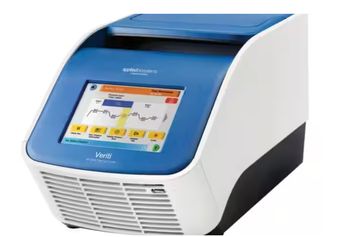
Thermo Fisher Scientific Veriti 96-Well
 Thermo Fisher Scientific · Model Veriti 96-Well
Innovative VeriFlex™ Blocks allow for precise PCR optimization or to run up to 6 independent assays Six Temperature Zones for convenient PCR optimization Standard and fast enabled cycling to address your current and future PCR needs Easy-to-use graphical interface (6.5 inch VGA Touch Screen) Convenient protocol transfer from one Veriti™ Thermal Cycler to another using USB Reduced PCR cycling time when using faster ramp rates Optional VeritiLink™ Remote Management Software provides you with peace of mind, allowing you to remotely manage more than 50 cyclers from your PC or internet-compatible phone.
Key tips
- ·Run QC controls before trusting any repair - an analyzer that passes self-test can still report clinically wrong results.
- ·Rule out a reagent lot change before opening the instrument - it can look exactly like a hardware fault.
- ·Centrifuge rotors have a hard retirement age/cycle limit regardless of visible condition - don't eyeball it.
Typical Failure Modes
Compiled for this model from its own documentation and established engineering knowledge for this equipment class - not from a verified service record. Confirm against the manufacturer's service manual.
Thermal / block uniformity fault
HighSymptoms: Wells at the edge vs centre give different Ct, failed thermal verification, ramp errors.
Root cause: Peltier block ageing / a failed Peltier zone, a heated-lid fault, or a fan / heatsink fault.
Optical / calibration fault (real-time)
HighSymptoms: High background, low signal, dye / ROI or pure-dye calibration fails, poor amplification curves.
Root cause: Excitation LED / lamp ageing, optics contamination, or an out-of-date calibration.
Heated lid / seal fault
MediumSymptoms: Evaporation, condensation on the seal, inconsistent replicates, lid-pressure error.
Root cause: Heated-lid heater or the lid-pressure mechanism / seal.
Software / instrument-comms fault
MediumSymptoms: Instrument not detected, runs will not start or export, firmware mismatch.
Root cause: USB / network link, driver, or the control PC.
Fan / cooling fault
LowSymptoms: Slow ramp-down, over-temperature warning, loud fan.
Root cause: Failed or clogged cooling fan.
Serviceable Parts & Consumables
Serviceable items for this model, compiled from its documentation and engineering knowledge for this equipment class. Service class and relative cost are estimates, not manufacturer figures; no part numbers are given. Confirm intervals and pricing against the manufacturer.
Peltier sample block
Class Major service partRel. cost $$$$R&R Difficult
Excitation LED / lamp module
Class Periodic replacementRel. cost $$$R&R Moderate
Heated-lid heater / seal
Class Major service partRel. cost $$R&R Moderate
Cooling fan
Class Periodic replacementRel. cost $R&R Fairly easy
Dye calibration kit
Class Frequent wear itemRel. cost $$R&R Easy
| Part | Service class | Relative cost | R&R difficulty |
|---|---|---|---|
| Peltier sample block | Major service part | $$$$ | Difficult |
| Excitation LED / lamp module | Periodic replacement | $$$ | Moderate |
| Heated-lid heater / seal | Major service part | $$ | Moderate |
| Cooling fan | Periodic replacement | $ | Fairly easy |
| Dye calibration kit | Frequent wear item | $$ | Easy |
Relative cost: $ lowest · $$$$ highest service-part cost for this equipment class. Not a price.
PM Checklist
Preventive-maintenance tasks typical of this equipment class. Perform to the manufacturer's procedure and your facility's policy - this is general reference, not a schedule for this specific unit.
- ·Daily QC controls run and reviewed
- ·Calibration verification per assay
- ·Routine cleaning and decontamination
- ·Scheduled reagent-path and pump-tubing maintenance
Troubleshooting Approach
A starting sequence for this model, compiled from its documentation and engineering knowledge for this equipment class. Follow the manufacturer's service documentation for the actual procedure.
Symptom: Poor uniformity or failed thermal check
- Run the temperature-verification / thermal-performance tool with a probe kit.
- Check the heated lid seals and applies even pressure.
- Confirm the cooling fan and heatsink are clear.
- If one block zone is off, plan a block / Peltier replacement.
- Re-verify with a known assay after service.
Symptom: High background or failed dye calibration (real-time)
- Run the background, pure-dye and (if applicable) uniformity calibrations in order.
- Clean the optical surfaces / sample block per the manual.
- Use fresh calibration plates within their expiry.
- Replace the excitation source if signal is low.
- Confirm a known control assay amplifies normally.
Typical Location
Where this class of equipment is typically deployed - general reference, not this unit's own placement record.
- Central / core laboratory
- Point-of-care testing stations
- Blood bank
- Microbiology lab
Documents & Manuals
No documents available for this device yet.
Troubleshoot this device with Bio
Describe a symptom or error code. Bio answers from this device's own documented error codes, failure modes, parts, and guides.
Ask Bio