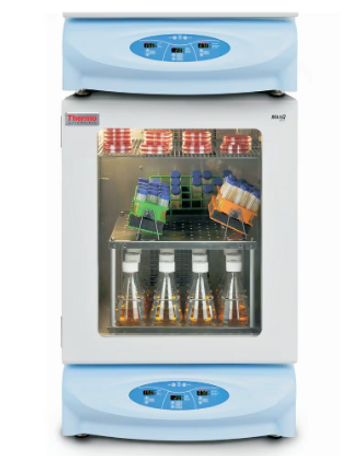
Thermo Fisher Scientific MaxQ 6000
 Thermo Fisher Scientific · Model MaxQ 6000
Stackable units accept flasks up to 6L Two adjustable-height shelves provide added storage Choose from two temperature ranges to fulfill a variety of molecular biology, protein expression or plasmid purification studies Available in incubated or refrigerated models Precisely monitor and control chamber temperature over complete range with ±0.1°C accuracy at 37°C with PID temperature controller Overtemperature safety feature with independent thermostat provides additional backup by controlling heat if main temperature controller fails Solid-state DC brushless motor, variable speed control from 15 to 500rpm Continuous and timed operation from 0.1 hour up to 999 hours or 0.1 minute to 999 minutes View speed, operating time and temperature simultaneously on three individual LED displays, which help minimize errors in establishing running conditions Displayed time counts up during continuous operation and down during timed runs Visual/audible signals alert user to temperature deviations; heat turns off if temperature deviates ±1°C of setpoint Shaker shutdown and audible/visual alarms signal if unit operates ±10% of set speed, preventing the shaker from walking Eliminate sudden starts and stops with soft start feature User-adjustable speed calibration can be performed using a digital handheld tachometer, where verification is required and protocols can be standardized Safety interlock stops shaking motion when the door is open Platform motion stops when excess vibration is detected due to an unbalanced load Retains parameters during power failure and restarts unit automatically after power is restored RS-232 interface allows remote monitoring of speed, time and temperature Large viewing window and internal light allow sample visibility, minimizing the need to open the door Door can be hinged from the right or left by the user for convenient placement in the lab 18 × 18 in. platform can be dual-tiered inside the chamber to double the shaking capacity Corrosion-resistant stainless-steel chamber accommodates a variety of 18 × 18 in. (46 × 46cm) universal and dedicated platforms Durable powder-coated, cold-rolled steel exterior construction Electrical outlet inside chamber provides power for safe operation of shakers, stirrers or rotators.
Key tips
- ·Run QC controls before trusting any repair - an analyzer that passes self-test can still report clinically wrong results.
- ·Rule out a reagent lot change before opening the instrument - it can look exactly like a hardware fault.
- ·Centrifuge rotors have a hard retirement age/cycle limit regardless of visible condition - don't eyeball it.
Typical Failure Modes
Compiled for this model from its own documentation and established engineering knowledge for this equipment class - not from a verified service record. Confirm against the manufacturer's service manual.
Will not hold set temperature
HighSymptoms: Chamber above or below setpoint, temperature alarm, slow recovery after the door opens.
Root cause: Heater element, a temperature-sensor / controller fault, a door / gasket leak, or a circulation-fan fault.
CO2 concentration fault (CO2 incubator)
HighSymptoms: CO2 above or below setpoint, CO2 alarm, pH drift in cultures.
Root cause: CO2 sensor (TC or IR) drift, an empty / low CO2 supply, or a solenoid / regulator fault.
Humidity fault (CO2 incubator)
MediumSymptoms: Low humidity, plates drying out, condensation problems.
Root cause: Empty water pan, or an evaporation / airflow issue.
Over-temperature safety trip
MediumSymptoms: Chamber stops heating, over-temp alarm, will not restart.
Root cause: Controller / sensor fault driving the heater high, or an independent over-temp thermostat.
Door / gasket fault
LowSymptoms: Door will not seal, temperature swings, condensation at the door.
Root cause: Worn door gasket or a sagging hinge.
Serviceable Parts & Consumables
Serviceable items for this model, compiled from its documentation and engineering knowledge for this equipment class. Service class and relative cost are estimates, not manufacturer figures; no part numbers are given. Confirm intervals and pricing against the manufacturer.
Heater element
Class Major service partRel. cost $$R&R Moderate
Temperature sensor / controller
Class Major service partRel. cost $$R&R Moderate
CO2 sensor (CO2 incubator)
Class Periodic replacementRel. cost $$$R&R Moderate
CO2 solenoid / regulator (CO2 incubator)
Class Major service partRel. cost $$R&R Moderate
Door gasket
Class Periodic replacementRel. cost $R&R Fairly easy
| Part | Service class | Relative cost | R&R difficulty |
|---|---|---|---|
| Heater element | Major service part | $$ | Moderate |
| Temperature sensor / controller | Major service part | $$ | Moderate |
| CO2 sensor (CO2 incubator) | Periodic replacement | $$$ | Moderate |
| CO2 solenoid / regulator (CO2 incubator) | Major service part | $$ | Moderate |
| Door gasket | Periodic replacement | $ | Fairly easy |
Relative cost: $ lowest · $$$$ highest service-part cost for this equipment class. Not a price.
PM Checklist
Preventive-maintenance tasks typical of this equipment class. Perform to the manufacturer's procedure and your facility's policy - this is general reference, not a schedule for this specific unit.
- ·Daily QC controls run and reviewed
- ·Calibration verification per assay
- ·Routine cleaning and decontamination
- ·Scheduled reagent-path and pump-tubing maintenance
Troubleshooting Approach
A starting sequence for this model, compiled from its documentation and engineering knowledge for this equipment class. Follow the manufacturer's service documentation for the actual procedure.
Symptom: Will not hold set temperature
- Compare the chamber to an independent calibrated thermometer at several points.
- Confirm the door seals and the gasket is intact.
- Check the circulation fan runs.
- Verify the heater draws current.
- Replace the sensor, controller or heater as isolated, then verify stability over several hours.
Symptom: CO2 out of range (CO2 incubator)
- Verify CO2 with an independent calibrated analyser (Fyrite or electronic).
- Confirm the CO2 supply pressure and that the cylinder is not empty.
- Check / calibrate the CO2 sensor per the manual (TC sensors drift with humidity and door openings).
- Inspect the inlet filter and solenoid.
- Recalibrate and re-verify against the reference.
Typical Location
Where this class of equipment is typically deployed - general reference, not this unit's own placement record.
- Central / core laboratory
- Point-of-care testing stations
- Blood bank
- Microbiology lab
Documents & Manuals
No documents available for this device yet.
Related calculators
From BioLab, for work done with this kind of equipment.
Troubleshoot this device with Bio
Describe a symptom or error code. Bio answers from this device's own documented error codes, failure modes, parts, and guides.
Ask Bio