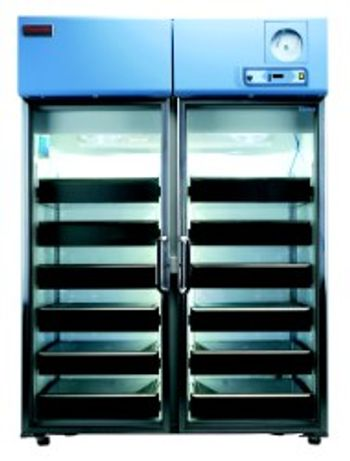
Thermo Fisher Scientific Forma Blood Bank Refrigerators
 Thermo Fisher Scientific · Model Forma Blood Bank Refrigerators
Microprocessor Control. Adjustable temperature control from 1° to 8°C, factory pre-set at 4°C. Icon-based controls and displays include graphic references for universal operation. Setpoint security with key-operated, triple-position master switch controls power to all systems for added safety. Audible/visual warnings for overtemperature, undertemperature and power failure, with visual status reports on critical functions. Alarm setpoints pre-set to warn of temperature deviation at +5.5°C overtemperature and +1.5°C undertemperature. Advanced defrost sensor manages defrost cycle, minimizing frost build-up to maintain refrigeration coil efficiency. Enlarged digital display with resolution to within 0.1°C. Alarm-silence, ringback and automatic reset functions. Pushbutton alarm test verifies sensor continuity. Battery backup function during power failure. Extra-long alarm probe lead allows manual testing and verification. Remote alarm contacts Refrigeration System. Heavy-duty, industrial-grade, hermetically sealed compressors. Automatic defrost for optimum cooling capacity. Automatic condensate removal; no drain lines required Construction. Built-in 15.2cm, seven-day circular chart temperature recorder (freestanding recorder on FRBB404). Full-extension adjustable stainless-steel drawers. Dual-pane glass viewing door(s), insulated to prevent condensation (optional on FRBB404). High-density CFC-free urethane foam insulation protects cabinet from ambient temperature fluctuations, minimizes operating costs. Positive, forced-air circulation to maintain temperature uniformity at all drawer levels. Directional air flow assures quick recovery after door openings. Interior cabinet lights with door activated ON/OFF switch, plus independent switch on control panel (except on 133L models). Self-closing doors close against closed-cell peripheral gasket. Door-locking provision. 2.5cm access port on FRBB404. Adjustable leveling feet (optional casters available). Smooth, scratch-resistant painted interior and exterior surfaces for easy cleaning Optional accessories include. Voltage safeguard, freestanding. 2″ (5cm) diameter access port with cover (standard 1″ [2.5cm] port for FRBB404). Stainless-steel interior and exterior surfaces. 2″ (5cm) casters. Additional drawers, stainless steel drawer dividers. Heated glass doors and door-swing variations available on most models. Finished countertop for FRBB404.
Key tips
- ·Run QC controls before trusting any repair - an analyzer that passes self-test can still report clinically wrong results.
- ·Rule out a reagent lot change before opening the instrument - it can look exactly like a hardware fault.
- ·Centrifuge rotors have a hard retirement age/cycle limit regardless of visible condition - don't eyeball it.
Typical Failure Modes
Compiled for this model from its own documentation and established engineering knowledge for this equipment class - not from a verified service record. Confirm against the manufacturer's service manual.
Chamber temperature out of range / alarm
HighSymptoms: High- or low-temperature alarm, chamber not holding the setpoint, wide temperature swings.
Root cause: Compressor / refrigeration fault, a door / gasket leak, a dust-clogged condenser, an iced evaporator, or a temperature-sensor / controller fault.
Door / gasket / hinge fault
MediumSymptoms: Door will not seal, ajar alarm, condensation or frost at the door.
Root cause: Worn door gasket, a sagging hinge, or a mis-adjusted door.
Condenser / airflow fault
MediumSymptoms: Compressor runs long, temperature creeps up, condenser hot.
Root cause: Dust-clogged condenser or a failed condenser fan.
Monitoring / recorder / controller fault
MediumSymptoms: Chart recorder not writing, the controller / touchscreen unresponsive, data not logging, remote alarm not firing.
Root cause: Recorder drive, the touchscreen / controller, or the alarm / comms board.
Backup / battery fault
LowSymptoms: Loss of monitoring on a power blip.
Root cause: Aged monitoring battery.
Serviceable Parts & Consumables
Serviceable items for this model, compiled from its documentation and engineering knowledge for this equipment class. Service class and relative cost are estimates, not manufacturer figures; no part numbers are given. Confirm intervals and pricing against the manufacturer.
Door gasket
Class Periodic replacementRel. cost $$R&R Fairly easy
Condenser fan
Class Major service partRel. cost $$R&R Moderate
Temperature sensor / probe
Class Major service partRel. cost $$R&R Moderate
Compressor / refrigeration components
Sealed-system work; refrigeration certification required.
Class Major service partRel. cost $$$$R&R Expert-level
Controller / recorder drive
Class Major service partRel. cost $$R&R Moderate
Monitoring battery
Class Periodic replacementRel. cost $R&R Fairly easy
| Part | Service class | Relative cost | R&R difficulty |
|---|---|---|---|
| Door gasket | Periodic replacement | $$ | Fairly easy |
| Condenser fan | Major service part | $$ | Moderate |
| Temperature sensor / probe | Major service part | $$ | Moderate |
| Compressor / refrigeration components Sealed-system work; refrigeration certification required. | Major service part | $$$$ | Expert-level |
| Controller / recorder drive | Major service part | $$ | Moderate |
| Monitoring battery | Periodic replacement | $ | Fairly easy |
Relative cost: $ lowest · $$$$ highest service-part cost for this equipment class. Not a price.
PM Checklist
Preventive-maintenance tasks typical of this equipment class. Perform to the manufacturer's procedure and your facility's policy - this is general reference, not a schedule for this specific unit.
- ·Daily QC controls run and reviewed
- ·Calibration verification per assay
- ·Routine cleaning and decontamination
- ·Scheduled reagent-path and pump-tubing maintenance
Troubleshooting Approach
A starting sequence for this model, compiled from its documentation and engineering knowledge for this equipment class. Follow the manufacturer's service documentation for the actual procedure.
Symptom: Chamber temperature out of range / will not hold the setpoint
- Compare the chamber to an independent calibrated reference at several points.
- Confirm the door seals and that airflow / vents are not blocked by product.
- Check the circulation fan and the condenser fan / condenser (cooled units).
- Verify the heater or the refrigeration draws current / runs.
- Calibrate the temperature sensor / setpoint; escalate a sealed-system refrigeration fault to a certified tech.
Symptom: CO2 concentration out of range (CO2 incubator)
- Verify CO2 with an independent calibrated analyser (Fyrite or electronic).
- Confirm the CO2 supply pressure and that the cylinder is not empty.
- Check / calibrate the CO2 sensor (TC sensors drift with humidity and door openings).
- Inspect the inlet filter and the solenoid / regulator.
- Recalibrate and re-verify against the reference.
Symptom: Over-temperature safety trip / monitoring or alarm fault
- Let the unit cool and compare the display to an independent reference.
- Replace the temperature sensor if it disagrees.
- Check the independent over-temp thermostat.
- Test the local and remote alarm relays.
- Confirm stable control and working alarms before returning to use.
Typical Location
Where this class of equipment is typically deployed - general reference, not this unit's own placement record.
- Central / core laboratory
- Point-of-care testing stations
- Blood bank
- Microbiology lab
Documents & Manuals
Troubleshoot this device with Bio
Describe a symptom or error code. Bio answers from this device's own documented error codes, failure modes, parts, and guides.
Ask Bio