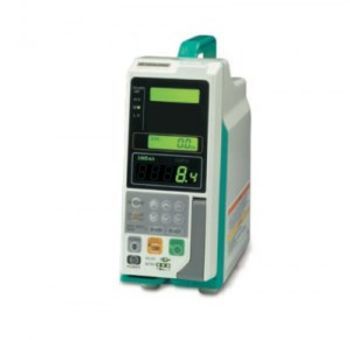
Terumo Terufusion TE-171 Infusion Pump
 Terumo · Model Terufusion TE-171 Infusion Pump
Accuracy (Nominal value) - Within ±3% (Conditions) Infusion set: Specified TeruFuSIoN® Infusion sets type e for pump, solution: water/saline, test time: second hour, delivery rate: 1,0 mL/h or more, temperature: 25 °C; Within ±5% (Conditions) Infusion set: Specified TeruFuSIoN® Infusion sets for pump, solution: water/saline, test time: second hour, delivery rate: 1.0 mL/ h or more, temperature: 25 °C. Delivery rate - 0.1 – 1,200 mL/h (0.1 – 99.9 mL/h: 0.1 mL/h step, 100 – 1,200 mL/h: 1 mL/h step). The delivery rate can be set in 1 mL/h step throughout the range by the internal mode select switch. Delivery limit - 1 – 9,999 mL (1 mL step) or ‘----’ (delivery limit free) Volume delivered - 0.0 – 9,999 mL (0.0 – 99.9 mL: 0.1 mL step, 100 – 9,999 mL: 1 mL step). The volume delivered reading is in 1 mL step from 1 to 9,999 mL by the internal mode select switch. Purging - Higher than 500 mL/h Alarms - AIR/OCCLUSION/FLOW ERR./DOOR/LOW BATT. *operation indicator flashes red, and the alarm message comes on. Operating conditions - Temperature: +5 to +40 °C, humidity: 20 to 90% Storage conditions - Temperature: –20 to +45 °C, humidity: 10 to 95% (No condensation) Power supply - AC 100 – 240 V, 50 Hz DC12 – 15 V; Internal Nickel-Cadmium battery operating time approx. 3 hours. Conditions: new battery, delivery rate: 25 mL/h, temperature: 25 °C with the power off, after 15-hour charging Power consumption - 28 VA (AC 100 – 240 V), 11 W (DC power) Classification - Class I & internal power supply: Type CF/IPX1 Continuous operation Dimensions - 100 (W) x 215 (H) x 208 (D) mm (excl. protrusions) Weight - Approx. 3.6 kg (Te-171).
Key tips
- ·Free-flow protection must be verified on every PM - a failed anti-free-flow clamp is a direct overdose risk.
- ·Test occlusion alarms in both directions - failing to alarm when it should is more dangerous than a false alarm.
- ·Battery run-time complaints are the most common real-world nuisance call - a full charge/discharge cycle test catches most of them.
Typical Failure Modes
Compiled for this model from its own documentation and established engineering knowledge for this equipment class - not from a verified service record. Confirm against the manufacturer's service manual.
Failure / error message stops delivery
HighSymptoms: The pump alarms and displays an error message / code and stops.
Root cause: A subsystem fault indexed in the service manual - motor / drive, a sensor, set-detection, or a board.
Occlusion alarm / pressure fault
MediumSymptoms: Repeated occlusion alarms, delivery stops, or an occlusion is missed.
Root cause: Kinked or clamped line, a closed roller clamp, a positional patient tube, pressure-sensor drift, or an improperly loaded set.
Air-in-line alarm
MediumSymptoms: Frequent air-in-line alarms, delivery stops.
Root cause: Air in the set, an improperly loaded set, or an ultrasonic air-detector fault.
Flow-rate accuracy drift
MediumSymptoms: Delivered volume outside tolerance on the annual test, especially at low rates.
Root cause: Worn pumping mechanism / plunger drive.
Battery will not hold charge
MediumSymptoms: Short run time, low-battery early after a full charge.
Root cause: Aged battery pack.
Door / plunger / sensor mechanical wear
LowSymptoms: Set will not load, door will not latch, plunger grip poor.
Root cause: Worn door latch, plunger jaws, or anti-free-flow mechanism.
Serviceable Parts & Consumables
Serviceable items for this model, compiled from its documentation and engineering knowledge for this equipment class. Service class and relative cost are estimates, not manufacturer figures; no part numbers are given. Confirm intervals and pricing against the manufacturer.
Battery pack
Class Periodic replacementRel. cost $$R&R Fairly easy
Pumping mechanism / rotor / plunger drive
Class Major service partRel. cost $$$R&R Difficult
Pressure / air-detector sensor assembly
Class Major service partRel. cost $$R&R Moderate
Door / latch / anti-free-flow assembly
Class Major service partRel. cost $$R&R Moderate
Drive motor / gearbox
Class Major service partRel. cost $$$R&R Difficult
| Part | Service class | Relative cost | R&R difficulty |
|---|---|---|---|
| Battery pack | Periodic replacement | $$ | Fairly easy |
| Pumping mechanism / rotor / plunger drive | Major service part | $$$ | Difficult |
| Pressure / air-detector sensor assembly | Major service part | $$ | Moderate |
| Door / latch / anti-free-flow assembly | Major service part | $$ | Moderate |
| Drive motor / gearbox | Major service part | $$$ | Difficult |
Relative cost: $ lowest · $$$$ highest service-part cost for this equipment class. Not a price.
PM Checklist
Preventive-maintenance tasks typical of this equipment class. Perform to the manufacturer's procedure and your facility's policy - this is general reference, not a schedule for this specific unit.
- ·Occlusion pressure and flow-rate accuracy verification
- ·Battery conditioning cycle
- ·Door latch and air-in-line sensor inspection
- ·Post-drop functional check before return to service
- ·Annual PM per manufacturer schedule
Troubleshooting Approach
A starting sequence for this model, compiled from its documentation and engineering knowledge for this equipment class. Follow the manufacturer's service documentation for the actual procedure.
Symptom: Error message or code
- Note the exact error message / code.
- Look it up in the pump's technical service manual troubleshooting section.
- Use the biomed diagnostics / utilities to test the affected subsystem.
- Follow the manual's parts-replacement procedure.
- Run the scheduled-maintenance test set (including flow accuracy) after any repair.
Symptom: Occlusion or delivery problem
- Check the line for kinks, clamps and a closed roller clamp; check the patient site.
- Reload the set correctly, clearing all air.
- Confirm an approved set for this pump.
- Run the pressure / air-detector (or rotor) test in diagnostics.
- Replace the set; refer the pump if a sensor / mechanism fault is indicated.
Technical Specs
- Height
- 215 mm
- Length
- 208 mm
- Flow Rate Range
- 0.1 to 1200 ml/h
- Weight
- 3.6 kg
- Flow Accuracy
- 3 %
- Width
- 100 mm
Typical Location
Where this class of equipment is typically deployed - general reference, not this unit's own placement record.
- Patient care floors
- ICU
- OR
- Oncology / infusion centers
- Home health (portable pumps)
Documents & Manuals
No documents available for this device yet.
Safety & Recalls
Synced live from the FDA openFDA API.
- RECALL
These roller pumps were assembled with pump shafts that may fail at the location of the thread where a locknut is installed. The failure is associated with a noise that is atypical of roller pump operation. The noise is caused when an unsecured shaft end contacts the rotating pulley of the roller pump. Prolonged use of a roller pump in this condition could lead to an eventual pump stop, resulting in the inability to create pump flow due to pulley loosening and drive belt damage.
- RECALL
Potential improper bonding between the tube and luer for certain lots of Surflo Winged Infusion Set with Filter and Needle Protection (Surshield).
- RECALL
Incorrect customer notification label applied to the Tyvek lid of this specific lot of Terumo Cardiovascular Procedure Kits
- RECALL
Terumo CVS has received reports of 27 instances in which the 6 inch Roller Pump jammed during cardioplegia delivery. There has been one report of the pump jamming during a case that concluded with an adverse patient outcome, although there was no indication that the pump jam contributed to the adverse patient outcome.
- RECALL
Terumo Cardiovascular Systems (Terumo CVS) discovered and rejected a single digital encoder cable assembly during incoming inspection because it had a loose wire. The assembly is used in the 4" and the 6" roller pumps for the Terumo Advanced Perfusion System 1.
- RECALL
Terumo CVS discovered that our In house service center has incorrectly installed a felt washer into the main bearing of nine roller pumps that had been returned for repair or preventative maintenance unrelated to the felt washer. The felt washer was added as a validated running change to production to all roller pumps manufactured since February 2009. The felt washer should not have been installed
- RECALL
3-T Medical Systems one way vent valves, included in the Custom Terumo Cardiovascular kits, may separate at the bond that holds the two halves
- RECALL
The firm has received multiple reports of the lower roller pump tube clamp mechanism failing to function in a small population of devices, making it difficult to remove or insert the tubing. If the failure occurs, the clamp dial will no longer be able to control opening/closing of the tube clamp mechanism.
- RECALL
Vent port may be occluded and prevent delivery of fluid
- RECALL
The pumps may fail to power up or experience unplanned pump stops.
- RECALL
Overspeed and underspeed errors, erratic pump behavior, jerky operation at low RPMs, pump instability, pump slowdowns and pump stops due to overspeed max events may occur due to a grease leak onto the motor speed encoder disk.
- RECALL
Loose Flash at tip of Weighted Flexible Sucker: A loose strand of stainless steel left on the device during manufacturing by an outside supplier may result in an unretrieved metal fragment remaining in the patient.
- RECALL
The system may malfunction due to t-filter corrosion on an internal circuit board.
- RECALL
Failure to operate; The pump may fail to operate, and be difficult to hand crank, due to an internal electrical short condition.
- RECALL
The hand crank may crack in the bearing/shaft area due to a manufacturing defect. (Note: Some of the hand cranks subject to this recall were shipped as replacements for hand cranks recalled in the Summer of 2006.)
- RECALL
The roller pump will pause in response to a pressure alarm condition, as designed, but then may not resume operation as expected after the alarm condition has been cleared.
- RECALL
The pump may lose communication with the central control monitor, causing the monitor to display a service message "System Computer Needs Service" and to become non-operational.
- RECALL
The roller pump speed control knobs and the centrifugal pump speed control knobs may fail to function/change pump speed.
- RECALL
Six inch roller pumps were mislabeled as 4 inch roller pumps.
- RECALL
The pump may stop during the autodose delivery without completion of the dose delivery to the patient.
- RECALL
The tube clamp mechanism on the roller pump may not open when the rotation knob is turned, making it difficult to remove and/or insert tubing.
- RECALL
Small cracks in the blood chamber may allow air to enter the rotor of the device
- RECALL
The pumps will stop, show an overspeed error message, and will not restart using routine procedures if the user reduces the pump speed to zero RPM while the pump is operating in pulse mode.
- RECALL
Device module(s) may fail to properly initialize during start up, thus resulting in that single module being inoperable and a red 'X' being displayed on the monitor screen.
- RECALL
The internal ribbon cable may loosen from the roller pump display board, resulting in loss of local control and/or local display.
- RECALL
Roller Pump: Due to a circuit board malfunction the roller pumps may stop during use without displaying an error message, may stop during use with an overspeed error posted on the local display, or may fail to start/restart resulting in the pump(s) being non-functional.
- RECALL
A belt slip message may be displayed on the roller pump due to low belt tension or the presence of grease.
- RECALL
The roller pump tube clamp mechanism may fail to release , making it difficult to remove or insert the tubing, and thereby delaying perfusion.
Related calculators
From BioLab, for work done with this kind of equipment.
Troubleshoot this device with Bio
Describe a symptom or error code. Bio answers from this device's own documented error codes, failure modes, parts, and guides.
Ask Bio