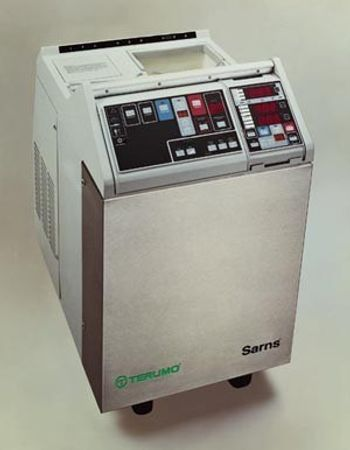
Terumo TCM II
 Terumo · Model TCM II
Digital Heater/Cooler Maintains exact temperatures with sensitive, microprocessor-driven controls Minimizes patient rewarming time with powerful heaters and high-efficiency mixing manifold Reduces patient cooling time by melting ice Sarns optional remote control and display module for temperature management at your fingertips while the main unit is situated in a convenient, remote location Temperature displays in digital readouts for up to nine temperature probes; readouts for up to 9 temperature probes by using 3 temperature modules; alarm can be set for 3 probes (one probe per module) located at crucial temperature sites Precise temperature controls maintained by a microprocessor which allows oxygenator water temperature selection from 0 - 42°C in one-degree increments Independent cardioplegia control offers three pump speeds for variable cooling rates and a separate reservoir accommodates drop-in heat exchangers Pressure-regulated blanket ports with water-supply maintain the same temperature as water going to the oxygenator heat exchanger.
Key tips
- ·Never skip temperature-accuracy verification to save time - it's the one check that directly prevents burns.
- ·Hose/blanket connector wear is the most common real fault and the easiest to miss on a quick visual check.
Typical Failure Modes
Compiled for this model from its own documentation and established engineering knowledge for this equipment class - not from a verified service record. Confirm against the manufacturer's service manual.
Will not reach or hold set patient / water temperature
HighSymptoms: Water temperature drifts from setpoint, patient temperature not tracking, over/under-temp alarm.
Root cause: Heater / thermoelectric or refrigeration fault, a temperature-probe fault, or a circulation-pump / flow fault.
Circulation-pump / flow fault
MediumSymptoms: Low-flow alarm, blanket not filling, pump noisy.
Root cause: Worn pump, an air-locked circuit, or a kinked / disconnected hose.
Patient-probe fault
MediumSymptoms: Patient temperature implausible or open-probe alarm, auto-control will not regulate.
Root cause: Damaged patient temperature probe or its connector.
Leak / reservoir fault
MediumSymptoms: Low-water alarm, water on the floor, air in the lines.
Root cause: Reservoir low, a hose / fitting leak, or a blanket leak.
Refrigeration fault (cooling units)
MediumSymptoms: Cannot cool water, compressor not running.
Root cause: Compressor, condenser fan, or a sealed-system fault.
Serviceable Parts & Consumables
Serviceable items for this model, compiled from its documentation and engineering knowledge for this equipment class. Service class and relative cost are estimates, not manufacturer figures; no part numbers are given. Confirm intervals and pricing against the manufacturer.
Circulation pump
Class Periodic replacementRel. cost $$$R&R Difficult
Patient temperature probe
Class Frequent wear itemRel. cost $$R&R Easy
Heater / thermoelectric module
Class Major service partRel. cost $$$R&R Difficult
Hoses / quick-connectors
Class Periodic replacementRel. cost $$R&R Easy
Refrigeration components (cooling units)
Class Major service partRel. cost $$$R&R Difficult
| Part | Service class | Relative cost | R&R difficulty |
|---|---|---|---|
| Circulation pump | Periodic replacement | $$$ | Difficult |
| Patient temperature probe | Frequent wear item | $$ | Easy |
| Heater / thermoelectric module | Major service part | $$$ | Difficult |
| Hoses / quick-connectors | Periodic replacement | $$ | Easy |
| Refrigeration components (cooling units) | Major service part | $$$ | Difficult |
Relative cost: $ lowest · $$$$ highest service-part cost for this equipment class. Not a price.
PM Checklist
Preventive-maintenance tasks typical of this equipment class. Perform to the manufacturer's procedure and your facility's policy - this is general reference, not a schedule for this specific unit.
- ·Hose / blanket connector inspection
- ·Temperature-accuracy verification
- ·Annual electrical safety test
Troubleshooting Approach
A starting sequence for this model, compiled from its documentation and engineering knowledge for this equipment class. Follow the manufacturer's service documentation for the actual procedure.
Symptom: Will not hold set temperature
- Confirm the reservoir is filled and the blanket circuit is primed (no air).
- Verify the water temperature against an independent thermometer.
- Check the patient probe against a reference and swap it.
- Confirm the circulation pump delivers flow.
- Replace the probe, pump or heater / refrigeration components as isolated.
Symptom: Low-flow or leak alarm
- Check the hoses for kinks and confirm the quick-connectors are seated.
- Top up the reservoir and bleed air from the circuit.
- Inspect the blanket and hoses for leaks.
- Replace a leaking hose / blanket.
- Confirm the flow alarm clears and temperature control is stable.
Technical Specs
- Height
- 34.4 in
- Length
- 31.5 in
- Weight
- 282 356 lbs with the tanks full
- Width
- 20 in
Typical Location
Where this class of equipment is typically deployed - general reference, not this unit's own placement record.
- Operating Room
- PACU
- Emergency Department
- Labor & Delivery
- NICU
Documents & Manuals
Troubleshoot this device with Bio
Describe a symptom or error code. Bio answers from this device's own documented error codes, failure modes, parts, and guides.
Ask Bio