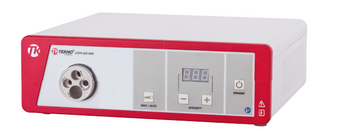
TEKNO-MEDICAL 300W
 TEKNO-MEDICAL · Model 300W
Equates Xenon 300 Watt Operating Life > 30.000 h Colour temperature 6.000 - 6.500°K Line voltage 110 - 240 VAC, 50-60 Hz Type Class 1, Typ BF Power consumption 300 W Brightness control 0 - 100% adjustable Light exit Storz/Wolf/Olympus/ACMI Video inputs BNC Weight 10 kg Size (W x H x D) 355 x 120 x 340 mm Produced and tested acc 93/42/ECC, IEC 601-1/, EN 60601-1.
Key tips
- ·When no category-specific guidance fits, default to the manufacturer's own service manual and the general troubleshooting method in the Engineer's Guide.
- ·Run an incoming and annual electrical safety test regardless of how niche the device is.
Typical Failure Modes
Compiled for this model from its own documentation and established engineering knowledge for this equipment class - not from a verified service record. Confirm against the manufacturer's service manual.
No or dim light output
HighSymptoms: Endoscope image dark, no light at the cable tip, sudden loss during a case.
Root cause: Xenon / halogen lamp at end of life, a lamp-ignition fault, or a burnt lamp module.
Cooling fan fault / thermal shutdown
HighSymptoms: Unit shuts down after a period, over-temperature warning.
Root cause: Failed or obstructed cooling fan, or a blocked air intake.
Light-cable coupling fault
MediumSymptoms: Weak light only from one cable, or light only with the cable pushed in hard.
Root cause: Worn turret / cable adapter, or a damaged light cable (broken fibres).
Intensity control / iris fault
LowSymptoms: Brightness will not adjust, or auto-intensity does not track.
Root cause: Mechanical iris or the intensity control.
Serviceable Parts & Consumables
Serviceable items for this model, compiled from its documentation and engineering knowledge for this equipment class. Service class and relative cost are estimates, not manufacturer figures; no part numbers are given. Confirm intervals and pricing against the manufacturer.
Xenon / halogen lamp module
Track lamp hours; let it cool before changing.
Class Frequent wear itemRel. cost $$$R&R Fairly easy
Cooling fan
Class Periodic replacementRel. cost $$R&R Moderate
Light-cable adapter / turret
Class Major service partRel. cost $$R&R Moderate
Iris / intensity control assembly
Class Major service partRel. cost $$R&R Moderate
Mains fuse
Class Major service partRel. cost $R&R Fairly easy
| Part | Service class | Relative cost | R&R difficulty |
|---|---|---|---|
| Xenon / halogen lamp module Track lamp hours; let it cool before changing. | Frequent wear item | $$$ | Fairly easy |
| Cooling fan | Periodic replacement | $$ | Moderate |
| Light-cable adapter / turret | Major service part | $$ | Moderate |
| Iris / intensity control assembly | Major service part | $$ | Moderate |
| Mains fuse | Major service part | $ | Fairly easy |
Relative cost: $ lowest · $$$$ highest service-part cost for this equipment class. Not a price.
PM Checklist
Preventive-maintenance tasks typical of this equipment class. Perform to the manufacturer's procedure and your facility's policy - this is general reference, not a schedule for this specific unit.
- ·Follow the manufacturer's PM schedule
- ·Perform incoming and annual electrical safety testing per facility biomedical program
Troubleshooting Approach
A starting sequence for this model, compiled from its documentation and engineering knowledge for this equipment class. Follow the manufacturer's service documentation for the actual procedure.
Symptom: No or dim light
- Check the lamp-hours counter and replace the lamp module if near end of life (let it cool first).
- Confirm the lamp ignites (listen / watch on power-up).
- Try a known-good light cable.
- Check the mains fuse (unplug first).
- Verify full, even output at the cable tip.
Symptom: Thermal shutdown
- Confirm the fan runs and the intake / exhaust are unobstructed.
- Clean the vents.
- Replace the fan if it is noisy or stopped.
- Let the unit cool and restart.
- Monitor for recurrence during a long run.
Typical Location
Where this class of equipment is typically deployed - general reference, not this unit's own placement record.
- Varies by device - check the unit's own manual for facility placement guidance
Documents & Manuals
Troubleshoot this device with Bio
Describe a symptom or error code. Bio answers from this device's own documented error codes, failure modes, parts, and guides.
Ask Bio