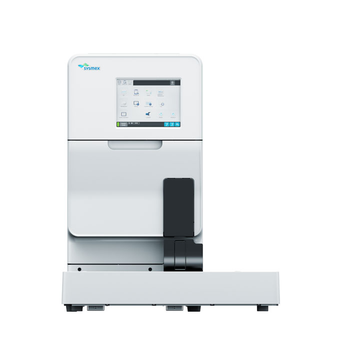
Sysmex UF-5000 / UF-4000
Sysmex · Model UF-5000 / UF-4000
Body Fluids The new technology opens up many unexplored diagnostic avenues. The integrated body fluid mode is available at the flick of a switch and delivers seven diagnostic parameters in BF mode. Clinical investigation of bacterial or viral infections in body fluids is possible through the WBC differentiation and bacterial count. Bacterial detection Further diagnostic significance is obtained thanks to the new blue laser, which offers greater sensitivity. Bacteria are stained with the new RFID dye reagents, contributing to greater accuracy for measurement and differentiation. UTI infections The new Gram pos / Gram negative flag provides valuable information as the clinician in understanding the patient with a UTI infection. The UF offers a faster and far easier way than the classic gram staining to provide the same information. You can now identify UTIs faster and reliably, to support clinical decisions in the choice of antibiotics to prescribe. Haematuria Historically, it has been challenging to differentiate RBC and crystals. Using the depolarised side scatter light in the FFC technology, results can indicate the presence and degree of haematuria. The analysis can also differentiate epithelial cells and casts. It offers a total of seventeen parameters in urine mode. Modular While the UF-5000 can be used as an excellent independent analyser, it truly lives up to its potential as an integral part of the UN-Series in a load and leave configuration. Place the samples in the rack, and simply let the system configuration do its work. If the samples are negative, all the better. If a closer look is warranted, digital images can be generated from the UD-10. Modular concept: easy to combine with other members of the UN-Series (UC-3500 and UD-10) for a fully automated urinalysis workflow. With the introduction of the Urinalysis Work Area Information Management System (U-WAM), Sysmex can improve the workflow efficiency of the new urinalysis series.
Key tips
- ·Run QC controls before trusting any repair - an analyzer that passes self-test can still report clinically wrong results.
- ·Rule out a reagent lot change before opening the instrument - it can look exactly like a hardware fault.
- ·Centrifuge rotors have a hard retirement age/cycle limit regardless of visible condition - don't eyeball it.
Typical Failure Modes
Compiled for this model from its own documentation and established engineering knowledge for this equipment class - not from a verified service record. Confirm against the manufacturer's service manual.
Result / QC failure
HighSymptoms: Strip results flagged or biased, QC out of range, colour blocks misread.
Root cause: Expired or mishandled strips, a dirty / aged optics head, or a calibration issue.
Strip transport / feed fault
MediumSymptoms: Strip not transported, jams, or read at the wrong position.
Root cause: Worn strip-transport belt / tray or a position-sensor fault.
Optics / reflectance-head fault
MediumSymptoms: Repeated optics errors, non-uniform reads across the pads.
Root cause: Contaminated or aged reflectance LEDs / optics.
Sediment / microscopy module fault (if fitted)
MediumSymptoms: Poor particle images, flow-cell or camera errors.
Root cause: Flow-cell contamination, a pump fault, or the camera / focus.
Printer / LIS fault
LowSymptoms: No printout, results not sent to the LIS.
Root cause: Printer or the interface configuration.
Serviceable Parts & Consumables
Serviceable items for this model, compiled from its documentation and engineering knowledge for this equipment class. Service class and relative cost are estimates, not manufacturer figures; no part numbers are given. Confirm intervals and pricing against the manufacturer.
Strip transport belt / tray
Class Periodic replacementRel. cost $$R&R Moderate
Optics / reflectance head
Class Major service partRel. cost $$R&R Moderate
Calibration strips / QC
Class Frequent wear itemRel. cost $R&R Easy
Sediment flow cell / pump tubing (if fitted)
Class Frequent wear itemRel. cost $$R&R Moderate
Printer / paper
Class Periodic replacementRel. cost $R&R Fairly easy
| Part | Service class | Relative cost | R&R difficulty |
|---|---|---|---|
| Strip transport belt / tray | Periodic replacement | $$ | Moderate |
| Optics / reflectance head | Major service part | $$ | Moderate |
| Calibration strips / QC | Frequent wear item | $ | Easy |
| Sediment flow cell / pump tubing (if fitted) | Frequent wear item | $$ | Moderate |
| Printer / paper | Periodic replacement | $ | Fairly easy |
Relative cost: $ lowest · $$$$ highest service-part cost for this equipment class. Not a price.
PM Checklist
Preventive-maintenance tasks typical of this equipment class. Perform to the manufacturer's procedure and your facility's policy - this is general reference, not a schedule for this specific unit.
- ·Daily QC controls run and reviewed
- ·Calibration verification per assay
- ·Routine cleaning and decontamination
- ·Scheduled reagent-path and pump-tubing maintenance
Troubleshooting Approach
A starting sequence for this model, compiled from its documentation and engineering knowledge for this equipment class. Follow the manufacturer's service documentation for the actual procedure.
Symptom: Result or QC failure
- Repeat with a fresh strip from a correctly stored, in-date pack.
- Run the calibration strip / grey check.
- Run QC controls at each level.
- Clean the optics head and strip tray.
- Quarantine the strip lot if QC fails; refer the analyzer if QC passes but results still look wrong.
Symptom: Strip transport fault
- Clear any jammed strip.
- Clean and inspect the transport belt / tray.
- Check the position sensor.
- Cycle several test strips.
- Replace the transport belt if feed is unreliable.
Typical Location
Where this class of equipment is typically deployed - general reference, not this unit's own placement record.
- Central / core laboratory
- Point-of-care testing stations
- Blood bank
- Microbiology lab
Documents & Manuals
Safety & Recalls
Synced live from the FDA openFDA API.
- RECALL
When excessive amounts of urine spills on the rack transport track and reaches the electrical components of the CV-11 conveyor, there is a potential for smoke and/or sparks which may present a combustion hazard.
Troubleshoot this device with Bio
Describe a symptom or error code. Bio answers from this device's own documented error codes, failure modes, parts, and guides.
Ask Bio