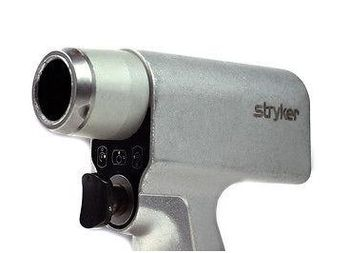
Stryker System 4 Single Trigger
 Stryker · Model System 4 Single Trigger
Stryker System 4 Single Trigger Rotary Handpiece.
Key tips
- ·Never defeat or bypass a return-electrode monitoring (REM) alarm to finish a case - it's a direct burn risk.
- ·Verify OR table battery backup - a table that loses power mid-procedure is a real, documented incident type.
- ·Track surgical light lamp-hours rather than waiting for failure - a sudden failure mid-case is avoidable.
Typical Failure Modes
Compiled for this model from its own documentation and established engineering knowledge for this equipment class - not from a verified service record. Confirm against the manufacturer's service manual.
Weak or no power / stalls under load
HighSymptoms: Handpiece runs slow, stalls when drilling / cutting, or does not run at all.
Root cause: Worn motor / turbine, worn gears / bearings, a low or aged battery, or (pneumatic) low supply pressure / a worn hose.
Overheats in use
MediumSymptoms: Handpiece or attachment gets hot quickly, burn / thermal-necrosis risk.
Root cause: Worn bearings / gears, a dry / seized attachment, or over-duty use.
Battery will not hold charge (battery tools)
HighSymptoms: Few cases per charge, will not reach full charge, sudden shutdown.
Root cause: Aged battery pack or a charger fault.
Chuck / coupling / attachment fault
MediumSymptoms: Bur / blade / pin slips or will not lock, attachment wobbles, quick-coupler worn.
Root cause: Worn chuck / collet or coupling.
Trigger / control fault
MediumSymptoms: Speed will not vary, forward/reverse or oscillate will not select, trigger sticks.
Root cause: Worn trigger / control mechanism or its seals.
Serviceable Parts & Consumables
Serviceable items for this model, compiled from its documentation and engineering knowledge for this equipment class. Service class and relative cost are estimates, not manufacturer figures; no part numbers are given. Confirm intervals and pricing against the manufacturer.
Motor / turbine assembly
Class Periodic replacementRel. cost $$$R&R Difficult
Gear / bearing service kit
Class Periodic replacementRel. cost $$R&R Difficult
Battery pack (battery tools)
Class Periodic replacementRel. cost $$$R&R Fairly easy
Chuck / collet / quick-coupler
Class Periodic replacementRel. cost $$R&R Moderate
Trigger / seal kit
Class Periodic replacementRel. cost $$R&R Moderate
| Part | Service class | Relative cost | R&R difficulty |
|---|---|---|---|
| Motor / turbine assembly | Periodic replacement | $$$ | Difficult |
| Gear / bearing service kit | Periodic replacement | $$ | Difficult |
| Battery pack (battery tools) | Periodic replacement | $$$ | Fairly easy |
| Chuck / collet / quick-coupler | Periodic replacement | $$ | Moderate |
| Trigger / seal kit | Periodic replacement | $$ | Moderate |
Relative cost: $ lowest · $$$$ highest service-part cost for this equipment class. Not a price.
PM Checklist
Preventive-maintenance tasks typical of this equipment class. Perform to the manufacturer's procedure and your facility's policy - this is general reference, not a schedule for this specific unit.
- ·Pre-case functional check
- ·Electrosurgical return-electrode cable inspection
- ·Table hydraulic / mechanical inspection
- ·Annual electrical safety test and full PM
Troubleshooting Approach
A starting sequence for this model, compiled from its documentation and engineering knowledge for this equipment class. Follow the manufacturer's service documentation for the actual procedure.
Symptom: Weak, stalling or no power
- Fit a fully charged battery (battery tools) or confirm the pneumatic supply pressure and hose.
- Fit a fresh, sharp attachment and confirm it seats and locks.
- Run the handpiece off the patient and listen / feel for bearing or gear roughness.
- Service the handpiece (bearings / gears / seals) or replace the motor.
- Confirm rated speed and torque and normal running temperature after service.
Symptom: Overheats
- Use sharp attachments and observe the duty cycle.
- Check the attachment / coupling is not dragging or dry.
- Feel for bearing roughness.
- Service the bearings / gears.
- Confirm the handpiece runs cool under a normal load.
Technical Specs
- Function
- Saw
Typical Location
Where this class of equipment is typically deployed - general reference, not this unit's own placement record.
- Operating rooms
- Procedure rooms
- Interventional suites
Documents & Manuals
No documents available for this device yet.
Safety & Recalls
Synced live from the FDA openFDA API.
- RECALL
Due to potential for tourniquet cuffs to detach from the bladder at the welding connection and result in the cuff not being able to maintain pressure.
- RECALL
Due to manufacturing issue, reprocessed shears, may become stuck in the "on position" resulting in continuous activation.
- RECALL
Tourniquet cuff flange may become detached from the bladder. If leak occurs during the procedure, there may be risk of hemorrhage, resulting in blood loss greater than expected. Other serious risks include cerebral hypotension and cardiovascular collapse and arrest, risking stroke or death. Specific to IVRA, patient toxicity may also occur due to rapid systemic absorption of anesthetics.
- RECALL
Stryker Neurovascular has observed that devices with Out of United States (OUS) approved Instructions for Use (IFU) and Packaging Labels (pouch and carton), different configurations, have been erroneously distributed to customers in the US.
- RECALL
Mislabeling; tourniquet cuff packaging labeled as dual port single bladder but contains a tourniquet cuff single port single bladder.
- RECALL
Unreleased software was installed on customer systems resulting in the visual feedback on the screen to show the points to be off from the physical reference point of the pointer or suction.
- RECALL
Stryker Neurovascular is recalling their DAC- Distal Access Catheter -038 136cm, a Distal Access Catheter by removal. The reason for the recall is: the DAC Lot #0000486382 was released with out-of-specification endotoxin results.
- RECALL
Increased incidence of disposable tourniquet cuffs "not able to achieve desired pressure" and "not holding pressure" due to 1) Cuff fabric tearing during use, and 2) Pinched or unseated O-ring at the connection between the cuff, disposable fill line, and/or cuff hosing, which may lead to loss of vascular occlusion, which may lead to operative site blood loss, hemorrhage, or other complications.
- RECALL
Mislabeling; dual-bladder tourniquet cuffs are labeled as single-bladder inflatable cuffs.
- RECALL
Potential for the inner bit to contain a crack, that may or may not be visible, which may lead to metal fragments entering the surgical site and/or delayed disengagment during use.
- RECALL
Seal integrity of the blister pack may be compromised and sterility cannot be assured
- RECALL
There is a potential for the cuff to leak air leading to a loss of vascular occlusion.
- RECALL
Tourniquet cuffs are potentially mislabeled. If used may lead to (1) Device misuse during procedure (2) Inadequate Limb Compression Force.
- RECALL
Complaints have been received regarding difficulty in removing the driver from the screw. High driver removal forces can lead to the screw pulling out still attached to the driver. This could result in an additional anchor insertion site in the bone being used.
- RECALL
A design related issue can contribute to the device exhibiting brittle behavior. This behavior may result in fractures of the catheter shaft.
- RECALL
Stryker Instruments is voluntarily recalling specific lots of sterile MIS Toolsteel Burs because the burs may exhibit signs of corrosion.
- RECALL
Issue with the process for detection of leaking Pressure Tourniquet Cuffs (PTC). Leaking PTC devices may result in excessive blood loss requiring surgical or medical intervention or systemic leakage of local anesthetic during Bier Block requiring medical intervention.
- RECALL
Stryker Sustainability Solutions has received reports indicating that devices from one lot (lot# 3574704) were labeled as 100mm models (CB5LT) while the devices inside of the packaging were 75mm models (CB5ST).
- RECALL
Stryker Instruments is recalling the Stryker SelectCore Variable Throw Biopsy Device due to the potential for for the stylet to eject from the SelectCore device during actuation.
- RECALL
Stryker Instruments is voluntarily recalling the CBCII Wound Drains and Ambulating Bulb for a potential sterility breach in the packaging
- RECALL
The Color Cuff Sterile Disposable Tourniquet Cuffs with Quick-Connect Fitting may have an incorrect end-connector. A customer reported having received a luer connector instead of a quick connect fitting. An incorrect connector may lead to an inoperable system due to incompatibility with the Smart Pump.
- RECALL
Stryker received reports from the field of the impaction plate dissociating/fracturing from the main body of the broach handle.
- RECALL
Stryker has identified a potential for the auger and/or cannula to fracture when the Dekompressor is used contrary to the warnings in the Instructions For Use (IFU). Specifically, manually bending the cannula can weaken the device and may result in a fracture of the auger and/or cannula. This could result in the need for additional medical intervention to remove the broken piece, pain or loss of m
- RECALL
Stryker Osteosynthesis has become aware that LEFT GAMMA3 nails are marked as right nails.
- RECALL
When preparing plasma using VitaPrep, it was reported that a small amount of blood collected in the bottom of the centrifuge cup following the centrifugation step. Firm has since discovered that if blood is present in the Luer connection of the VitaPrep following the blood draw step, this blood could be displaced to the outside of the syringe when the VitaPrep cap is reattached to the syringe. T
- RECALL
Stryker Orthopaedics has become aware of the potential for the above noted Accolade Rasp Handle Assembly to fracture upon use.
- RECALL
Product was packaged with a four inch needle in stead of the correct five inch needle. There is a potential that the needle may not be able to reach the fracture site, which may require additional medical intervention. In addition, if the stylet needs to be changed and the additional stylet that comes in the package is used, this additional stylet is one inch longer than the needle. which could l
- RECALL
Stryker Orthopaedics has become ware that there is the potential for interpretation of the product labeling which may lead to an incorrect implant being used.
- RECALL
There is potential for a breach in sterility in the blister packaging. This can lead to the use of non-sterile product which, if contaminated, could lead to a patient infection.
- RECALL
Failure to infuse and potential compromised sterility: The seal on the tyvek tray cover may fail, compromising sterility, and the device may fail to infuse the drug, resulting in a loss of pain mitigation.
- RECALL
The label on one side on the Ray TFC Device (Ray Cage) is incorrect. It reads 20 mm x 26 mm instead of 20 mm x 21 mm.
- RECALL
Kit fibers may not illuminate along entire length, which may result in inadequate visibility of the urethral structures during surgery
Troubleshoot this device with Bio
Describe a symptom or error code. Bio answers from this device's own documented error codes, failure modes, parts, and guides.
Ask Bio