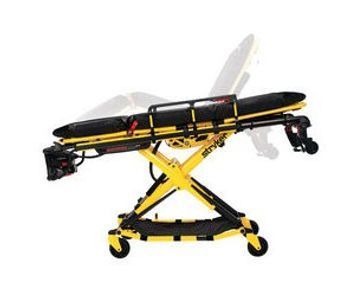
Stryker Power-PRO XT
 Stryker · Model Power-PRO XT
Ambulance Cot The Power-PRO XT is an innovative battery-powered hydraulic system that raises and lowers the patient with the touch of a button. The industry-leading Stryker Power-PRO XT powered ambulance cot dramatically reduces strenuous lifting and the associated risk of back injury. Medics experience frequent spinal loading due to repetitive motions such as lifting, lowering, carrying, and bending. Use of the Power-PRO XT has proven to reduce spinal loading, resulting in reduced injuries, lost or modified workdays, and workers’ compensation costs, and increased recruitment and retention. The innovative battery powered hydraulic system raises and lowers patients with the touch of a button. The Stryker Power-PRO XT sets the standard for superior performance and outstanding ergonomics. Easy to use manual back-up system provides complete cot operation in the event of power loss. Foot end mounted Stryker SMRT battery is accessible and easily changed in any situation. Retractable head section allows cot to be shortened in any height position for maximum versatility. Exclusive automatic high speed retract feature reduces load and unload times. The Stryker Power-PRO XT – now the industry standard of care.
Key tips
- ·Mounting and securement hardware takes real fatigue from vibration and road shock - inspect it as carefully as the device itself.
- ·Post-call battery and function checks catch transport-induced faults that a scheduled PM would miss for months.
Typical Failure Modes
Compiled for this model from its own documentation and established engineering knowledge for this equipment class - not from a verified service record. Confirm against the manufacturer's service manual.
Hydraulic height / Trendelenburg will not lift or holds poorly
HighSymptoms: Pump will not raise the deck, or the deck settles under load.
Root cause: Worn hydraulic pump / seals, an internal valve leak, or low hydraulic fluid.
Brake / steer castor fault
MediumSymptoms: Brake will not hold, fifth-wheel steer ineffective, castor shimmy.
Root cause: Worn brake linkage, castors, or the fifth-wheel mechanism.
Backrest / Fowler mechanism fault
MediumSymptoms: Backrest will not raise / hold, gas strut weak, pneumatic assist failed.
Root cause: Worn gas spring / strut or the release mechanism.
Siderail / IV pole / accessory fault
LowSymptoms: Siderails will not latch or drop, IV pole loose, litter attachments worn.
Root cause: Worn latches, detents, or accessory sockets.
Powered drive fault (powered stretchers)
MediumSymptoms: Drive assist will not engage or is weak, drive-fault code.
Root cause: Drive battery, motor / controller, or the throttle.
Serviceable Parts & Consumables
Serviceable items for this model, compiled from its documentation and engineering knowledge for this equipment class. Service class and relative cost are estimates, not manufacturer figures; no part numbers are given. Confirm intervals and pricing against the manufacturer.
Hydraulic pump / seal kit
Class Major service partRel. cost $$R&R Moderate
Castor / brake-linkage set
Class Periodic replacementRel. cost $$R&R Moderate
Backrest gas spring / strut
Class Periodic replacementRel. cost $$R&R Fairly easy
Siderail latch / accessory sockets
Class Major service partRel. cost $$R&R Fairly easy
Drive battery (powered stretchers)
Class Periodic replacementRel. cost $$R&R Fairly easy
| Part | Service class | Relative cost | R&R difficulty |
|---|---|---|---|
| Hydraulic pump / seal kit | Major service part | $$ | Moderate |
| Castor / brake-linkage set | Periodic replacement | $$ | Moderate |
| Backrest gas spring / strut | Periodic replacement | $$ | Fairly easy |
| Siderail latch / accessory sockets | Major service part | $$ | Fairly easy |
| Drive battery (powered stretchers) | Periodic replacement | $$ | Fairly easy |
Relative cost: $ lowest · $$$$ highest service-part cost for this equipment class. Not a price.
PM Checklist
Preventive-maintenance tasks typical of this equipment class. Perform to the manufacturer's procedure and your facility's policy - this is general reference, not a schedule for this specific unit.
- ·Post-call function and battery check
- ·Mounting / securement inspection
- ·Annual full PM and vibration-tolerance check
Troubleshooting Approach
A starting sequence for this model, compiled from its documentation and engineering knowledge for this equipment class. Follow the manufacturer's service documentation for the actual procedure.
Symptom: Will not lift or settles under load
- Check the hydraulic fluid level.
- Pump the deck up under load and time how fast it settles.
- Inspect the pump and cylinder for external leaks.
- Rebuild the pump with the seal kit or bleed the system per the manual.
- Confirm it holds at full height under the rated load.
Symptom: Brake will not hold or castor shimmy
- Inspect the brake linkage and each castor.
- Adjust the central-brake linkage.
- Replace worn castors and the fifth-wheel components.
- Confirm the brake holds on an incline.
- Check steer-lock engagement.
Technical Specs
- Height
- 41.5 in Highest Position
- Length
- 81 in standard
- Weight
- 125 lbs
- Patient Weight Capacity
- 700 lbs
- Width
- 23 in
Typical Location
Where this class of equipment is typically deployed - general reference, not this unit's own placement record.
- Ambulance / transport vehicles
- Emergency Department
- Inter-facility transport teams
Documents & Manuals
Safety & Recalls
Synced live from the FDA openFDA API.
- RECALL
Base leg assembly may bend and result in difficulty engaging/disengaging from fastener, difficulty loading/unloading from ambulance, difficulty raising or lowering the cot, cot tip, or erratic or unintended motion.
- RECALL
Transport Cot has insufficient volume of epoxy to assemblies installed in the head section and foot sectioning system may result in separation of head end or foot end from the cot and result in unexpected disengagement while loading/unloading or transport.
- RECALL
Cot may experience unintended motion due to damaged cables. Potential risk of soft tissue injury to patients such as scrapes or bruises resulting from the cot lowering faster than expected.
- RECALL
Ambulance Cots may not meet crash test standard BS EN 1789
- RECALL
The power load floor plates which hold the ambulance cot anchors in place during patient transport, may be broken.
- RECALL
Complaints of smoke coming from the foot end of the cot. This reportedly occurred when either the battery was placed into the cot or shortly after placing the battery into the cot. In addition to the alleged smoking, one of the reports had also noted that when the user attempted to lower the cot (prior to the alleged smoking) the device went into high speed retract and then a few moments later i
- RECALL
Due to the buildup of grease within the hose and motor, the product may require multiple attempts to start. The grease may also migrate into the attachment end of the motor. There is a negligible possibility that the orange grease may leak from the attachment end of the motor and contaminate the surgical wound resulting in soft tissue inflammation.
- RECALL
Potential for power cord to melt; hazards include electric shock and fire.
- RECALL
The Stryker Universal Battery Charger is not transmitting usage data to the Stryker Cloud as designed. The firm is initiating a software correction to address the issue.
- RECALL
Model 6390 Power-LOAD systems built between September 12, 2012 and September 27, 2012 may have been built with a load switch slide that does not meet specifications causing the lifting ability of the arms to be negatively impacted.
- RECALL
Reports that the AC Power Adaptor may not operate due to wires coming loose in the unit.
- RECALL
Firm has determined Guardian Services does not contain 100% data backup for 12 OfficePACS Power customers on a daily basis.
- RECALL
On 06/09/2009, Stryker Sustain ability Solutions, formerly Ascent Healthcare Solutions, recalled lots 674201 & 674290 of their Reprocessed Mitek Arthroscopic Wand due to the lots not being tested in accordance with the functional test requirement during the time frame of 04/14/09 to 05/25/09.
- RECALL
The head section wheel assembly may flex outward from the cot because the head section wheel bolts, which hold the assembly upright, may back out.
- RECALL
A problem with the design of the transformers may cause the transformers' circuit breakers to trip, which could result in loss of power to connected medical devices.
Troubleshoot this device with Bio
Describe a symptom or error code. Bio answers from this device's own documented error codes, failure modes, parts, and guides.
Ask Bio