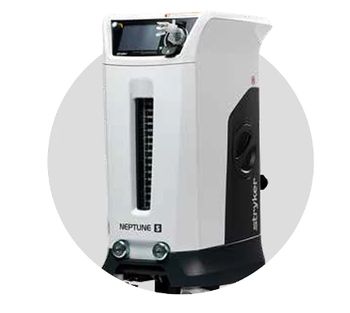
Stryker Neptune S
 Stryker · Model Neptune S
Constantly closed Closed waste management system with 8L fluid capacity reduces your exposure to hazardous fluids. Powerful suction Powerful and reliable suction, adjustable from 50 to 520mm-Hg, elevates the visibility in poor prep cases. Specimen collection Manifold with a collection tray and backup basket offering additional specimen collection security, capturing specimen 2mm or larger. Magnetic docking Easy manipulation and seamless docking with magnetic connection. Hands-free cleaning Automated docking station allows for hands-free cleaning and washing with just a click of a button. Zero canisters Neptune S eliminates the use and disposal of heavy canisters, waste boxes or solidifiers.
Key tips
- ·Always leak-test under load - a regulator that reads correctly at rest can still leak and fail in real use.
- ·Canister and tubing changes are an infection-control issue as much as a mechanical one.
Typical Failure Modes
Compiled for this model from its own documentation and established engineering knowledge for this equipment class - not from a verified service record. Confirm against the manufacturer's service manual.
Will not power on or unexpected shutdown
HighSymptoms: The suction & vacuum is dead, reboots, or shuts down mid-use.
Root cause: Mains lead / fuse, an aged battery, or a power-supply board fault.
Battery will not hold charge
MediumSymptoms: Short run time on battery; low-battery alarm soon after a full charge.
Root cause: Aged rechargeable battery pack or a charger fault.
Display / control-panel fault
MediumSymptoms: Blank, dim or distorted display; unresponsive keys or touchscreen.
Root cause: Display, backlight, or control-board fault.
Fails self-test or calibration
MediumSymptoms: Power-on self-test or the scheduled performance check fails or is out of tolerance.
Root cause: Sensor drift or an internal board fault; recalibration or repair needed.
Serviceable Parts & Consumables
Serviceable items for this model, compiled from its documentation and engineering knowledge for this equipment class. Service class and relative cost are estimates, not manufacturer figures; no part numbers are given. Confirm intervals and pricing against the manufacturer.
Rechargeable battery pack
Class Periodic replacementRel. cost $$R&R Fairly easy
Power supply / mains board
Class Major service partRel. cost $$$R&R Difficult
Display / control-panel assembly
Class Major service partRel. cost $$$R&R Moderate
Cooling fan
Class Major service partRel. cost $R&R Moderate
| Part | Service class | Relative cost | R&R difficulty |
|---|---|---|---|
| Rechargeable battery pack | Periodic replacement | $$ | Fairly easy |
| Power supply / mains board | Major service part | $$$ | Difficult |
| Display / control-panel assembly | Major service part | $$$ | Moderate |
| Cooling fan | Major service part | $ | Moderate |
Relative cost: $ lowest · $$$$ highest service-part cost for this equipment class. Not a price.
PM Checklist
Preventive-maintenance tasks typical of this equipment class. Perform to the manufacturer's procedure and your facility's policy - this is general reference, not a schedule for this specific unit.
- ·Regulator calibration and leak check
- ·Canister / tubing replacement
- ·Annual full PM
Troubleshooting Approach
A starting sequence for this model, compiled from its documentation and engineering knowledge for this equipment class. Follow the manufacturer's service documentation for the actual procedure.
Symptom: Will not power on
- Confirm the outlet, mains lead and fuse.
- Try on battery, then on mains only, to isolate the supply.
- Look for a power indicator or POST code.
- Replace the fuse / battery / power supply as isolated.
- Run the self-test after any repair.
Symptom: Fails self-test or calibration
- Note the exact failure message / code.
- Power-cycle and repeat the self-test.
- Verify against a reference / simulator where one applies.
- Recalibrate per the service manual.
- Refer the affected board for service if it will not hold calibration.
Typical Location
Where this class of equipment is typically deployed - general reference, not this unit's own placement record.
- Operating Room
- Emergency Department
- Patient floors (wall suction regulators)
- Central vacuum plant
Documents & Manuals
No documents available for this device yet.
Safety & Recalls
Synced live from the FDA openFDA API.
- RECALL
It has been identified that the impacted docking station (SN 2521008873) was not product released from manufacturing and may not have completed required testing prior to being shipped to your facility. There is a potential risk of electrical shock due to the device s safety testing being unverifiable.
- RECALL
Bolts on the vacuum pump filter housing and the flange plate were not properly tightened, impacting the function of the Neptune rovers. Systems with loose bolts may fail to provide sufficient suction force or loss of suction during a procedure.
- RECALL
There is a potential for the product to activate without manual input when plugged into a power source or remain active after buttons are released. Unintentional activation of the device may result in localized burns to the patient or physician from electrical currents carried through conductive objects or fluids. Medical/surgical intervention may be needed to correct these injuries
- RECALL
Due to a distribution error, product from the affected lot was shipped expired.
- RECALL
Stryker initiated a voluntary recall of the 120 V Neptune 3 Rover on 07/01/2016, due to a potential for the device to experience system errors causing the device to shutdown if high levels of electromagnetic interference are present in the operating room.
- RECALL
The Fluid Coupling Sleeve, a component within the Neptune Waste Management System Docker, may be out of specification. This can cut or dislodge the PTFE seal and cause a leak between the Rover and Docker couplers during docking or leaking from the Rover coupler after docking. The potential hazard is waste fluid and/or fresh water dispensed from the Neptune 2 Rover at the incorrect time.
- RECALL
Stryker Instruments is initiating a recall of the Neptune 2 Waste Management System due to complaints related to installation failures of the Neptune 2 diverter valve assembly during docking.
- RECALL
The purpose of this correction is to upgrade the Neptune 2 Waste Management Systems in the field to the recently obtained 510(k) clearance specifications.
- RECALL
Stryker has received two reports of serious injury as a result of tissue damage associated with the use of the Neptune 2, including an event in which one customer connected the Neptune 2 System to a passive chest drainage tube post operatively, resulting in a fatality. The current IFU did not specifically warn against connecting all Neptune Waste Management devices, which is a high vacuum/high flow device, to a passive drainage tube. June 12, 2012, customers were instructed to review the revised IFU, distribute to affected departments, and educate users of the Neptune on this warning. Warning Labels, which are pending distribution, are required on all Neptune devices. Further investigation found the Neptune 1 Silver, Neptune 2 Ultra (120V) and Neptune 2 Ultra (230V) lacked FDA 510(k) clearance and therefore are not legally marketed without determination of their safety and effectivene
- RECALL
Beginning May 24, 2011 Stryker Neptune 2 (N2) Waste Management Systems castors were replaced with a new castor design because investigation found the old design had the potential for the casters to bind compromising the Rover's ability to roll. This can result in additional strain on the operator, due to multiple exposures resulting in back pain.
- RECALL
The grounding pin may break inside of the electrical plug, resulting in a shock hazard.
- RECALL
Cap may be cracked and fail, exposing O.R. staff to patient blood, and cause an unexpected loud noise in the O.R.
Troubleshoot this device with Bio
Describe a symptom or error code. Bio answers from this device's own documented error codes, failure modes, parts, and guides.
Ask Bio