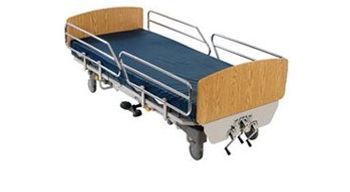
Stryker Manual
 Stryker · Model Manual
Best-In-Class Low Height. Retractable Fifth Wheel. Centrally-Located Brake. Removable Crank Handles. Siderail Positioning. CPR Release.
Key tips
- ·Casters and the wheel-lock brake take the most day-to-day wear - check both every PM, not just on complaint.
- ·A cracked weld or loose frame joint is a safety-critical finding - pull the unit from service until it's repaired.
Typical Failure Modes
Compiled for this model from its own documentation and established engineering knowledge for this equipment class - not from a verified service record. Confirm against the manufacturer's service manual.
A powered bed function will not run
HighSymptoms: Backrest, knee, height, Trendelenburg or the boost / turn assist will not move from the siderail or caregiver controls.
Root cause: Failed linear actuator, a control-board fault, a control-panel fault, or a pinched / damaged control cable.
Brake / castor-lock fault
MediumSymptoms: Bed will not brake or release, drifts, central brake pedal ineffective.
Root cause: Worn central-brake linkage or castor.
Integrated scale / bed-exit fault
MediumSymptoms: Weight reads implausibly or will not zero, bed-exit alarm false-triggers or fails.
Root cause: Load-cell drift or damage, or a scale-control fault.
Battery back-up fault
MediumSymptoms: Functions and alarms do not work during a power interruption, battery-fault indicator.
Root cause: Aged back-up battery or a charger fault.
Siderail / CPR-release / mechanical fault
LowSymptoms: Siderail will not latch, rattles, or the CPR release is slow / stiff.
Root cause: Worn siderail latch or the CPR mechanism.
Serviceable Parts & Consumables
Serviceable items for this model, compiled from its documentation and engineering knowledge for this equipment class. Service class and relative cost are estimates, not manufacturer figures; no part numbers are given. Confirm intervals and pricing against the manufacturer.
Linear actuator (backrest / knee / height)
Class Major service partRel. cost $$$R&R Difficult
Central-brake / castor assembly
Class Major service partRel. cost $$R&R Difficult
Load cell / scale sensor set
Recalibrate the scale after replacement.
Class Major service partRel. cost $$$R&R Difficult
Back-up battery
Class Periodic replacementRel. cost $$R&R Fairly easy
Siderail control panel / control board
Class Major service partRel. cost $$$R&R Moderate
| Part | Service class | Relative cost | R&R difficulty |
|---|---|---|---|
| Linear actuator (backrest / knee / height) | Major service part | $$$ | Difficult |
| Central-brake / castor assembly | Major service part | $$ | Difficult |
| Load cell / scale sensor set Recalibrate the scale after replacement. | Major service part | $$$ | Difficult |
| Back-up battery | Periodic replacement | $$ | Fairly easy |
| Siderail control panel / control board | Major service part | $$$ | Moderate |
Relative cost: $ lowest · $$$$ highest service-part cost for this equipment class. Not a price.
PM Checklist
Preventive-maintenance tasks typical of this equipment class. Perform to the manufacturer's procedure and your facility's policy - this is general reference, not a schedule for this specific unit.
- ·Caster / wheel and brake function check
- ·Frame, weld, and mounting-hardware inspection
- ·Upholstery / surface condition check
- ·Annual full PM
Troubleshooting Approach
A starting sequence for this model, compiled from its documentation and engineering knowledge for this equipment class. Follow the manufacturer's service documentation for the actual procedure.
Symptom: A powered function is dead
- Confirm the bed is plugged in and the battery is charged, and any function lock-out is off.
- Try the function from both the siderail and caregiver controls to isolate the control from the actuator.
- Check the control cable / harness for pinch damage along the articulation.
- Replace the actuator or control board as isolated.
- Load-test the function to the rated capacity.
Symptom: Scale or bed-exit inaccurate
- Remove all load and confirm the scale reads zero and can be tared.
- Hang / place a known reference weight and confirm the reading.
- Inspect the load-cell mounts for binding or debris.
- Recalibrate per the service manual.
- Replace the load-cell set if it will not calibrate.
Technical Specs
- Bed Type
- Manual
Typical Location
Where this class of equipment is typically deployed - general reference, not this unit's own placement record.
- Ambulance / transport vehicles
- Emergency Department
- Inter-facility transport teams
Documents & Manuals
Safety & Recalls
Synced live from the FDA openFDA API.
- RECALL
Stryker Neurovascular is recalling their DAC- Distal Access Catheter -038 136cm, a Distal Access Catheter by removal. The reason for the recall is: the DAC Lot #0000486382 was released with out-of-specification endotoxin results.
- RECALL
Potential for current software to miscount when scanning in multiple sponge-products from the same unique sponge-pack type
- RECALL
Malfunctioning of the Exeter Rasp/trial introducer/extractor Handle.
- RECALL
The Inserter Inner Shaft would not fit through the Inserter. The inner diameter of the cannulated shaft of the inserter was undersized.
- RECALL
A package labeled as Part #5901-S-4818, Lot MAC7C14, standard humeral head trial, contained part # 5901-E-4818 Lot MAC7C14, offset humeral head trial.
- RECALL
Surgeons have experienced unthreading of the screwdrivers outer shafts during use.
- RECALL
Stryker received four reports regarding a handle which separates at the point where it is welded to the shaft on the Xia 3 Anti-Torque Key during surgery.
- RECALL
Stryker Orthopaedics has become ware that there is the potential for the above referenced instruments to fracture in two pieces along the width of the body under the striking plate.
- RECALL
During testing and review, Stryker Endoscopy discovered that the sterilization parameters for the 132 degree C gravity steam sterilization cycle in the IFU may not consistently sterilize all instruments in the 45cm Laparoscopic Instruments Tray.
- RECALL
The Inner Shaft does not extend far enough from the tip of the Revision Screwdriver to fully engage the bone screw.
- RECALL
Sharp edges will cause a glove to tear and cut someone. Sharp edges on the slots machines in select lots of the Triathlon TS Femoral Trials, sizes 1-8, have been discovered.
- RECALL
The threaded part of the instrument may break when connected to the screw and potentially result in an adverse health consequence.
- RECALL
Insertion/Removal Difficulties: The Baseplate Impactor/Extractor may not assemble/disassemble easily to the baseplate.
Troubleshoot this device with Bio
Describe a symptom or error code. Bio answers from this device's own documented error codes, failure modes, parts, and guides.
Ask Bio