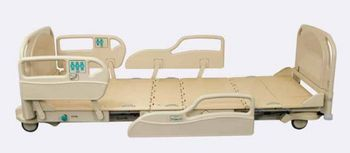
Stryker CHG Spirit Plus
 Stryker · Model CHG Spirit Plus
Ultra-low resting position reduces falls injury and trauma. Height range allows in-bed care at the correct height. Height range reduces the risk of falls getting in and out of bed. Eases the strain of manual handling. Eliminates the need for side-rail restraint when patient resting. Reduces the need to watch restless patients. Helps reduce hospital stays and bed-blocking. Helps reduce ward staffing levels and costs. Cuts the cost of treatment and compensation resulting from patient falls injury and staff back-strain. Exceptional height range 20-85cm. Full lock and steer for manoeverability at any height. Embedded footboard controls. Embedded patient controls. Selective and full security lock-out. Backrest and knee profiling. Auto-profiling. Instant CPR. Trendelenberg and reverse trendeleberg. Bed and deck angle monitoring. Auto cardiac chair position. Extendable deck length for taller patients. Removeable head and foot board. Fold-down quad rails for safe resting and patient transfer. Battery back-up with power monitor. Life-time anti-microbial surface treatment. Easy-clean decking.
Key tips
- ·Mounting and securement hardware takes real fatigue from vibration and road shock - inspect it as carefully as the device itself.
- ·Post-call battery and function checks catch transport-induced faults that a scheduled PM would miss for months.
Typical Failure Modes
Compiled for this model from its own documentation and established engineering knowledge for this equipment class - not from a verified service record. Confirm against the manufacturer's service manual.
A powered bed function will not run
HighSymptoms: Backrest, knee, height, Trendelenburg or the boost / turn assist will not move from the siderail or caregiver controls.
Root cause: Failed linear actuator, a control-board fault, a control-panel fault, or a pinched / damaged control cable.
Brake / castor-lock fault
MediumSymptoms: Bed will not brake or release, drifts, central brake pedal ineffective.
Root cause: Worn central-brake linkage or castor.
Integrated scale / bed-exit fault
MediumSymptoms: Weight reads implausibly or will not zero, bed-exit alarm false-triggers or fails.
Root cause: Load-cell drift or damage, or a scale-control fault.
Battery back-up fault
MediumSymptoms: Functions and alarms do not work during a power interruption, battery-fault indicator.
Root cause: Aged back-up battery or a charger fault.
Siderail / CPR-release / mechanical fault
LowSymptoms: Siderail will not latch, rattles, or the CPR release is slow / stiff.
Root cause: Worn siderail latch or the CPR mechanism.
Serviceable Parts & Consumables
Serviceable items for this model, compiled from its documentation and engineering knowledge for this equipment class. Service class and relative cost are estimates, not manufacturer figures; no part numbers are given. Confirm intervals and pricing against the manufacturer.
Linear actuator (backrest / knee / height)
Class Major service partRel. cost $$$R&R Difficult
Central-brake / castor assembly
Class Major service partRel. cost $$R&R Difficult
Load cell / scale sensor set
Recalibrate the scale after replacement.
Class Major service partRel. cost $$$R&R Difficult
Back-up battery
Class Periodic replacementRel. cost $$R&R Fairly easy
Siderail control panel / control board
Class Major service partRel. cost $$$R&R Moderate
| Part | Service class | Relative cost | R&R difficulty |
|---|---|---|---|
| Linear actuator (backrest / knee / height) | Major service part | $$$ | Difficult |
| Central-brake / castor assembly | Major service part | $$ | Difficult |
| Load cell / scale sensor set Recalibrate the scale after replacement. | Major service part | $$$ | Difficult |
| Back-up battery | Periodic replacement | $$ | Fairly easy |
| Siderail control panel / control board | Major service part | $$$ | Moderate |
Relative cost: $ lowest · $$$$ highest service-part cost for this equipment class. Not a price.
PM Checklist
Preventive-maintenance tasks typical of this equipment class. Perform to the manufacturer's procedure and your facility's policy - this is general reference, not a schedule for this specific unit.
- ·Post-call function and battery check
- ·Mounting / securement inspection
- ·Annual full PM and vibration-tolerance check
Troubleshooting Approach
A starting sequence for this model, compiled from its documentation and engineering knowledge for this equipment class. Follow the manufacturer's service documentation for the actual procedure.
Symptom: A powered function is dead
- Confirm the bed is plugged in and the battery is charged, and any function lock-out is off.
- Try the function from both the siderail and caregiver controls to isolate the control from the actuator.
- Check the control cable / harness for pinch damage along the articulation.
- Replace the actuator or control board as isolated.
- Load-test the function to the rated capacity.
Symptom: Scale or bed-exit inaccurate
- Remove all load and confirm the scale reads zero and can be tared.
- Hang / place a known reference weight and confirm the reading.
- Inspect the load-cell mounts for binding or debris.
- Recalibrate per the service manual.
- Replace the load-cell set if it will not calibrate.
Typical Location
Where this class of equipment is typically deployed - general reference, not this unit's own placement record.
- Ambulance / transport vehicles
- Emergency Department
- Inter-facility transport teams
Documents & Manuals
Safety & Recalls
Synced live from the FDA openFDA API.
- RECALL
A design related issue can contribute to the device exhibiting brittle behavior. This behavior may result in fractures of the catheter shaft.
- RECALL
The beds with the high rail side rail option may not be complaint with IEC 60601-2-52/C1:2010. There is a potential risk of entrapment.
- RECALL
Customer complaints associated with faulty brake system
- RECALL
Inaccurate scale systems
- RECALL
Stryker has received a report that single size 3.5 stem was packaged as size 2.5 stem resulting in a possible product mix.
- RECALL
Stryker Orthopaedics has become aware that a size 3 Accolade stem was in a box labeled as a size 5 Accolade stem.
- RECALL
Accolade TMZF Plus Hip Stems are being recalled due to grit blast media which was observed in the drive hole.
- RECALL
Certain surgical protocols do not provide specific instructions for initiating power to the calcar planer prior to engagement with bone.
- RECALL
Operative Technique: further clarification and guidance is needed to help reduce the potential for distal mis-drilling of the short Gamma3 Trochanteric Nails.
- RECALL
Product deviation : Specific lots of sprayed HA hip stems did not meet Stryker's Internal Material Specification for tensile bond strength and crystallinity.
- RECALL
Stryker Orthopaedics became aware of a visual defect in certain blister packages of certain devices.
- RECALL
Lack of assurance of Sterility (package integrity): Anomalies in seal width and strength that may affect the integrity of the sterile barrier.
Troubleshoot this device with Bio
Describe a symptom or error code. Bio answers from this device's own documented error codes, failure modes, parts, and guides.
Ask Bio