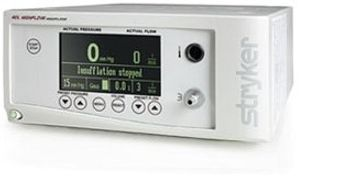
Stryker 40L
 Stryker · Model 40L
Broad flow rate range. LCD display of status. Video on-screen display. SIDNE compatible for voice command. Built-in gas heating technology.
Key tips
- ·A failed leak test means the scope does not get reprocessed or used - send it for repair, full stop.
- ·A shortened reprocessing cycle is a real infection-control failure, not a minor deviation - follow AAMI ST91 exactly.
- ·Track light-source lamp-hours against the manufacturer's limit rather than running to failure.
Typical Failure Modes
Compiled for this model from its own documentation and established engineering knowledge for this equipment class - not from a verified service record. Confirm against the manufacturer's service manual.
Will not reach or hold set intra-abdominal pressure
HighSymptoms: Pressure alarm, insufflation stops, cannot maintain pneumoperitoneum, high-flow alarm.
Root cause: CO2 supply low, a leak in the tubing / trocar, a solenoid / valve fault, or a pressure-sensor fault.
Poor video image
HighSymptoms: Noisy, dark, discoloured or out-of-focus image, dropouts, no image.
Root cause: Camera head / coupler fault, a camera-cable fault, or a CCU / video-processor fault.
White-balance / colour fault
MediumSymptoms: Cannot white-balance, persistent colour cast.
Root cause: Camera head sensor drift, a dirty coupler, or the light source colour temperature.
Gas heater fault (if fitted)
LowSymptoms: Gas delivered cold, heater alarm.
Root cause: Heating element or its sensor in the heated tubing / unit.
Output / connector fault
LowSymptoms: Signal only on one output, connector damage, HD/SDI dropout.
Root cause: Worn video output connector or an output board fault.
Serviceable Parts & Consumables
Serviceable items for this model, compiled from its documentation and engineering knowledge for this equipment class. Service class and relative cost are estimates, not manufacturer figures; no part numbers are given. Confirm intervals and pricing against the manufacturer.
Insufflator solenoid / valve block
Class Major service partRel. cost $$$R&R Difficult
Camera head / coupler
Class Periodic replacementRel. cost $$$R&R Moderate
Camera cable
Class Periodic replacementRel. cost $$R&R Fairly easy
Pressure-sensor / regulator assembly
Class Major service partRel. cost $$R&R Moderate
CCU / video-processor board
Class Major service partRel. cost $$$R&R Difficult
| Part | Service class | Relative cost | R&R difficulty |
|---|---|---|---|
| Insufflator solenoid / valve block | Major service part | $$$ | Difficult |
| Camera head / coupler | Periodic replacement | $$$ | Moderate |
| Camera cable | Periodic replacement | $$ | Fairly easy |
| Pressure-sensor / regulator assembly | Major service part | $$ | Moderate |
| CCU / video-processor board | Major service part | $$$ | Difficult |
Relative cost: $ lowest · $$$$ highest service-part cost for this equipment class. Not a price.
PM Checklist
Preventive-maintenance tasks typical of this equipment class. Perform to the manufacturer's procedure and your facility's policy - this is general reference, not a schedule for this specific unit.
- ·Leak testing before each reprocessing cycle
- ·Scope reprocessing per AAMI ST91
- ·Light source lamp-hour tracking
- ·Annual full PM
Troubleshooting Approach
A starting sequence for this model, compiled from its documentation and engineering knowledge for this equipment class. Follow the manufacturer's service documentation for the actual procedure.
Symptom: Will not hold set pressure
- Confirm the CO2 cylinder / supply is not empty and is at pressure.
- Leak-test the tubing set and all trocar / stopcock connections.
- Run the insufflator's self-test / calibration.
- Check the solenoid and pressure sensor per the service manual.
- Replace the tubing set; refer the valve block or sensor if the fault persists.
Symptom: Poor video image
- Clean and re-white-balance; inspect the scope lens / coupler.
- Swap the camera head and cable to isolate head vs CCU.
- Check the light cable and lamp hours.
- Try a second monitor / output cable.
- Replace the camera head or refer the CCU as isolated.
Typical Location
Where this class of equipment is typically deployed - general reference, not this unit's own placement record.
- Endoscopy suite / GI lab
- Operating Room
- Bronchoscopy suite
Documents & Manuals
Troubleshoot this device with Bio
Describe a symptom or error code. Bio answers from this device's own documented error codes, failure modes, parts, and guides.
Ask Bio